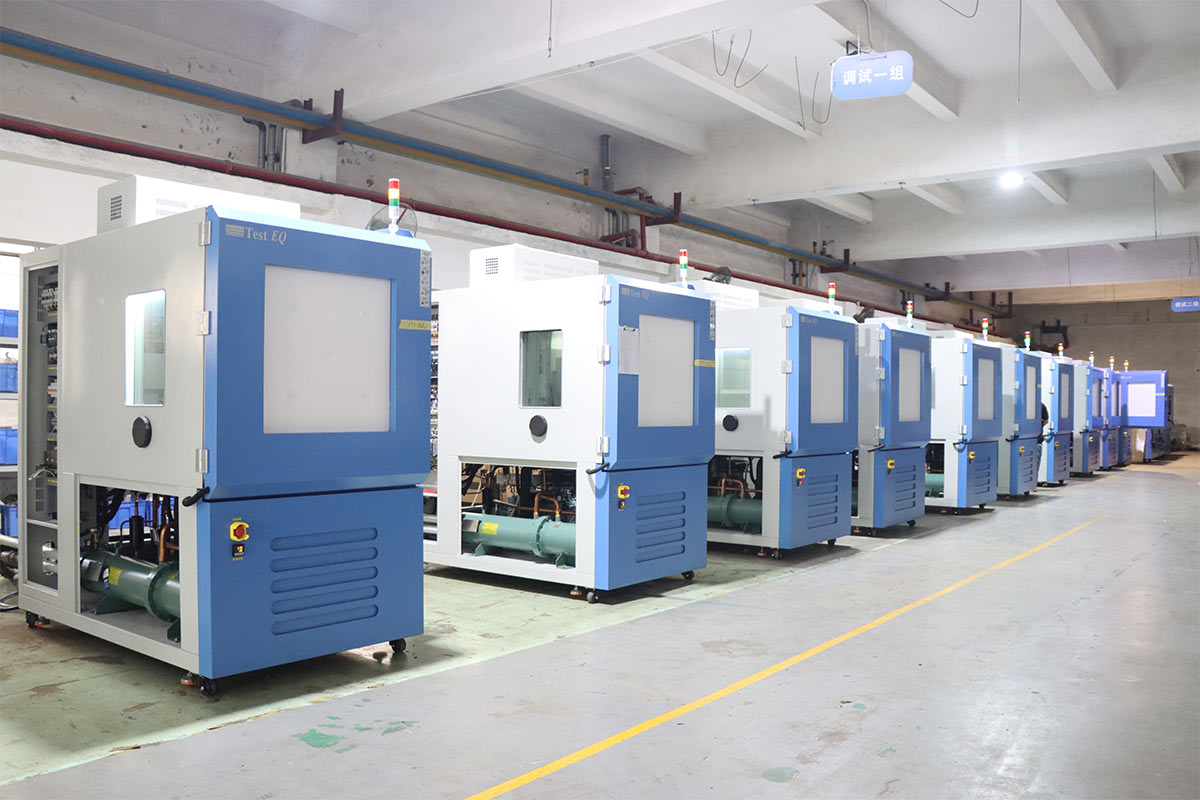
Introduction to Thermal Shock Chamber Testing Standards:
Thermal shock testing standards aim to evaluate a product's performance under sudden temperature changes, including:
MIL-STD-810G Method 503.5 : Temperature Shock and Cyclic Testing
ESS/HALT method : Accelerated life and temperature cycling validation
IEC/ISO Industry Standards : Reliability Verification for Consumer and Industrial Electronics
These standards help engineers predict potential failures and optimize designs, ensuring that products are stable and reliable in real-world application environments.
TestEQThermal Shock Test ChamberTechnical Advantages:
Temperature range: -70°C to +180°C
Temperature change rate: 3–15°C/min
Precise temperature control and uniformity
Control accuracy: ±0.5°C
Temperature uniformity: ≤±2°C
High stability and reliability
High-performance refrigeration system and optimized airflow design
The intelligent control system supports remote monitoring and data logging.
Customized and modular design
We can customize the cabin size, temperature change rate, and control system according to customer needs.
Applicable to military, aerospace, automotive electronics and other application scenarios
Typical applications:
• Military electronics : communications, radar, tactical instruments
• Aerospace : Satellite electronics, avionics systems, structural materials
• Automotive electronics : batteries, ECUs, sensors
• Industrial electronics : PCBs, semiconductor devices, consumer electronics
Procurement Tip : Choosing equipment that complies with MIL-STD-810G and ESS standards can ensure that products enter high-standard markets and reduce testing risks.
FAQ :
Q1: What is the difference between a thermal shock chamber and a regular temperature test chamber?
A1: Thermal shock chambers focus on simulating the impact of rapid temperature changes on products by alternating high and low temperatures, while regular temperature chambers are mainly used for steady-state high and low temperature testing.
Q2: Is MIL-STD-810G Method 503.5 applicable to all electronic products?
A2: This method is mainly used for military and high-reliability product verification. Commercial electronics can choose ESS or IEC/ISO standards according to their needs.
Q3: Does the TestEQ thermal shock test chamber support remote monitoring?
A3: Yes, it does. The intelligent control system can monitor temperature changes in real time and record data, which is convenient for laboratory review and report generation.
Q4: Can the chamber size and temperature change rate be customized?
A4: Yes, TestEQ offers modular design to meet the needs of different industries and testing requirements.
in conclusion:
Environmental testing that meets Thermal Shock Chamber standards is crucial for products entering high-reliability markets. TestEQ's thermal shock chambers combine MIL-STD-810G and ESS methods to ensure product stability under extreme temperature variations, improving testing efficiency, reducing risks, and guaranteeing compliance.
CTA:
"Request a Custom Thermal Shock Chamber Solution" Contact TestEQ for tailored specifications, technical consultation, and a free quote to meet your MIL-STD-810G and industrial testing requirements..