
Why is the salt spray test so crucial for buyers?
For engineers, procurement teams, and laboratory managers, salt spray testing is not just a test—it is a risk control tool.
It helps you:
• Verify coating durability (powder coating, plating, anodizing)
• Compare suppliers and materials objectively
• Reduce product failure risks in harsh environments
• Meet customer and regulatory requirements
• Shorten product development cycles
In many industries (automotive, aerospace, electronics), passing a salt spray test is a mandatory entry requirement.
Salt Spray Testing Standards:
To ensure global comparability, salt spray testing follows strict standards:
• ASTM B117 (USA – most widely used)
• ISO 9227 (international standard)
• IEC 60068-2-11 (electronics reliability testing)
• JIS Z 2371 (Japan industrial standard)
Among these, ASTM B117 salt spray testing is the most searched and specified standard in B2B procurement.
Types of Salt Spray Tests:
Different products require different corrosion stress levels:
1. Neutral Salt Spray (NSS)
Standard baseline test
5% NaCl solution
35°C constant temperature
2. Acetic Acid Salt Spray (AASS)
More acidic → faster corrosion
Used for decorative coatings
3. Copper Accelerated Acetic Acid Salt Spray (CASS)
Highly aggressive
Common in automotive plating validation
4. Cyclic Corrosion Testing (CCT)
Combines salt spray + drying + humidity
Closer to real-world environments
If your customers are automotive OEMs, they increasingly prefer CCT over NSS.
How a Salt Spray Test Chamber Works
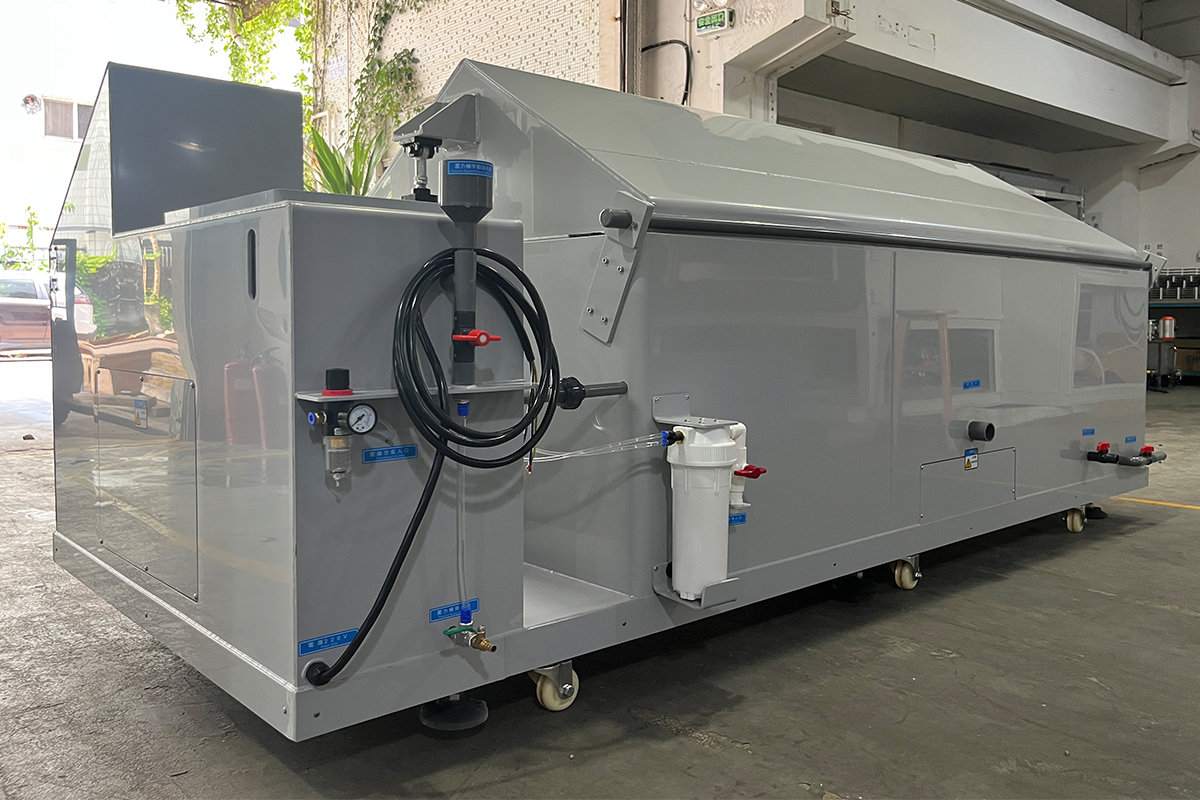
A salt spray test chamber creates a stable corrosion environment through:
• Precision atomization system → uniform salt fog
• Temperature control system → stable 35°C (or custom)
• pH & concentration control → compliant with ASTM B117
• Air saturation tower → ensures correct humidity conditions
• Corrosion-resistant chamber body (PVC / FRP)
TestEQ chambers are engineered to ensure uniform fog distribution + repeatability, which is the key factor affecting test credibility.
Key Technical Parameters
| Parameter | Standard Requirement |
|---|---|
| Temperature | 35°C (NSS) |
| Salt Solution | 5% NaCl |
| pH Value | 6.5 – 7.2 |
| Spray Rate | 1–2 ml/80cm²/hr |
| Test Time | 24–1000+ hours |
Salt Spray Testing vs Real Environment
One common misunderstanding:
Salt spray testing does not equal real-life corrosion time, but it is extremely useful for:
• Comparing coatings
• Ranking suppliers
• Identifying weak points
For higher accuracy, advanced users combine:
Salt Spray Test + Cyclic Corrosion Test (CCT)
How to Choose the Right Salt Spray Test Chamber
If you are sourcing a salt spray test chamber, focus on these 5 factors:
1. Uniformity of Salt Fog
Directly affects test validity
2. Control Accuracy
Temperature, pH, and spray rate stability
3. Material Durability
PVC vs fiberglass construction
4. Standard Compliance
ASTM B117 / ISO 9227 support
5. Customization Capability
Size, automation, cyclic testing upgrades
Why TestEQ Salt Spray Test Chambers
TestEQ is positioned as a Reliability Testing System Provider, not just an equipment supplier.
Key advantages:
• High uniformity spray system (critical for repeatability)
• Precise control for ASTM B117 / ISO 9227 compliance
• Support NSS / AASS / CASS / CCT testing
• Custom-built chamber sizes for industrial applications
• Stable long-duration testing (1000+ hours capability)
• Designed for automotive, EV, aerospace, and electronics industries
Especially strong in non-standard customized corrosion testing systems
Typical Applications
Salt spray testing is widely used in:
• Automotive parts (fasteners, coatings, EV battery components)
• Aerospace materials
• Electronic connectors and enclosures
• Marine and offshore equipment
• Metal finishing and plating industries
Conclusion
Salt spray testing remains one of the most important methods for corrosion resistance evaluation. Whether you are validating coatings, qualifying suppliers, or meeting industry standards, it provides a fast and standardized solution.
Choosing a high-quality salt spray test chamber is not just about equipment—it directly impacts test credibility, customer trust, and product reliability.
Internal Linking Module
Recommended Equipment
A compact laboratory corrosion testing system designed for ASTM B117 / ISO 9227 compliance, suitable for routine salt fog testing of small to medium samples.
Advanced corrosion testing equipment that combines salt spray, humidity, and drying cycles for more realistic environmental simulation and higher reliability validation.
Related Standards
The most widely used global standard for neutral salt spray corrosion testing, defining temperature, concentration, and spray parameters for consistent laboratory results.
International standard framework covering environmental reliability tests including corrosion, temperature, humidity, and combined stress testing for electronic components.
Related Resources
Salt Spray Testing Complete Guide
A full technical overview explaining test principles, corrosion mechanisms, standards comparison, and chamber selection guidance for engineers and procurement teams.
A comprehensive resource explaining major reliability testing methods such as thermal cycling, corrosion testing, and humidity testing, including their industrial use cases in automotive, semiconductor, and aerospace sectors.
FAQ
1. What is salt spray testing in simple terms?
Salt spray testing is a laboratory method that simulates long-term corrosion in a short time by exposing materials to a controlled salt mist environment. It is widely used to evaluate how well coatings, metals, and products resist rust and corrosion.
2. Why is ASTM B117 important in salt spray testing?
ASTM B117 is the most recognized global standard for salt spray testing. It defines test conditions such as temperature (35°C), salt concentration (5% NaCl), and spray requirements, ensuring consistent and comparable corrosion results across different laboratories and industries.
3. What industries use salt spray testing the most?
Salt spray testing is widely used in automotive, aerospace, electronics, marine, and metal finishing industries. It is especially important for EV battery systems, automotive coatings, and outdoor metal components that require high corrosion resistance.
4. How accurate is salt spray testing compared to real-world corrosion?
Salt spray testing does not directly replicate real-world time exposure, but it is highly effective for comparative evaluation. It helps engineers rank materials, identify weak coatings, and predict relative corrosion performance under accelerated conditions.
5. What should I look for in a salt spray test chamber supplier?
Key factors include spray uniformity, temperature stability, compliance with ASTM B117 / ISO 9227, long-term durability, and support for advanced testing modes like CASS and cyclic corrosion testing (CCT). High-quality chambers ensure reliable and repeatable test data for engineering decisions.
6. What is the difference between NSS, CASS, and cyclic corrosion testing?
• NSS (Neutral Salt Spray): Standard corrosion test for general applications
• CASS (Copper Accelerated Acetic Acid Salt Spray): More aggressive, used for automotive coatings
• Cyclic Corrosion Testing (CCT): Combines salt spray, humidity, and drying cycles for more realistic environmental simulation
CCT is increasingly preferred in automotive and advanced engineering industries.
CTA
Looking for a reliable salt spray test chamber supplier?
TestEQ provides:
✔ ASTM B117 compliant systems
✔ Custom corrosion testing solutions
✔ Fast engineering support for B2B projects
"Contact TestEQ today to get:"
• Technical proposal
• Chamber configuration recommendation
• Competitive quotation within 24 hours