Why Thermal Cycling Test Results Are Not Repeatable
In automotive, aerospace, semiconductor, and electronics industries, thermal cycling testing is one of the most critical reliability validation methods. Yet many laboratories and manufacturers encounter the same problem:
The same product produces different test results under seemingly identical conditions.
For engineers, this creates uncertainty in failure analysis.
For laboratory managers, it reduces confidence in test data.
For procurement teams, it raises concerns about chamber performance and long-term ROI.
At TestEQ we frequently help customers identify the hidden causes behind inconsistent thermal cycling results. In most cases, the issue is not the DUT (Device Under Test) itself — but the overall testing system.
1. Poor Temperature Uniformity Inside the Chamber
One of the most common causes of non-repeatable results is uneven temperature distribution.
Even if the chamber display shows the correct setpoint, the actual temperature around the specimen may vary significantly due to:
Weak airflow design
Improper air circulation
Overloaded test area
Poor sensor positioning
For semiconductor modules, EV components, or PCB assemblies, even a small temperature deviation can change thermal stress behavior and fatigue cycles.
A chamber with poor uniformity may produce:
Different crack propagation rates
Inconsistent solder joint failures
Unstable electrical performance data
This is especially critical during high ramp-rate thermal cycling testing.
2. Ramp Rate Instability Changes Material Stress
Many laboratories focus only on maximum ramp rate specifications, while ignoring ramp stability.
For example:
A chamber labeled as “15°C/min” may not maintain a true linear ramp under load
Compressor fluctuation can cause temperature overshoot
Control lag may create unstable transitions
The result is inconsistent thermal expansion and contraction behavior.
In automotive electronics testing such as AEC-Q100 validation, unstable ramp control can directly affect:
Solder fatigue life
Packaging reliability
Connector durability
Battery module integrity
This is why advanced thermal cycling chambers require not only fast ramp capability, but also highly stable PID control logic and optimized refrigeration systems.
3. Sensor Calibration Does Not Reflect Real Testing Conditions
Another overlooked factor is calibration mismatch.
Some chambers are calibrated under empty-load conditions, while real production testing includes:
Heavy fixtures
Large DUTs
Multi-layer racks
Complex cable routing
Once thermal mass changes, chamber behavior changes as well.
If the chamber control system cannot compensate dynamically, actual specimen temperature may lag far behind displayed chamber temperature.
This leads to:
False pass/fail results
Reproducibility issues between labs
Inconsistent qualification reports
For ISO/IEC-compliant laboratories, this becomes a serious reliability concern.
4. Chamber Design Directly Impacts Repeatability
Not all environmental test chambers are engineered for long-term repeatability.
In many low-cost systems:
Airflow architecture is simplified
Heat exchange efficiency is unstable
Refrigeration capacity fluctuates under continuous cycling
Control software lacks adaptive compensation algorithms
Over time, performance drift becomes unavoidable.
For industries requiring high-reliability testing, chamber engineering quality matters more than initial purchase price.
Key design factors include:
Air duct optimization
Refrigeration system stability
Thermal insulation structure
Multi-point temperature monitoring
Intelligent control algorithms
5. Why Repeatability Matters More Than Maximum Performance
Many buyers compare environmental chambers only by:
Temperature range
Ramp speed
Chamber size
However, experienced engineers focus on another metric:
Repeatability
A chamber capable of repeating identical test conditions cycle after cycle provides:
More trustworthy qualification data
Faster root-cause analysis
Lower retest costs
Higher laboratory efficiency
Better compliance confidence
In high-value industries such as EV batteries, aerospace electronics, and semiconductors, repeatable data is essential for product validation and risk reduction.
How TestEQ Improves Thermal Cycling Consistency
TestEQ specializes in engineered environmental test chambers designed for high-reliability industries.
Our systems are optimized for:
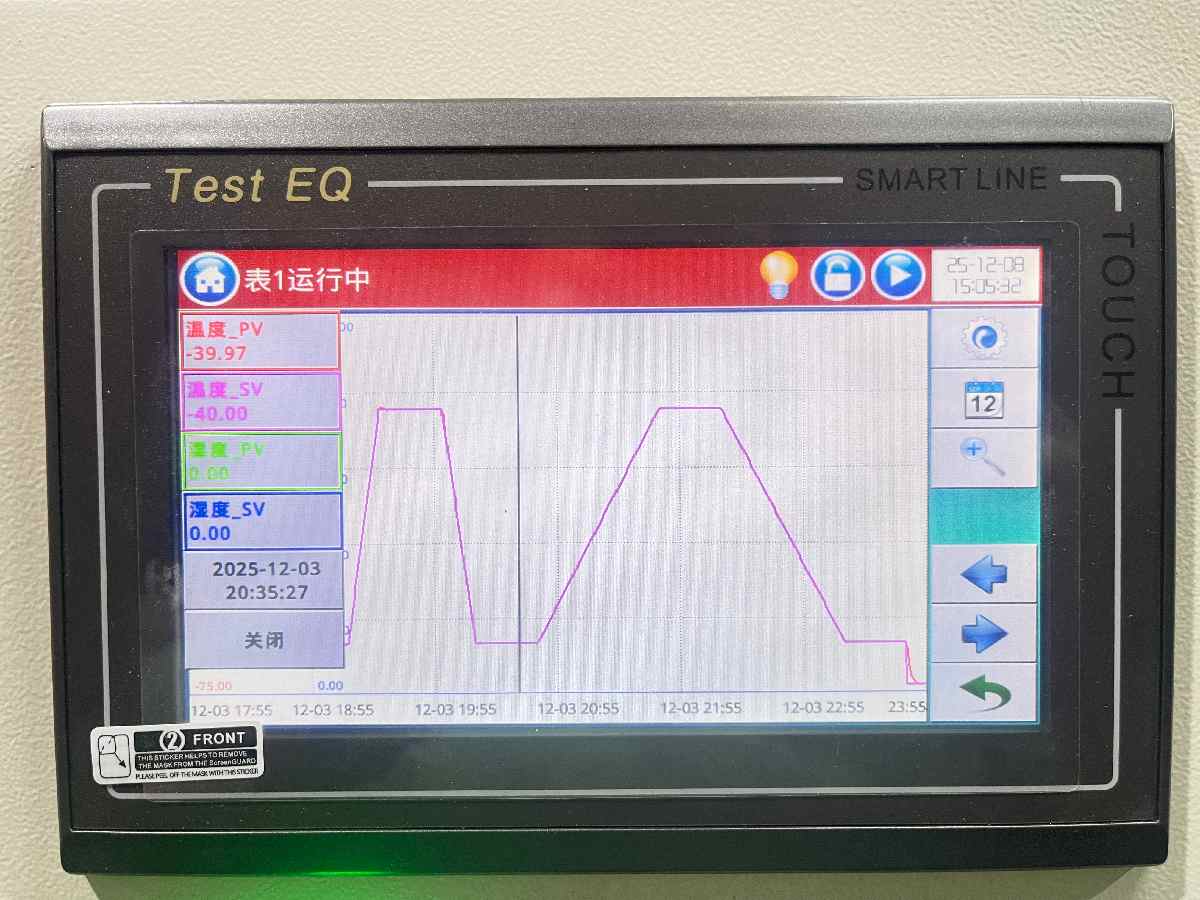
Stable linear ramp performance
Precise temperature uniformity
Continuous cycling durability
Advanced intelligent control systems
Customized testing solutions for automotive and semiconductor applications
For fast ramp-rate applications from 5°C/min to 25°C/min linear performance, chamber stability becomes the key factor separating theoretical specifications from real-world repeatability.
Typical Applications
Thermal cyclingrepeatability is especially important for:
Automotive ECU validation
Semiconductor packaging verification
PCB and solder joint fatigue analysis
Aerospace component durability testing
Military electronics qualification
As reliability standards continue to become stricter, environmental chamber stability is no longer optional — it is part of the qualification process itself.
Internal Linking Module
Recommended equipment
Recommended Standards
Recommended Resources
FAQ
Why do identical thermal cycling tests produce different results?
Differences in airflow, ramp stability, sensor calibration, and chamber loading conditions can all affect repeatability.
Does faster ramp rate reduce test accuracy?
Not necessarily. However, poorly controlled fast ramp systems can create overshoot and unstable thermal stress conditions.
How important is temperature uniformity in thermal cycling?
Very important. Even small temperature variations can significantly affect fatigue behavior and failure mechanisms.
Can chamber loading affect thermal cycling results?
Yes. Large or heavy DUTs change thermal mass and airflow patterns, influencing actual specimen temperature.
What industries require highly repeatable thermal cycling testing?
Automotive, semiconductor, aerospace, defense, EV battery, and electronics industries all require high repeatability.
How can laboratories improve thermal cycling consistency?
Using properly engineered chambers, regular calibration, optimized airflow design, and stable control systems greatly improves repeatability.
CTA
Looking for more stable and repeatable thermal cycling testing solutions?
"Explore advanced environmental test chambers "from TestEQ Environmental Chambers for automotive, semiconductor, aerospace, and high-reliability applications.