What Is IEC 60068-2-78?
IEC 60068-2-78 is part of the IEC 60068 series of environmental testing standards. It specifies a damp heat test under steady-state conditions, commonly used to determine the ability of a specimen to withstand prolonged exposure to controlled humidity and temperature.
Unlike a cyclic damp heat test, the primary environmental condition remains stable during the exposure period. This makes the method suitable for evaluating moisture resistance and the effects of sustained humid environments.
Typical objectives include evaluating:
• Moisture resistance
• Insulation performance
• Corrosion susceptibility
• Material degradation
• Electrical leakage or insulation resistance changes
• Mechanical and dimensional stability
• Long-term reliability under humid conditions
IEC 60068-2-78 should be selected according to the product specification and applicable qualification requirement. The standard defines the environmental test method, while the actual severity, duration and acceptance criteria are normally determined by the relevant product specification or test plan.
IEC 60068-2-78 Test Conditions
IEC 60068-2-78 testing requires controlled environmental conditions throughout the exposure period. Temperature, relative humidity, exposure duration and specimen configuration should be established according to the applicable test specification.
| Test Parameter | Consideration |
|---|---|
| Temperature | Defined according to the applicable test specification |
| Relative Humidity | Controlled at the required high-humidity condition |
| Exposure Duration | Determined by the applicable test plan or product specification |
| Specimen Condition | Non-operating or operating condition as specified |
| Specimen Loading | Test specimens should allow adequate air circulation |
| Monitoring | Continuous monitoring and recording of temperature and relative humidity |
| Recovery | Recovery and post-test inspection performed according to the applicable test requirements |
| Acceptance Criteria | Defined by the relevant product specification or qualification plan |
The chamber should maintain stable temperature and humidity throughout the test. Temperature and humidity uniformity are particularly important because local variations can cause different moisture exposure levels across the specimen.
For large or thermally active specimens, engineers should evaluate chamber performance under representative loading rather than relying only on empty-chamber specifications.
IEC 60068-2-78 Test Procedure
A typical IEC 60068-2-78 test sequence includes specimen preparation, environmental conditioning, controlled damp heat exposure, recovery and final inspection.
1. Specimen Preparation
The test specimen is prepared according to the applicable product specification. Initial electrical, mechanical or functional measurements may be performed to establish a baseline.
2. Chamber Stabilization
The environmental test chamber is brought to the specified temperature and relative humidity before or during specimen conditioning, depending on the selected test procedure.
3. Damp Heat Exposure
The specimen remains exposed to the specified steady-state temperature and humidity for the required duration.
During exposure, the chamber should maintain stable environmental conditions without unnecessary temperature or humidity fluctuations.
4. Recovery
After exposure, the specimen may undergo a defined recovery period under specified environmental conditions before final measurements are performed.
5. Final Inspection and Evaluation
The specimen is inspected for visible, electrical, mechanical or functional degradation.
Typical evaluation criteria may include:
• Electrical performance
• Insulation resistance
• Leakage current
• Corrosion
• Surface degradation
• Mechanical performance
• Functional operation
• Dimensional changes
The exact acceptance criteria should always follow the applicable product specification rather than being assumed from the environmental test method alone.
What Does Damp Heat Steady State Testing Evaluate?
Damp heat steady state testing evaluates how a product responds to prolonged exposure to a controlled high-humidity environment.
Moisture can enter materials and assemblies through surfaces, seals, interfaces and microscopic pathways. Over time, this can contribute to corrosion, insulation degradation, leakage current, swelling, delamination and other reliability problems.
For electronic products, humidity can affect:
• PCB assemblies
• Connectors
• Insulation systems
• Sensors
• Semiconductor packages
• Coatings
• Sealing materials
• Adhesive interfaces
For automotive and industrial products, damp heat testing can help evaluate the reliability of electrical and electronic systems exposed to humid operating or storage environments.
The test is therefore useful for identifying moisture-related failure mechanisms before products are deployed into demanding environments.
IEC 60068-2-78 vs IEC 60068-2-30
IEC 60068-2-78 and IEC 60068-2-30 both address damp heat testing, but they are intended for different environmental exposure profiles.
| Feature | IEC 60068-2-78 | IEC 60068-2-30 |
|---|---|---|
| Main Focus | Damp heat, steady state | Damp heat, cyclic |
| Temperature Profile | Relatively stable temperature | Temperature changes during cycles |
| Humidity Exposure | Sustained humidity exposure | Cyclic humidity exposure |
| Condensation Effects | Depends on specified test conditions | Cyclic conditions may promote condensation |
| Typical Purpose | Long-duration moisture resistance | Resistance to cyclic climatic stress |
| Typical Equipment | Temperature humidity chamber | Temperature humidity chamber with cyclic control |
The correct method depends on the environmental conditions the product is expected to experience and the requirements of the applicable product specification.
IEC 60068-2-78 should not automatically be substituted for IEC 60068-2-30. Engineers should identify the required test method before selecting chamber operating parameters.
IEC 60068-2-78 vs IEC 60068-2-38
IEC 60068-2-78 and IEC 60068-2-38 are also related but serve different test objectives.
| Feature | IEC 60068-2-78 | IEC 60068-2-38 |
|---|---|---|
| Primary Focus | Damp heat, steady state | Composite temperature/humidity testing |
| Environmental Profile | Steady high humidity exposure | Combined temperature and humidity sequence |
| Cycling | Cycling is not the primary characteristic | Includes defined environmental changes |
| Typical Application | Moisture resistance and product reliability | Electronic component environmental qualification |
| Chamber Requirement | Stable temperature and humidity control | Programmable temperature and humidity profile |
IEC 60068-2-38 is more appropriate when the qualification program requires a composite sequence of temperature and humidity stresses. IEC 60068-2-78 is focused on steady-state damp heat exposure.
For procurement teams, this distinction is important because a chamber designed for basic constant humidity exposure may require different control and programming capabilities than a system used for composite environmental sequences.
What Products Require IEC 60068-2-78 Testing?
IEC 60068-2-78 testing can be applied to a wide range of products and components where moisture resistance is important.
Typical examples include:
Electronic Components
• Semiconductor devices
• IC packages
• Resistors and capacitors
• Sensors
• Connectors
• Relays
• PCB assemblies
Automotive Electronics
• Electronic control units
• Sensors
• Automotive connectors
• BMS components
• Power electronics
• Vehicle communication modules
Industrial Equipment
• Control systems
• Industrial electronics
• Power supplies
• Instrumentation
• Communication equipment
Electrical Products
• Switches
• Relays
• Insulation systems
• Electrical assemblies
• Enclosures and components
The exact applicability depends on the product specification, environmental profile and qualification program.
IEC 60068-2-78 Applications
Damp heat steady state testing is widely used in reliability qualification and environmental durability programs.
Automotive
Automotive electronic components can be exposed to humid environments for extended periods. Damp heat testing can help evaluate moisture-related degradation of ECUs, sensors, connectors and power electronics.
Semiconductor and Electronics
Humidity exposure can contribute to package degradation, corrosion, leakage and insulation problems. Controlled damp heat testing provides a repeatable environment for evaluating these risks.
Industrial Electronics
Industrial control equipment may operate in environments where humidity and temperature remain elevated for long periods. IEC 60068-2-78 testing can support environmental qualification and reliability assessment.
Telecommunications
Communication equipment and electronic modules may require moisture resistance evaluation before deployment in demanding environments.
Research and Development
Engineers can use controlled damp heat exposure to compare materials, coatings, sealing technologies and component designs during product development.
How to Select a Chamber for IEC 60068-2-78
Selecting a chamber for IEC 60068-2-78 requires more than checking the temperature and humidity range.
Engineers should evaluate the following parameters:
1. Temperature and Humidity Range
The chamber must cover the required test conditions with sufficient operating margin.
2. Humidity Control Stability
Stable relative humidity control is essential for steady-state damp heat testing. Excessive fluctuation can change the actual environmental exposure.
3. Temperature Uniformity
Temperature uniformity directly affects humidity distribution and specimen exposure. The chamber should provide adequate uniformity throughout the working space.
4. Working Volume
The chamber should accommodate the specimen while leaving sufficient space for proper air circulation.
5. Thermal Load
Large or heat-generating specimens can affect chamber recovery and humidity control. Test engineers should evaluate performance under the expected load.
6. Data Recording
Temperature and humidity data logging helps laboratories document test conditions and support qualification records.
7. Safety and Condensation Management
The chamber should include appropriate protection and control systems for long-duration high-humidity operation.
For laboratory qualification, the chamber should be selected based on the complete test profile rather than a single nominal specification.
Temperature Humidity Chamber Requirements
A temperature humidity chamber used for IEC 60068-2-78 should provide reliable control of both temperature and relative humidity over the required exposure duration.
Important capabilities include:
• Programmable temperature control
• Programmable relative humidity control
• Stable long-duration operation
• Temperature uniformity
• Humidity uniformity
• Automatic water supply or humidification system
• Condensation management
• Data logging
• Alarm and safety protection
• Calibration capability
For demanding applications, chamber performance should be verified through calibration and uniformity testing.
Test laboratories should also consider specimen placement. Overloading the working space or blocking air circulation can affect the actual environmental conditions experienced by the test specimen.
Common Testing Mistakes
Several common mistakes can reduce the reliability or repeatability of damp heat testing.
Using the Wrong Test Method
Steady-state damp heat and cyclic damp heat are different test conditions. Selecting the wrong method can produce results that do not represent the intended environmental exposure.
Overloading the Chamber
Excessive specimen loading can restrict airflow and create temperature or humidity gradients.
Ignoring Specimen Heat Generation
Powered electronic specimens may generate heat and change local chamber conditions. The thermal load should be considered during chamber selection.
Relying Only on Empty-Chamber Specifications
A chamber may meet its temperature and humidity specifications without load but perform differently with a large or thermally active specimen.
Inadequate Calibration
Temperature and humidity sensors should be calibrated according to the laboratory's quality system and applicable requirements.
Incorrect Specimen Placement
Specimens should be positioned to allow appropriate airflow and representative environmental exposure.
IEC 60068-2-78 and Product Reliability
Damp heat testing is an important component of environmental reliability evaluation because moisture can accelerate several physical and chemical degradation mechanisms.
Potential failure mechanisms include:
• Corrosion
• Electrochemical migration
• Insulation degradation
• Leakage current
• Material swelling
• Delamination
• Coating degradation
• Seal degradation
• Electrical malfunction
The test does not guarantee field reliability by itself. Instead, it provides controlled environmental exposure that can be incorporated into a broader qualification and reliability program.
For products used in automotive, semiconductor, aerospace, telecommunications and industrial applications, IEC 60068-2-78 can be combined with other environmental tests according to the product qualification plan.
TestEQ Solutions for IEC 60068-2-78 Testing
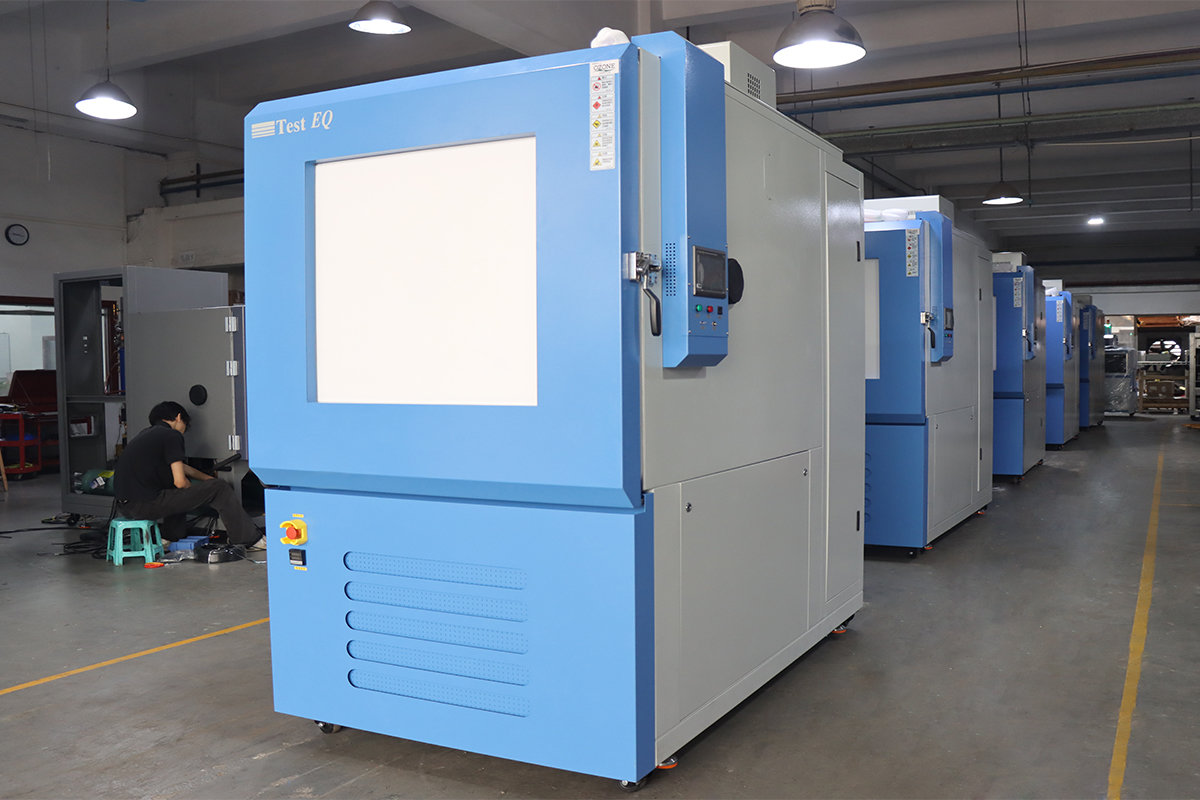
TestEQ provides temperature and humidity environmental test chambers designed for controlled climatic and reliability testing.
Typical configurations can support:
• Temperature and humidity testing
• Long-duration damp heat exposure
• Programmable environmental profiles
• Electronic component reliability testing
• Automotive electronics testing
• Semiconductor reliability testing
• Industrial product qualification
• Custom chamber configurations
TestEQ environmental chambers can be configured according to required temperature range, humidity range, working volume, specimen load and test profile.
For applications involving IEC 60068-2-78, engineers should provide the required temperature, relative humidity, exposure duration, specimen dimensions, specimen weight and operating condition when requesting a chamber recommendation.
Frequently Asked Questions About IEC 60068-2-78
1.What is IEC 60068-2-78?
IEC 60068-2-78 is an environmental testing method for damp heat testing under steady-state conditions. It evaluates the resistance of products and components to prolonged exposure to controlled temperature and humidity.
2.What is the difference between IEC 60068-2-78 and IEC 60068-2-30?
IEC 60068-2-78 addresses steady-state damp heat, while IEC 60068-2-30 addresses cyclic damp heat. The environmental profiles and test objectives are therefore different.
3.What chamber is used for IEC 60068-2-78?
A temperature humidity chamber is typically used to maintain the specified temperature and relative humidity for the required exposure duration.
4.Does IEC 60068-2-78 define the product acceptance criteria?
The applicable product specification or qualification plan normally defines the acceptance criteria. The environmental test method establishes the test conditions and procedure.
5.Can IEC 60068-2-78 be used for automotive electronics?
Yes. The method can be incorporated into environmental reliability programs for automotive electronic components and systems when specified by the applicable product or qualification requirement.
6.How long does an IEC 60068-2-78 test take?
The exposure duration depends on the applicable test specification and qualification plan. Engineers should not assume a single test duration for every product.
7.Does the chamber need calibration?
Yes. Temperature and humidity measurement systems should be calibrated and verified according to the laboratory's quality system and applicable requirements.
8.Can TestEQ provide a custom IEC 60068-2-78 chamber?
Yes. Chamber configuration can be adapted to the required temperature and humidity range, working volume, specimen load, control requirements and test profile.
Internal Linking Module
Recommended Equipment
Designed for controlled temperature and relative humidity testing, suitable for IEC 60068 damp heat and long-duration environmental reliability testing.
A flexible environmental simulation system for temperature, humidity and climatic reliability testing across electronic, automotive and industrial applications.
Designed for large components, assemblies and systems requiring extended temperature and humidity exposure under controlled environmental conditions.
Related Standards
An overview of the IEC 60068 environmental testing series, covering temperature, humidity, temperature change, vibration and other environmental stresses.
Explains cyclic damp heat testing and how repeated temperature and humidity changes differ from steady-state damp heat exposure.
Covers composite temperature and humidity testing and provides guidance on environmental qualification for electronic components and products.
Technical Resources
Explains temperature and humidity testing principles, test conditions, chamber selection and common applications for product reliability testing.
Compares highly accelerated temperature and humidity stress testing with temperature-humidity-bias testing and explains when each method is appropriate.
Provides an engineering-focused framework for selecting chamber temperature range, humidity range, working volume, thermal load and control performance.
CTA
Get an IEC 60068-2-78 Test Chamber Solution
Need to perform IEC 60068-2-78 damp heat steady-state testing?
TestEQ provides temperature and humidity test chambers for environmental reliability testing of electronic components, automotive electronics, semiconductor devices, industrial equipment and other products requiring controlled temperature and humidity exposure.
Our engineers can help you select the appropriate chamber configuration based on your:
• IEC 60068-2-78 test conditions
• Required temperature and relative humidity
• Test duration
• Specimen dimensions and weight
• Heat load and operating condition
• Working chamber volume
• Data recording and calibration requirements
Whether you need a standard laboratory chamber or a customized temperature humidity test system, TestEQ can provide a configuration based on your actual test requirements.
Request a Technical Recommendation
Tell us your test temperature, humidity, specimen size, test duration and applicable standard. Our engineers will recommend a suitable chamber configuration.
Talk to a Test Chamber Engineer"[Get a Custom Chamber Solution]"