What Is RTCA DO-160 Section 5?
RTCA DO-160 is titled Environmental Conditions and Test Procedures for Airborne Equipment. Section 5 addresses temperature variation and evaluates the performance of equipment exposed to changes between applicable high and low operating temperature extremes.
The test program is selected according to the equipment's intended installation environment and applicable qualification requirements.
Section 5 includes two main testing approaches:
• Temperature variation testing: Procedures for Categories A, B, and C.
• Temperature shock testing: Procedures for Categories S1 and S2.
The purpose is to determine whether the equipment continues to meet its applicable performance requirements during the prescribed thermal exposure and temperature transitions.
Section 5 is not a substitute for every other environmental qualification test. Humidity, vibration, waterproofness, altitude, and other environmental conditions are addressed separately in the applicable DO-160 sections.
What Equipment Does DO-160 Section 5 Apply To?
DO-160 Section 5 is relevant to airborne equipment whose thermal performance must be evaluated as part of an aircraft environmental qualification program.
Typical applications include:
• Avionics control units
• Flight instrument systems
• Aircraft communication and navigation electronics
• Electronic control modules
• Power conversion and power management units
• Sensors and monitoring devices
• Cockpit displays and electronic interfaces
• Aircraft data processing equipment
• Electronic assemblies installed in different aircraft thermal environments
The applicable test category depends on the installation location, operating environment, equipment specification, and qualification plan.
Engineers should confirm the required category and test procedure before specifying a chamber.
RTCA DO-160 Section 5 Test Requirements
Section 5 establishes procedures for evaluating equipment during temperature transitions and, for applicable categories, temperature shock.
A practical test plan should define the following:
• Operating low and operating high temperatures
• Applicable temperature variation or shock category
• Required temperature change rate
• Equipment operating and non-operating states
• Stabilization criteria
• Functional performance monitoring
• Number of required test cycles
• Temperature measurement locations
• Applicable acceptance criteria
• Required test records and qualification documentation
The test limits and acceptance criteria should be obtained from the applicable DO-160 edition, equipment specification, and qualification plan rather than assumed from a generic chamber specification.
DO-160 Section 5 Temperature Change Rates
For DO-160G, Section 5.2 specifies the following temperature change rates:
Category | Application Context | Temperature Change Rate |
|---|---|---|
A | Equipment installed externally or internally on the aircraft | Minimum 10°C/min |
B | Equipment installed in a non-temperature-controlled or partially temperature-controlled aircraft interior | Minimum 5°C/min |
C | Equipment installed in a temperature-controlled aircraft interior | Minimum 2°C/min |
S1 | Temperature shock with a known temperature change rate | Greater than 10°C/min; record the rate in the qualification documentation |
S2 | Temperature shock with an unknown temperature change rate | Greater than 10°C/min |
These values describe temperature change rates, not universal operating temperature limits. The applicable high and low temperature endpoints must be determined separately.
Category selection should follow the applicable installation conditions and qualification requirements. The category and rate must not be selected solely on the basis of the test chamber's advertised performance.
DO-160 Section 5 Category A vs B vs C vs S1 vs S2
RTCA DO-160G Section 5 defines five categories for temperature variation and temperature shock testing. The main differences are the required temperature change rate, the test procedure, and the equipment's intended aircraft environment.
Understanding these differences helps aerospace engineers select the correct test method and helps laboratories specify a temperature test chamber that meets the actual qualification requirements.
DO-160 Section 5 Temperature Test Category Comparison
| Test Category | Intended Equipment Environment | Temperature Change Rate | Test Method | Key Equipment Consideration |
|---|---|---|---|---|
| Category A | Equipment installed externally or internally on the aircraft | Minimum 10°C/min | Temperature variation | Verify loaded chamber ramp rate and temperature recovery |
| Category B | Equipment in a non-temperature-controlled or partially temperature-controlled aircraft interior | Minimum 5°C/min | Temperature variation | Confirm temperature transition performance under the actual DUT load |
| Category C | Equipment in a temperature-controlled aircraft interior | Minimum 2°C/min | Temperature variation | Prioritize temperature stability, uniformity, and functional monitoring |
| Category S1 | Equipment subject to temperature shock with a known change rate | Greater than 10°C/min | Temperature shock with the rate documented | Verify the specified shock rate and applicable test apparatus |
| Category S2 | Equipment subject to temperature shock with an unknown change rate | Greater than 10°C/min | Temperature shock using the prescribed transfer procedure | Evaluate a two-compartment chamber or two separate chambers, as required |
Technical note: The rates above are based on DO-160G Section 5. The applicable temperature endpoints, exposure durations, operating states, and test sequence must be determined from the relevant procedures and equipment qualification requirements. Under DO-160G, equipment qualified to Category B is considered to have met Category C.
What Is the Difference Between Temperature Variation and Temperature Shock?
Temperature variation (Categories A, B, and C) evaluates equipment performance during prescribed temperature transitions between high and low operating extremes. The required transition rate depends on the applicable category.
Temperature shock (Categories S1 and S2) addresses more rapid or sudden temperature changes. The distinction between S1 and S2 is whether the temperature change rate is known. For Category S2, the prescribed procedure uses a two-compartment chamber or two separate chambers to transfer the equipment between temperature environments.
These procedures are not interchangeable. The correct category must be established from the applicable DO-160 edition, equipment installation conditions, and qualification plan.
Which DO-160 Section 5 Test Chamber Should You Choose?
Before requesting a quotation, aerospace engineers and laboratory procurement teams should confirm five key parameters:
Test category: A, B, C, S1, or S2.
Temperature endpoints: Required high and low temperatures.
Temperature change rate: The specified rate under actual test conditions.
DUT characteristics: Dimensions, weight, thermal mass, and operating status.
Test configuration: Single chamber, two-compartment chamber, or two separate chambers, as applicable.
A chamber's nominal temperature range alone does not demonstrate that it can meet the required temperature transition rate with the actual equipment installed.
For demanding temperature variation applications, evaluate the chamber's loaded performance, temperature recovery, airflow, and measurement configuration. For temperature shock applications, confirm that the proposed apparatus follows the applicable S1 or S2 procedure.
DO-160 Section 5 Temperature Variation Testing
Temperature variation testing evaluates equipment as the chamber transitions between the applicable temperature extremes.
For Categories A, B, and C, the procedure may be coordinated with the relevant ground-survival and operating-temperature procedures described in Section 4, where permitted by the test plan.
The evaluation may include:
• Exposure at specified low temperatures
• Functional checks at low temperature
• Transition toward high temperature
• Functional checks during applicable transitions
• Exposure at specified high temperatures
• Return toward the required temperature condition
• Equipment stabilization and performance verification
The objective is to determine whether the equipment continues to satisfy its applicable functional requirements throughout the prescribed temperature profile.
For chamber selection, engineers should verify that the system can achieve the required transition rate with the actual equipment installed—not only when the chamber is empty.
DO-160 Section 5 Temperature Shock Testing
Temperature shock testing addresses more rapid temperature transitions than conventional temperature variation testing.
Under DO-160G, Categories S1 and S2 use separate procedures from the standard A/B/C temperature variation procedure.
Category S1 applies when the temperature change rate is known. Category S2 applies when the rate is unknown, with the prescribed shock procedure using a two-compartment chamber or two separate chambers capable of maintaining the required low and high temperature conditions.
For a two-chamber arrangement, transferring the equipment between chambers can alter its thermal condition. The test setup must account for the required transfer and stabilization criteria specified by the applicable procedure.
Important engineering considerations include:
• Low- and high-temperature chamber setpoints
• Temperature recovery after DUT insertion
• Transfer time between chambers
• Equipment dimensions and thermal mass
• Fixture design and access
• Sensor placement
• Functional monitoring during the prescribed test sequence
• Repeatability between test cycles
A single-chamber solution should not automatically be assumed suitable for every temperature shock procedure. Confirm the required apparatus and procedure before selecting the equipment.
Environmental Test Chamber Requirements for DO-160 Section 5
A suitable chamber should be specified around the complete test profile and the equipment under test (EUT).
1. Temperature Range
The chamber must cover the required operating low and operating high temperatures, including any specified survival or transition conditions relevant to the test program.
2. Temperature Change Rate
The required ramp rate should be achievable with the actual DUT, fixtures, cables, and installed instrumentation.
For demanding temperature transitions, the chamber's loaded performance is more meaningful than an empty-chamber specification.
3. Temperature Stability and Uniformity
The chamber should maintain appropriate environmental conditions during exposure and functional verification. Temperature uniformity and stability requirements should be defined according to the test plan and equipment characteristics.
4. DUT Size and Thermal Mass
Large or heavy equipment can respond more slowly than the chamber air. Internal structures, metal housings, heat sinks, and mounting fixtures can affect the temperature response.
5. Functional Monitoring
The test setup may require cable ports for power, signal connections, communication interfaces, thermocouples, and data acquisition.
These connections should be planned before chamber manufacture to avoid interference with airflow, sealing, and temperature performance.
6. Humidity and Condensation Management
Section 5 is not intended to verify wet or icing performance. Where necessary, humidity may be controlled to minimize or prevent condensation during temperature transitions.
Condensation control should be based on the equipment's requirements and the applicable procedure.
7. Test Documentation
A suitable test configuration should support the recording of chamber temperature, DUT temperature where required, operating status, test sequence, and relevant measurement data.
How to Select a DO-160 Section 5 Temperature Test Chamber
For aerospace laboratories and procurement teams, the most effective approach is to prepare a requirement-based specification before requesting a quotation.
Selection Parameter | Information to Provide |
|---|---|
Equipment Under Test (EUT) | Avionics unit, sensor, control module, or other equipment |
DUT Dimensions | Length × width × height |
DUT Weight | Total test-item mass |
Temperature Range | Required low and high temperatures |
Temperature Change Rate | Required temperature ramp rate (°C/min) |
Test Category | Category A, B, C, S1, or S2, as applicable |
Operating Status | Powered or unpowered during each test phase |
Stabilization | Required stabilization time or acceptance criteria |
Functional Monitoring | Power, signal, communication, and other functional checks |
Cable Access | Number, size, and location of cable ports |
Data Acquisition | Required temperature and functional monitoring channels |
Test Apparatus | Single chamber, two-compartment chamber, or separate chambers |
Compliance Basis | Applicable RTCA DO-160 edition and equipment qualification plan |
Common Procurement Mistakes
Selecting by temperature range alone: A chamber may reach the required endpoints but fail to deliver the specified ramp rate with the actual DUT installed.
Ignoring thermal mass: Heavy housings and fixtures can delay DUT response and affect test timing.
Overlooking functional connections: Poorly planned cable access can complicate monitoring and reduce test efficiency.
Assuming all shock tests use the same apparatus: Category S1 and S2 have different procedural considerations. Confirm the applicable test method before procurement.
What DO-160 Section 5 Test Chamber Does TestEQ Provide?
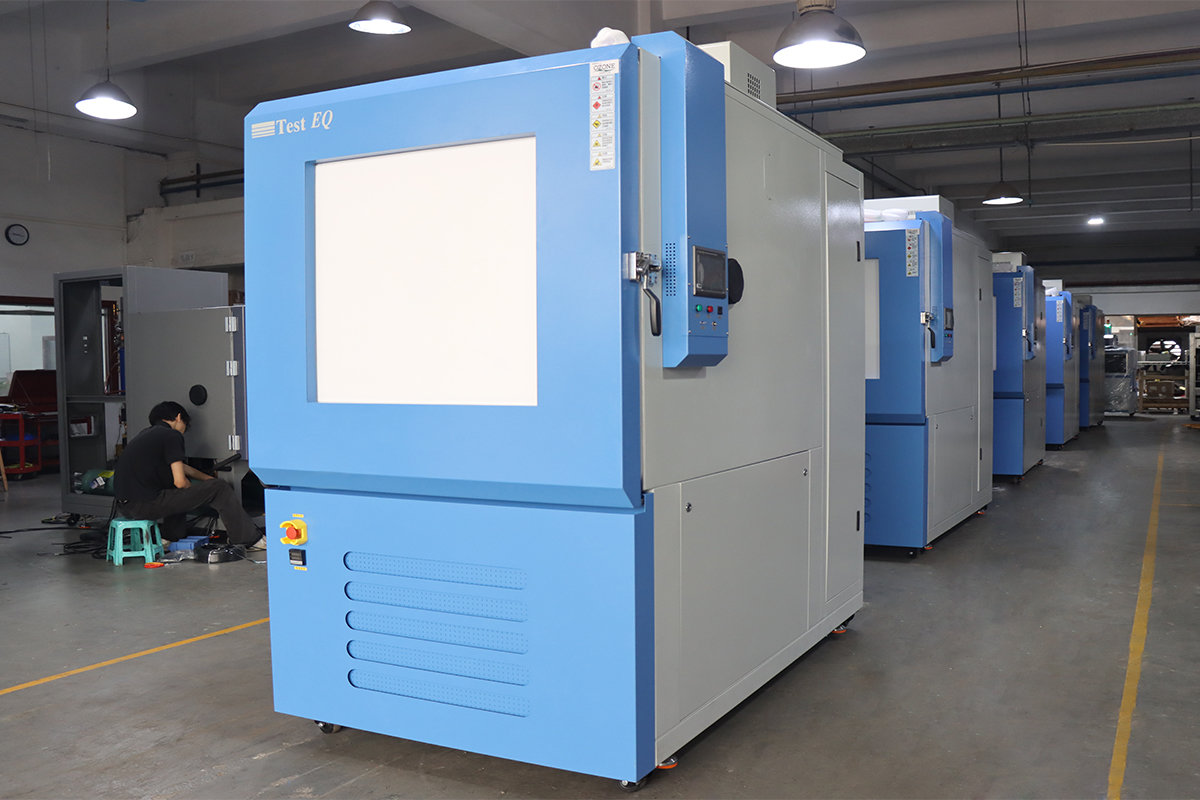
TestEQ provides configurable environmental test chambers for temperature variation and aerospace electronic equipment testing.
Depending on the application, the system can be specified around:
• High- and low-temperature exposure
• Controlled temperature transitions
• Rapid temperature change requirements
• Aerospace electronic equipment
• Custom chamber dimensions
• Cable feedthroughs and sensor connections
• Functional monitoring interfaces
• Temperature recording and data acquisition
• Single-chamber or application-specific configurations
For temperature shock applications, the required test apparatus should be confirmed against the applicable procedure before the chamber configuration is finalized.
TestEQ evaluates chamber requirements according to the specified temperature profile, DUT dimensions, thermal mass, operating conditions, and laboratory integration needs.
Note: TestEQ supplies environmental test equipment. Purchasing a chamber does not by itself establish DO-160 qualification or certification of the customer's equipment. The complete test system and procedure must meet the applicable qualification requirements.
Why Choose TestEQ for DO-160 Temperature Testing?
Selecting a temperature test chamber for aerospace equipment requires more than matching the required temperature range. The system must be configured around the specified temperature change rate, equipment thermal mass, operating conditions, and test setup.
TestEQ supports application-specific environmental test chamber configuration based on:
• Temperature Performance: Specifying the required temperature range and temperature change rate for the intended test profile.
• DUT-Based Engineering: Evaluating equipment dimensions, thermal mass, fixtures, and working volume.
• Functional Test Integration: Planning cable feedthroughs, temperature sensors, power connections, and monitoring interfaces.
• Test Configuration: Reviewing whether a single-chamber or temperature shock arrangement is appropriate for the specified procedure.
• Custom Chamber Design: Adapting chamber dimensions and interface requirements to the laboratory's application.
For aerospace engineers and laboratory procurement teams, the objective is to select a system that matches the actual test requirements—not simply the highest advertised ramp rate.
Applications
RTCA DO-160 Section 5 temperature testing is relevant to qualification programs for:
• Avionics and flight electronics
• Aircraft communication and navigation equipment
• Electronic control systems
• Sensors and monitoring devices
• Aircraft power electronics
• Aerospace research and development
• Environmental qualification laboratories
• Aviation equipment manufacturers and suppliers
The required test configuration depends on the equipment's intended installation and the applicable qualification plan.
Frequently Asked Questions About RTCA DO-160 Section 5 Temperature Testing
1. What Is RTCA DO-160 Section 5 Temperature Testing?
RTCA DO-160 Section 5 defines temperature variation and temperature shock test procedures for airborne equipment. The tests evaluate whether avionics and other aircraft electronic equipment continue to meet applicable performance requirements during prescribed temperature changes. The required procedure depends on the applicable DO-160 edition, equipment installation environment, test category, and qualification plan.
2. What Are the Temperature Change Rates for DO-160 Section 5 Categories A, B, C, S1, and S2?
Under DO-160G, Section 5 specifies minimum temperature change rates of 10°C/min for Category A, 5°C/min for Category B, and 2°C/min for Category C. Categories S1 and S2 address temperature shock, with specified rates greater than 10°C/min and different approaches to defining the change rate. Engineers should verify the applicable procedure and equipment qualification requirements before establishing the test profile.
3. What Is the Difference Between DO-160 Section 5 Temperature Variation and Temperature Shock Testing?
Temperature variation testing evaluates equipment during prescribed transitions between high and low temperature conditions. Temperature shock testing addresses more rapid thermal transitions using the applicable shock procedure. Under DO-160G, Categories A, B, and C cover temperature variation, while Categories S1 and S2 cover temperature shock. The required apparatus, transition procedure, and test sequence depend on the selected category.
4. What Temperature Range Is Required for an RTCA DO-160 Section 5 Test Chamber?
There is no single temperature range that applies to every DO-160 Section 5 test. The required low and high temperature endpoints depend on the equipment category, applicable test procedure, installation environment, and qualification specification. Before selecting a chamber, engineers should establish the required setpoints, exposure durations, transition rates, and operating conditions from the applicable standard and test plan.
5. Can a Standard Environmental Test Chamber Meet DO-160 Section 5 Requirements?
A standard environmental test chamber may be suitable if its verified performance meets the specified temperature range, loaded temperature change rate, stability, uniformity, and test configuration requirements. For demanding temperature shock procedures, a two-compartment chamber or two separate chambers may be necessary. Chamber suitability should be verified with consideration of the actual equipment, fixtures, cable connections, and thermal mass.
6. How Does DUT Size and Thermal Mass Affect DO-160 Temperature Testing?
The dimensions, weight, materials, and internal construction of the device under test (DUT) influence its thermal response. Large metal housings, heat sinks, and heavy mounting fixtures may respond more slowly than chamber air, even when the chamber achieves its specified temperature change rate. Engineers should evaluate the chamber's loaded performance and determine whether additional DUT temperature sensors are needed to verify the required test conditions.
7. What Information Should Engineers Provide When Requesting a DO-160 Section 5 Test Chamber Quote?
To obtain an appropriate chamber configuration and quotation, provide the equipment dimensions, weight, required low and high temperatures, temperature change rate, test category, powered or unpowered operating conditions, and required stabilization criteria. Also specify cable feedthroughs, functional monitoring, data acquisition, test duration, and any special fixture requirements. These details help TestEQ assess chamber capacity and configuration against the intended qualification program.
8. Does DO-160 Section 5 Require a Single-Chamber or Two-Chamber Temperature Test System?
The required system depends on the selected test category and procedure. Conventional temperature variation testing may be performed in a suitable single chamber, whereas the DO-160G Category S2 temperature shock procedure specifies a two-compartment chamber or two separate chambers. Engineers should confirm the required apparatus and transfer procedure before purchasing a system for temperature shock testing.
9. How Should Temperature, Equipment Function, and Test Data Be Monitored During DO-160 Section 5 Testing?
The test setup should support verification of the prescribed chamber conditions and the equipment's applicable functional performance. Depending on the qualification plan, monitoring may include chamber temperature, DUT temperature, electrical power, signal outputs, communication status, and other operational parameters. Sensor placement, sampling intervals, stabilization criteria, and data retention should be defined before testing to support traceable qualification records.
10. Can TestEQ Provide a Customized Temperature Test Chamber for RTCA DO-160 Section 5?
TestEQ can configure environmental test chambers around specified temperature ranges, temperature change rates, DUT dimensions, thermal mass, cable access, and monitoring requirements. For temperature shock applications, the required chamber arrangement should be confirmed against the applicable test procedure. Contact TestEQ with your equipment specifications and qualification profile to discuss a suitable chamber configuration for your aerospace testing application.
Internal Linking Module
Related Standards
Explore the DO-160 environmental qualification framework for airborne equipment, including temperature, altitude, humidity, vibration, and other environmental test procedures.
Understand temperature-change test methods used to evaluate the effects of specified temperature transitions on electronic components and equipment.
Learn how temperature cycling evaluates electronic component reliability under repeated high- and low-temperature exposure.
Related Test Chambers
Explore configurable environmental chambers for controlled high- and low-temperature testing of aerospace electronics, sensors, and electronic assemblies.
Evaluate chamber solutions for applications requiring controlled temperature ramp rates and rapid environmental transitions.
Explore two-zone and other thermal shock chamber configurations for rapid transitions between hot and cold environments, depending on the applicable test procedure.
Related Engineering Resources
Learn about thermal cycling procedures, test profiles, chamber design, and common failure mechanisms to support environmental reliability testing.
Compare the test methods, temperature transition approaches, and equipment considerations to help determine which procedure fits your qualification objectives.
Review key selection factors, including temperature range, DUT dimensions, test profile, ramp rate, and applicable standards, before preparing an equipment RFQ.
CTA
Need a Temperature Test Chamber for RTCA DO-160 Section 5?
TestEQ provides customized environmental test chambers for avionics, airborne electronics, and aerospace temperature testing. Systems can be configured around DO-160 temperature variation requirements, specified ramp rates, DUT dimensions, thermal loads, and functional monitoring needs.
Whether your application requires controlled temperature variation or a suitable temperature shock test configuration, our engineering team can help evaluate your chamber requirements based on the applicable test procedure.
Request a Custom DO-160 Test Chamber Quote
Send TestEQ your required temperature range, temperature change rate, DUT dimensions, test category (A, B, C, S1, or S2), and monitoring requirements to discuss a suitable configuration.
"Contact TestEQ" | Explore Environmental Test Chambers
Final chamber suitability depends on the applicable DO-160 edition, test procedure, and verified system performance.