What Is UAV Vibration Testing?
UAV vibration testing is a controlled laboratory test used to evaluate whether a drone, aircraft structure, subsystem, or onboard component can withstand vibration during transportation, operation, takeoff, landing, and other stages of its lifecycle.
Typical vibration sources include:
• Propeller and motor rotation
• Engine or propulsion-system excitation
• Aerodynamic turbulence
• Structural resonance
• Landing and takeoff loads
• Transportation vibration
• Equipment and payload interaction
The objective is not simply to expose a UAV to vibration. Engineers need to reproduce a representative vibration environment and determine whether the test item maintains structural integrity, functional performance, and reliability.
Why Do UAVs Need Vibration Testing?
Vibration can cause mechanical fatigue, fastener loosening, connector degradation, solder-joint damage, sensor instability, structural cracking, and unwanted resonance.
For UAV systems, vibration testing can be used to evaluate:
• Airframe structural reliability
• Flight-control system stability
• Avionics durability
• Camera and gimbal performance
• Navigation and sensor systems
• Battery and power-system reliability
• Communication equipment
• Payload mounting systems
• Electronic control units
• Mechanical assemblies
A vibration test can also help engineers identify resonant frequencies before they become field failures.
UAV Vibration Test Chamber Requirements
The requirements of a UAV vibration test chamber depend on the UAV size, weight, vibration profile, test objective, environmental conditions, and applicable standards. The following parameters should be evaluated before selecting or designing a test system.
| Requirement | What Engineers Should Consider | Typical Application |
|---|---|---|
| UAV Size & Weight | Chamber dimensions, payload capacity and shaker force should match the test article. | Complete UAV, airframe, large components |
| Vibration Type | Random vibration, sine vibration, resonance search or combined profiles. | Propulsion, avionics, structural testing |
| Frequency Range | Select according to the UAV's measured or specified vibration environment. | Motor, propeller and structural resonance |
| Acceleration / PSD | Test severity should be based on the applicable test specification and actual environment. | Reliability and qualification testing |
| Number of Axes | Single-axis, sequential multi-axis or combined multi-axis vibration. | UAV structure and component testing |
| Temperature Control | Consider required high/low temperature conditions during vibration testing. | Hot/cold operational environments |
| Humidity Control | Add humidity control when combined environmental testing is required. | Temperature + humidity + vibration |
| Test Fixture | Fixture stiffness, mounting configuration and resonance should be evaluated. | Airframe, avionics and payload testing |
| Monitoring & Data Acquisition | Measure control and response acceleration and monitor functional performance. | Qualification and failure analysis |
| Applicable Standards | Define the test method and severity according to the applicable specification, such as MIL-STD-810H Method 514.8. | UAV qualification and reliability testing |
The vibration profile, frequency range, acceleration, PSD, test duration and environmental conditions should be tailored to the UAV configuration, lifecycle environment and applicable test requirements rather than using a universal vibration profile. MIL-STD-810H Method 514.8 specifically emphasizes tailoring and recommends using measured environmental data whenever practical.
How UAV Vibration Testing Is Performed
A typical UAV vibration test program includes several engineering stages.
1. Define the Test Objective
The first step is to determine whether the test is intended for:
• Design verification
• Reliability evaluation
• Qualification
• Development testing
• Environmental stress screening
• Failure investigation
The test objective determines the appropriate vibration profile and severity.
2. Define the Vibration Environment
Engineers identify the vibration conditions associated with the UAV lifecycle.
Relevant parameters may include:
• Frequency range
• Acceleration
• PSD level
• Overall grms
• Sine vibration amplitude
• Sweep rate
• Test duration
• Number of axes
• Operational versus transportation vibration
For random vibration testing, power spectral density (PSD) is commonly used to describe vibration severity.
3. Design the Test Fixture
The fixture must provide a representative mechanical interface between the vibration exciter and the UAV or test article.
Poor fixture design can introduce unwanted resonances, excessive cross-axis vibration, or unrealistic boundary conditions.
For large or flexible UAV structures, fixture dynamics should therefore be evaluated before the qualification test.
4. Monitor the Test Article
Accelerometers and other sensors can be installed at appropriate control and response locations.
Engineers may monitor:
• Input acceleration
• Response acceleration
• Resonance
• Structural response
• Functional performance
• Temperature
• Humidity
• Electrical parameters
5. Analyze Test Results
After testing, engineers compare the measured response and functional condition with the applicable test requirements.
Typical failure indicators may include:
• Cracks or deformation
• Loose components
• Connector failure
• Electrical malfunction
• Sensor instability
• Fastener loosening
• Excessive resonance
• Loss of functional performance
MIL-STD-810H Vibration Testing for UAVs
MIL-STD-810H Method 514.8 provides guidance for defining vibration environments and conducting laboratory vibration tests. The method is intended to address vibration exposures that materiel may encounter throughout its lifecycle and emphasizes tailoring the test to the actual environment and test objective.
For UAV applications, engineers should not assume that one universal vibration profile applies to every drone.
The appropriate test profile depends on factors such as:
• UAV configuration
• Airframe type
• Propulsion system
• Installation location
• Flight condition
• Payload
• Component mass
• Operational environment
• Measured field vibration data
MIL-STD-810H Method 514.8 also discusses vibration control, test tolerances, fixture effects, cross-axis motion, and vibration response.
For UAV qualification programs, the test plan should therefore be developed around the actual operational environment rather than simply selecting a generic vibration value.
Temperature, Humidity and Vibration Combined Testing
UAVs rarely operate under vibration alone.
During actual operation, a drone may simultaneously experience:
• Mechanical vibration
• Temperature changes
• High or low humidity
• Aerodynamic loads
• Power-system heat
• Transportation and handling loads
A combined environmental test system can reproduce multiple stresses within a controlled laboratory environment.
For example:
Temperature + Humidity + Vibration
This configuration can be used to evaluate UAV systems under more representative environmental conditions.
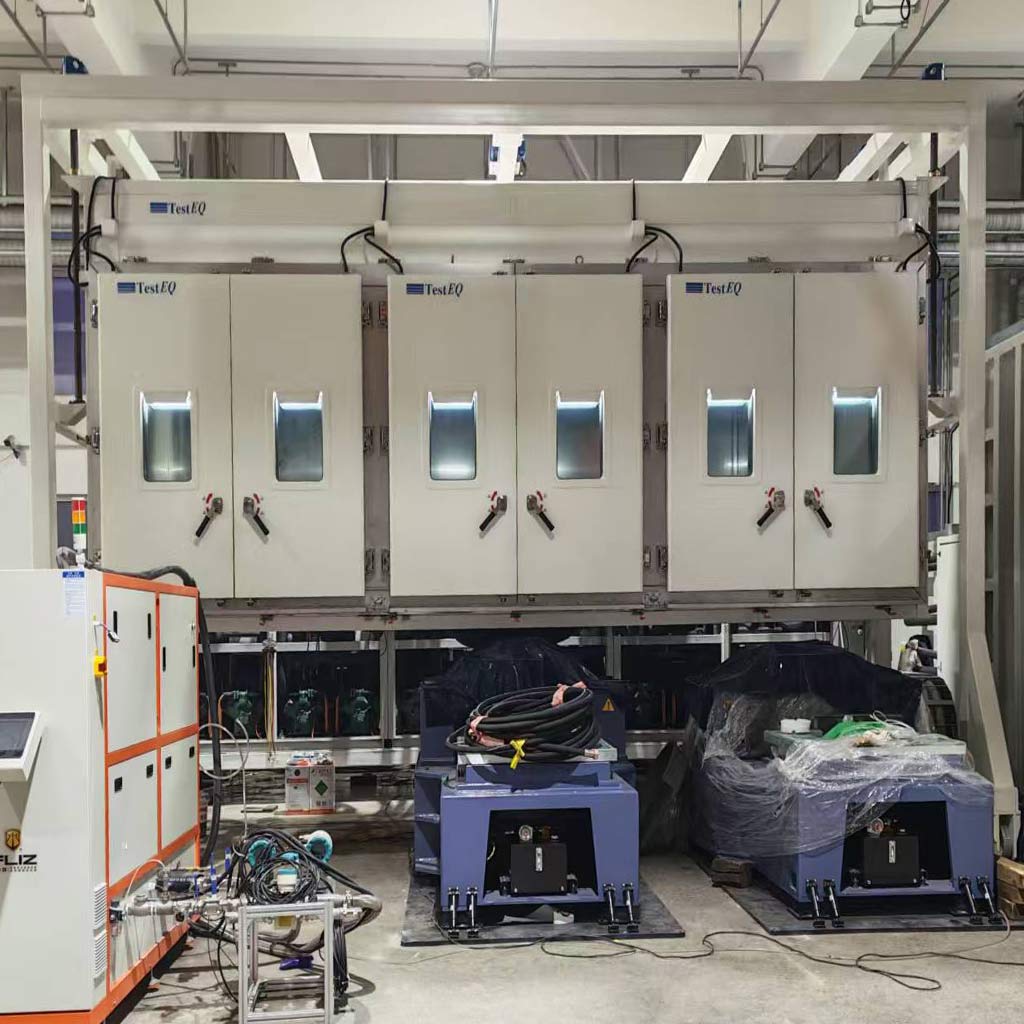
TestEQ's three-comprehensive vibration test chamber system supports independent and combined A/B/C vibration configurations, including AB, AC, BC and ABC three-axis linkage modes.
The system is designed for applications where temperature, humidity and vibration need to be controlled together.
UAV Components That Require Vibration Testing
UAV vibration testing can be applied at both complete-system and component levels.
UAV Airframe
Structural components can be evaluated for:
• Fatigue
• Resonance
• Structural deformation
• Fastener reliability
Flight Control System
Flight-control equipment can be evaluated for functional stability under vibration.
Avionics
Avionics and electronic control systems may require vibration exposure together with temperature and humidity conditions.
UAV Battery and Power System
Battery packs, power electronics, connectors and power-management components can be evaluated for vibration-related reliability issues.
Cameras and Gimbals
Payload equipment can be sensitive to vibration-induced image instability and mechanical resonance.
TestEQ UAV Vibration Test Chamber Project
TestEQ has delivered a three-comprehensive vibration test chamber system to a UAV R&D and testing laboratory in Beijing for UAV and component reliability verification.
The system was designed for synchronized environmental testing involving temperature, humidity and multi-axis vibration.
The project configuration includes three modular test chambers with an internal chamber size of approximately:
W2000 mm × H2000 mm × D1500 mm
The system supports independent operation of individual chambers as well as combined operation.
Key environmental capabilities include:
• Temperature range: -70°C to +120°C
• Humidity control: 20–98% RH
• Heating rate: up to 15°C/min
• Cooling rate: up to 15°C/min under specified conditions
• Multi-axis vibration configurations
• Temperature, humidity and vibration combined testing
The final chamber configuration, vibration system, fixture, frequency range, acceleration and environmental performance should be engineered according to the UAV test article and applicable test requirements.
How to Select a UAV Vibration Test Chamber
Before selecting a UAV vibration test chamber, engineers and procurement teams should define the following parameters:
1. UAV Size and Weight
The chamber and vibration system must accommodate the physical dimensions and mass of the test article.
2. Vibration Profile
Specify whether the test requires:
• Random vibration
• Sinusoidal vibration
• Sine-on-random
• Resonance search
• Operational vibration
• Transportation vibration
3. Number of Axes
Determine whether testing requires:
• Single-axis vibration
• Sequential multi-axis testing
• Multi-axis combined vibration
4. Environmental Conditions
Determine whether vibration needs to be combined with:
• Temperature
• Humidity
• Altitude
• Other environmental stresses
5. Fixture Requirements
The fixture should reproduce the required mounting condition while minimizing unwanted structural resonance.
6. Applicable Standards
The test system should be configured around the actual test specification and applicable standards, such as MIL-STD-810H Method 514.8 or customer-specific aerospace/UAV qualification requirements.
Why Choose TestEQ for UAV Environmental Testing?
TestEQ provides customized environmental simulation systems for UAV, aerospace, defense, semiconductor, automotive and electronic reliability applications.
Our engineering capability covers:
• Environmental test chambers
• Vibration test systems
• Temperature and humidity chambers
• Combined environmental vibration chambers
• Altitude test chambers
• Thermal shock systems
• Custom large-volume environmental chambers
For UAV applications, TestEQ can integrate chamber volume, temperature control, humidity control, vibration excitation, fixtures, monitoring and control systems according to the test objective.
The goal is not simply to provide a chamber, but to develop an environmental simulation system matched to the customer's test requirements.
Frequently Asked Questions
1.What is a UAV vibration test chamber?
A UAV vibration test chamber is an environmental testing system used to expose drones or UAV components to controlled vibration, with optional temperature and humidity conditions, to evaluate reliability and functional performance.
2.What vibration tests are used for UAVs?
UAVs may undergo random vibration, sinusoidal vibration, resonance search, transportation vibration, operational vibration, and combined environmental vibration testing depending on the test objective.
3.Does MIL-STD-810H apply to UAV vibration testing?
MIL-STD-810H Method 514.8 provides guidance for vibration testing of materiel. The vibration exposure should be tailored to the actual platform, lifecycle environment, test article and applicable qualification requirements.
4.Can temperature, humidity and vibration be tested simultaneously?
Yes. A combined environmental vibration system can synchronize temperature, humidity and vibration to reproduce multiple environmental stresses.
5.What is the difference between UAV vibration testing and environmental testing?
Vibration testing focuses on mechanical dynamic loads, while broader UAV environmental testing may include temperature, humidity, altitude, shock, vibration and other environmental stresses.
6.Can a UAV be tested as a complete system?
Yes. The chamber and vibration system can be engineered for complete UAV testing or for individual components such as avionics, batteries, gimbals, sensors and flight-control systems.
7.How do I select the right UAV vibration test chamber?
Selection should consider UAV dimensions, weight, fixture configuration, vibration profile, acceleration, frequency range, number of axes, environmental conditions, applicable standards and test objectives.
8.Can TestEQ customize a UAV vibration test chamber?
Yes. TestEQ can customize chamber dimensions, temperature and humidity performance, vibration configuration, fixtures, monitoring systems and combined environmental functions according to project requirements.
Internal Linking Module
Recommended Test Equipment
Explore TestEQ environmental testing systems designed for UAV, aerospace, electronics, and reliability testing applications.
A controlled vibration testing system for evaluating UAV structures, avionics, components, and other products under defined vibration profiles.
An environmental test chamber for evaluating UAV components under controlled temperature and humidity conditions and supporting combined environmental reliability programs.
A low-pressure environmental testing system for simulating high-altitude conditions and evaluating UAV, aerospace, and electronic equipment performance.
Related Testing Standards
Understand the environmental and vibration standards commonly considered for UAV and aerospace reliability testing.
A widely used U.S. military environmental test standard covering vibration, temperature, humidity, altitude, shock, and other environmental stresses.
Explore the IEC 60068 environmental testing series covering temperature, humidity, vibration, shock, and other environmental test methods.
Related Technical Resources
Explore practical engineering guides related to UAV vibration, environmental simulation, and reliability testing.
UAV Environmental Testing: A Complete Reliability Guide
Learn how temperature, humidity, vibration, altitude, and other environmental stresses can be evaluated during UAV reliability testing.
Understand common vibration test methods, vibration profiles, test fixtures, and key parameters used in product reliability testing.
Learn how to select an environmental test chamber based on test temperature, humidity, chamber volume, test standards, product configuration, and application requirements.
Call To Action:
Get a Custom UAV Vibration Test Chamber Solution
Planning a UAV, drone, avionics, or aerospace environmental reliability test?
TestEQ can design and manufacture customized UAV vibration test chambersfor vibration, temperature, humidity, and combined environmental testing. Our engineering team can help evaluate the chamber size, vibration configuration, fixture requirements, environmental conditions, and applicable testing standards for your application.
Send Us Your Test Requirements
To help us recommend the right system, please provide:
• UAV or test article dimensions and weight
• Required vibration type and frequency range
• Acceleration, PSD, or vibration profile
• Temperature and humidity requirements
• Number of vibration axes
• Applicable standard, such as MIL-STD-810H
• Required chamber volume and test space
• Any special fixture or monitoring requirements
Discuss your vibration profile, environmental conditions, and test configuration with our engineering team.
TestEQ — Environmental Test Chamber Engineering & Manufacturing
Due to confidentiality agreements, specific client names are not disclosed. However, parts of these projects can be verified through publicly available tender and procurement records.