1. What Is Battery Thermal Cycling Testing?
Battery thermal cycling testing simulates repeated exposure of batteries to alternating high and low temperature environments. The goal is to evaluate how internal chemical and mechanical structures respond to thermal stress over time.
Typical test conditions include:
• High temperature: +60°C to +85°C
• Low temperature: -40°C to -55°C
• Rapid transition cycles
• Controlled dwell time and ramp rate
This process is widely used in:
• EV battery packs
• Lithium-ion cell qualification
• Aerospace power systems
• Energy storage modules (ESS)
2. Key Failure Mechanisms in Thermal Cycling Tests
During repeated thermal expansion and contraction, batteries experience multiple degradation pathways. The most critical failure mechanisms include:
2.1 SEI Layer Degradation
The Solid Electrolyte Interface (SEI) layer continuously forms and breaks during thermal cycling. Temperature fluctuations accelerate:
• SEI cracking
• Lithium consumption
• Capacity fade
This leads to reduced cycle life and unstable performance.
2.2 Electrode Expansion and Mechanical Fatigue
Anode and cathode materials expand and contract under temperature stress. Over time, this causes:
• Particle fracture
• Loss of electrical contact
• Structural instability
This is especially severe in high-energy-density cells used in EV applications.
2.3 Electrolyte Decomposition
High temperatures accelerate electrolyte breakdown, producing gas and internal pressure buildup. Consequences include:
• Swelling
• Increased impedance
• Safety risks in extreme conditions
2.4 Internal Resistance Growth
Repeated thermal stress increases internal resistance due to interface degradation and material aging. This results in:
• Reduced discharge power
• Voltage instability
• Poor high-load performance
2.5 Current Collector Corrosion
Aluminum and copper current collectors may corrode or delaminate during extreme cycling, leading to:
• Electrical discontinuity
• Localized heating
• Potential cell failure
3. Why Thermal Cycling Accelerates Battery Failure
Unlike static temperature testing, thermal cycling introduces dynamic mechanical stress + electrochemical instability simultaneously.
Key acceleration factors:
• Rapid expansion/contraction mismatch
• Uneven thermal gradients inside cells
• Material fatigue accumulation
• Interface instability growth
This makes thermal cycling one of the most predictive reliability tests for next-generation batteries.
4. Engineering Value: What Engineers and Labs Should Focus On
For R&D engineers and quality validation teams, thermal cycling data is not just pass/fail—it is a diagnostic tool.
Key evaluation metrics include:
• Capacity retention rate
• Internal resistance increase (DCIR)
• Swelling ratio
• Voltage consistency
• Cycle-to-failure prediction
Proper analysis helps:
• Improve electrode formulation
• Optimize thermal management systems
• Extend battery lifecycle design
• Reduce field failure risks
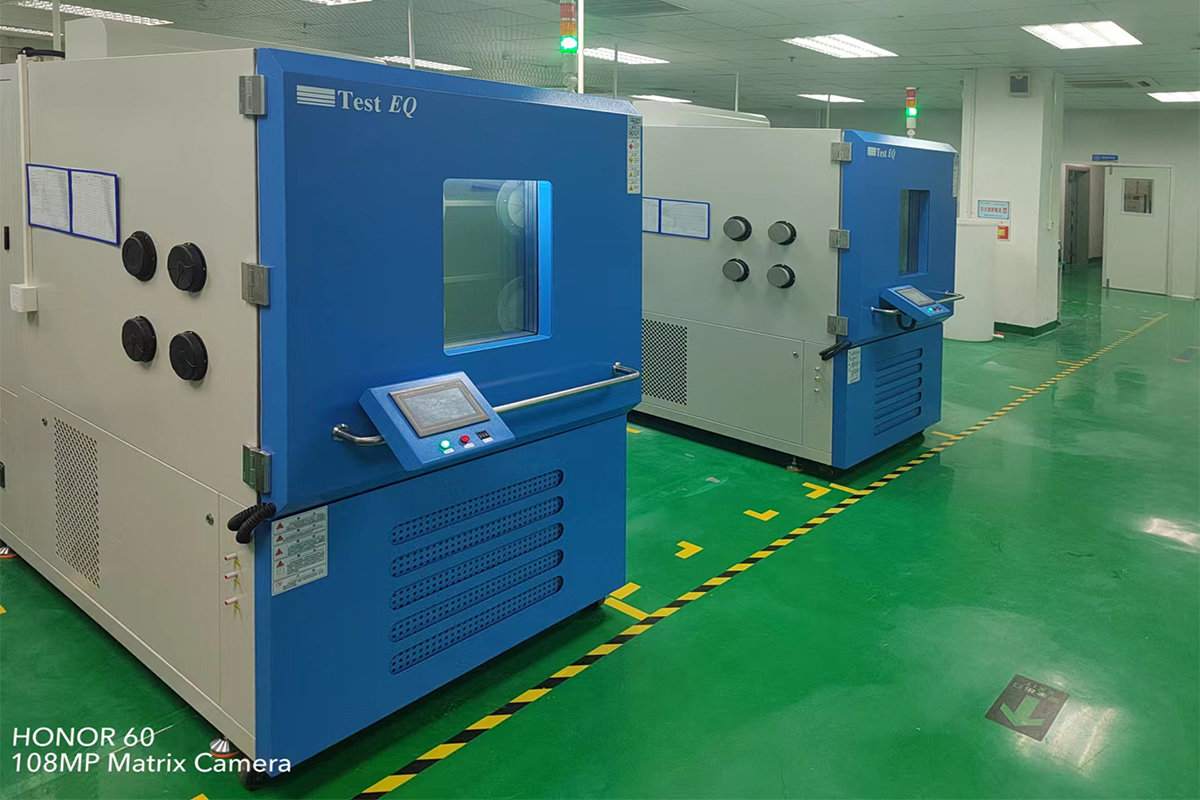
5. TestEQ Thermal Cycling Test Chamber Solution
To accurately simulate real-world conditions, test equipment must ensure precision, repeatability, and fast thermal transition capability.
TestEQ provides advanced environmental testing systems designed specifically for battery reliability validation:
Key Features:
• Rapid temperature transition capability (up to 15–25°C/min optional)
• Ultra-stable temperature uniformity
• Multi-zone thermal control architecture
• Safety protection for lithium battery testing
• Programmable cycling profiles for OEM validation
Application Coverage:
• Cell-level thermal abuse studies
• Energy storage system validation
• Aerospace and defense battery qualification
With high precision control, TestEQ chambers allow engineers to reproduce real-world thermal stress conditions and accelerate failure analysis efficiently.
6. How Thermal Cycling Testing Improves Product Reliability
By systematically analyzing failure mechanisms, manufacturers can:
• Identify weak material interfaces early
• Improve battery chemistry stability
• Reduce warranty and field failure cost
• Accelerate certification cycles (UL, IEC, ISO standards)
In competitive EV and energy markets, reliability is directly tied to product success and brand trust.
7. Conclusion
Battery thermal cycling testing is essential for understanding real-world degradation behavior. Key failure mechanisms such as SEI breakdown, electrode fatigue, and electrolyte decomposition directly impact battery life and safety.
With advanced testing solutions from TestEQ, engineers and laboratories can achieve deeper failure insights, improve design reliability, and accelerate product development cycles.
For organizations working on next-generation energy storage systems, precise thermal cycling validation is no longer optional—it is a core requirement for market success.
FAQ – Battery Thermal Cycling Testing Failure Mechanisms
1. What is battery thermal cycling testing used for?
Battery thermal cycling testing is used to evaluate how batteries perform under repeated high and low temperature changes. It helps identify long-term degradation mechanisms such as capacity fade, internal resistance increase, and structural fatigue. This test is widely used in EV batteries, energy storage systems, and aerospace applications to ensure reliability before commercialization.
2. What are the most common failure mechanisms in battery thermal cycling tests?
The most common failure mechanisms include SEI layer degradation, electrode material cracking, electrolyte decomposition, internal resistance growth, and current collector corrosion. These failures are caused by repeated thermal expansion and contraction, which accelerates electrochemical and mechanical aging inside the battery.
3. Why is thermal cycling more aggressive than constant temperature testing?
Thermal cycling is more aggressive because it introduces repeated mechanical stress in addition to temperature exposure. Unlike constant temperature tests, cycling creates expansion and contraction mismatches between battery materials, which accelerates structural fatigue, interface breakdown, and electrochemical instability.
4. How fast should a battery thermal cycling test chamber transition temperature?
The temperature ramp rate depends on the test standard and application. For most EV and advanced R&D applications, a ramp rate between 5°C/min and 15°C/min is commonly used. High-performance validation may require up to 20–25°C/min to simulate extreme real-world thermal shock conditions.
5. What parameters should engineers monitor during thermal cycling tests?
Engineers typically monitor capacity retention, internal resistance (DCIR), voltage stability, swelling behavior, and cycle-to-failure performance. These metrics help identify degradation trends and predict long-term battery reliability under real-world operating conditions.
6. What should buyers consider when selecting a battery thermal cycling test chamber?
Buyers should evaluate temperature accuracy, uniformity, ramp rate capability, safety protection for lithium batteries, chamber size flexibility, and control system precision. For industrial and EV applications, reliability, repeatability, and compliance with international testing standards are key purchasing factors.
CTA
Looking for a high-performance battery thermal cycling testing solution?