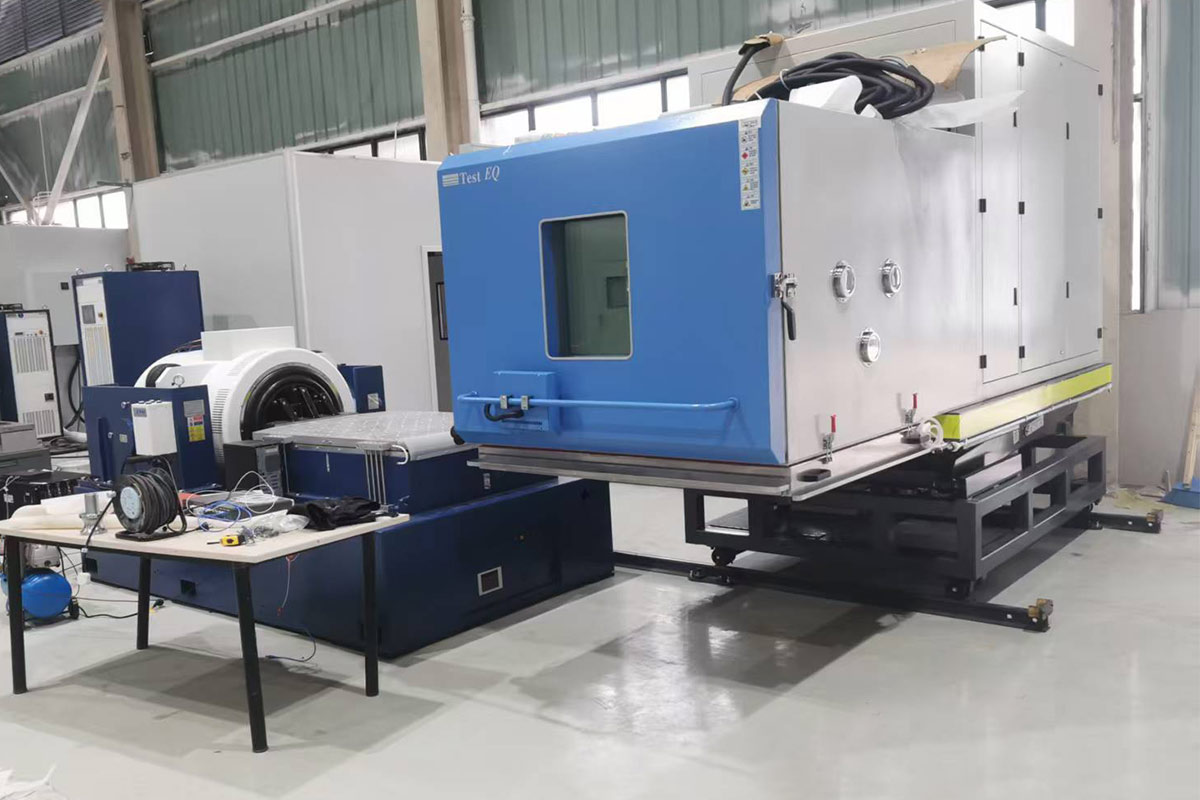
What Is a Temperature Humidity Vibration Test Chamber?
A Temperature Humidity Vibration Test Chamber (THV Chamber) is a multi-stress environmental simulation system that integrates:
• Temperature cycling (heat & cold)
• Humidity conditioning (moisture & condensation)
• Mechanical vibration (random or sinusoidal motion)
into a single controlled test environment.
It is designed to reproduce real-world operating conditions where products are exposed to simultaneous thermal, moisture, and mechanical stress.
Compared to traditional single-factor chambers, a THV system significantly improves failure detection efficiency and test realism, making it a critical tool for reliability engineering.
How a THV Chamber Works
A THV chamber integrates three subsystems working in synchronized control:
1. Temperature Control System
Uses refrigeration compressors and heating elements to simulate extreme conditions from typically -70°C to +180°C.
2. Humidity Control System
Maintains controlled relative humidity (20%–98% RH) to simulate condensation, corrosion, and insulation aging.
3. Vibration System
An electrodynamic or hydraulic shaker applies controlled vibration profiles:
• Sine wave vibration
• Random vibration
• Shock simulation
These systems operate independently or in synchronized test programs depending on the test standard.
Why Combined Testing Is Critical
Real-world environments are never single-stress conditions.
For example:
• EV batteries face heat + vibration + humidity during operation
• Aerospace electronics experience altitude + thermal cycling + vibration
• Automotive ECUs face engine vibration + thermal shock + moisture exposure
A THV chamber reproduces these multi-factor coupling effects, which cannot be achieved using separate test systems.
? This is why leading OEMs are shifting from single chambers to integrated THV systems.
Applications of THV Chambers
Automotive Industry
• EV battery pack validation
• ECU durability testing
• ADAS sensor reliability
• Powertrain electronic stress screening
• Avionics qualification testing
• Satellite component reliability
• Military electronics environmental validation
Electronics & Semiconductor
• PCB fatigue testing
• IC packaging reliability
• Consumer electronics durability testing
Energy Storage Systems
• Lithium battery cycling under vibration
• Thermal runaway simulation
• Safety certification testing
Benefits of THV Testing
✔ Faster Failure Detection
Combines multiple stress factors to accelerate degradation mechanisms.
✔ Reduced Test Time
Eliminates need for separate environmental and vibration tests.
✔ Higher Design Confidence
Reveals hidden design weaknesses before mass production.
✔ Compliance Ready
Supports standards such as:
• ISO environmental reliability standards
• MIL-STD vibration requirements
• Automotive OEM validation protocols
✔ Lower Total Testing Cost
One integrated system replaces multiple standalone machines.
Types of THV Test Chambers
Compact THV Chambers
For R&D labs and component-level testing.
Standard THV Systems
For subsystem validation in automotive and electronics.
Walk-in THV Chambers
For full-scale products such as EV batteries or aerospace assemblies.
Custom Engineering Systems
Designed for aerospace, defense, and advanced R&D applications.
Why TestEQ THV Systems
TestEQ designs engineering-grade environmental test systems for industrial reliability validation.
Our THV chambers focus on:
• High precision multi-stress control
• Long-duration stability testing
• Modular vibration integration design
• Global compliance capability
• Custom engineering for OEM requirements
We support engineering teams from R&D validation → qualification testing → production reliability screening.
FAQ
What is a Temperature Humidity Vibration Test Chamber used for?
It is used to simulate real-world environmental conditions combining temperature, humidity, and vibration for reliability testing of products.
Why is combined testing better than separate tests?
Because real-world conditions involve multiple stresses simultaneously, combined testing reveals failures that single-factor tests cannot detect.
Which industries use THV chambers?
Automotive, aerospace, electronics, semiconductor, and energy storage industries widely use THV chambers.
What standards does a THV chamber support?
It supports IEC, ISO, MIL-STD, and OEM-specific environmental testing standards.
Can vibration and climate tests run simultaneously?
Yes, advanced THV systems are designed to run vibration, temperature, and humidity simultaneously or in programmable sequences.
CTA:
"Talk to a TestEQ Engineer and Get a Tailored THV Chamber Configuration Within 24 Hours"