What Is J-STD-020?
J-STD-020 is an industry standard developed by JEDEC and IPC for moisture/reflow sensitivity classification of non-hermetic surface-mount devices.
Its primary purpose is to determine how sensitive a semiconductor package is to moisture-induced damage during the solder reflow process.
The classification procedure generally includes:
• Initial package conditioning and preparation
• Moisture soaking under specified temperature and humidity conditions
• Reflow simulation using a specified temperature profile
• Inspection and evaluation for moisture-related package damage
• Assignment of a Moisture Sensitivity Level (MSL)
The resulting MSL indicates the handling and floor-life requirements that apply to the classified package under the relevant conditions.
Important: J-STD-020 is a package classification standard. It is not a general-purpose humidity reliability test or a complete semiconductor qualification program. Moisture-sensitive device handling, packaging and floor-life management are addressed in related documents such as J-STD-033.
MSL Classification Levels
The Moisture Sensitivity Level (MSL) indicates the allowable floor life of a moisture-sensitive surface-mount device after it is removed from its moisture-barrier packaging, under the specified handling and environmental conditions.
J-STD-020 defines MSL classifications from Level 1 to Level 6. Lower MSL numbers generally indicate lower moisture sensitivity, while higher levels require more restrictive handling and shorter allowable exposure times.
MSL Level | Standard Floor Life |
|---|---|
MSL 1 | Unlimited under the specified conditions |
MSL 2 | 1 year |
MSL 2a | 4 weeks |
MSL 3 | 168 hours |
MSL 4 | 72 hours |
MSL 5 | 48 hours |
MSL 5a | 24 hours |
MSL 6 | Time on Label (TOL) |
Note: These floor-life values are commonly used reference values associated with the MSL system. Actual handling requirements must be checked against the applicable standard edition, specified environmental conditions, package labeling and J-STD-033 requirements.
How MSL Classification Works
MSL classification evaluates whether a non-hermetic surface-mount package can withstand moisture exposure followed by the thermal stress of solder reflow without unacceptable moisture-related damage.
The general classification process involves:
1. Preparing and inspecting the test samples.
2. Applying the specified moisture soak conditions.
3. Exposing the samples to the required reflow temperature profile.
4. Inspecting the packages for cracking, delamination or other specified failure indicators.
5. Determining the applicable MSL classification according to the standard's acceptance criteria.
The assigned MSL is used to establish appropriate moisture-sensitive device handling and storage controls.
J-STD-020 Test Requirements
J-STD-020 defines a controlled preconditioning and reflow exposure process for evaluating the moisture/reflow sensitivity of non-hermetic surface-mount packages.
The test program must follow the applicable edition of the standard, including its sample preparation, moisture soak, reflow exposure, inspection and acceptance requirements.
The major test stages include:
Sample Preparation
Test samples are prepared according to the applicable package requirements and test procedure. Initial inspection and conditioning help establish a consistent baseline before moisture exposure.
Moisture Soak
Packages are exposed to specified temperature and relative humidity conditions for a defined period. This stage simulates moisture absorption during handling and exposure to the surrounding environment.
The temperature, humidity and soak duration depend on the applicable MSL classification procedure and package characteristics.
Reflow Simulation
After moisture conditioning, the packages are exposed to a specified reflow temperature profile.
The reflow profile represents the thermal conditions associated with solder assembly. The required peak temperature and exposure conditions depend on the applicable package classification requirements.
Reflow simulation is normally performed using a suitable reflow oven or equivalent reflow system, not by a conventional temperature humidity chamber.
Package Inspection and Evaluation
After reflow exposure, samples are inspected according to the standard's evaluation procedures. The assessment may include examination for package cracking, delamination and other moisture-related damage.
The classification is determined using the applicable test criteria and acceptance requirements.
Environmental Test Conditions
Environmental conditioning is a key part of the J-STD-020 classification procedure. The specified temperature and relative humidity conditions influence the amount of moisture absorbed by the package before reflow exposure.
The actual environmental conditions and exposure duration must be selected from the applicable standard edition and test plan. They should not be replaced with arbitrary temperature or humidity settings.
Important environmental parameters include:
• Temperature: Maintained at the specified test setpoint.
• Relative Humidity (RH): Controlled according to the selected moisture soak condition.
• Exposure Duration: Programmed to meet the required moisture conditioning period.
• Environmental Uniformity: Maintained throughout the usable chamber workspace.
• Monitoring and Recording: Test conditions and operating data should be recorded for traceability.
For reliable classification results, laboratories should consider chamber loading, sample placement, air circulation, recovery after door opening and the stability of long-duration operation.
Moisture Soak Requirements
Moisture soak is the environmental conditioning stage in which semiconductor packages absorb moisture under specified temperature and humidity conditions before reflow simulation.
The purpose is to create a controlled and repeatable moisture exposure condition that supports the subsequent evaluation of package resistance to reflow-related damage.
A temperature humidity chamber used for this stage should support:
• Accurate temperature control over the required operating range
• Stable relative humidity control
• Consistent temperature and humidity distribution
• Programmable temperature and humidity profiles
• Continuous operation for the required soak duration
• Independent over-temperature protection
• Test data recording and monitoring
• Suitable shelves and sample placement arrangements
Factors Affecting Moisture Conditioning
Several factors can affect the repeatability of moisture soak testing:
Chamber Stability: Temperature and RH fluctuations can affect the consistency of environmental exposure.
Workspace Uniformity: Samples placed in different chamber locations should experience environmental conditions within the specified tolerances.
Sample Loading: Excessive loading or poor sample arrangement may affect airflow and environmental recovery.
Operating Duration: The chamber must maintain the required conditions throughout the complete conditioning period.
Test Data Traceability: Recorded temperature and humidity data help laboratories review and document the conditioning process.
The chamber configuration should therefore be selected according to the test plan, sample quantity, sample arrangement and required environmental conditions.
Reflow Profile Requirements
Reflow simulation is a critical part of J-STD-020 because it exposes moisture-conditioned packages to the thermal conditions associated with solder assembly.
The reflow process must follow the applicable temperature profile and exposure requirements defined by the relevant standard edition.
Key profile parameters may include:
Ramp-up rate
Preheat conditions
Time above specified temperatures
Peak reflow temperature
Time at peak temperature
Cooling conditions
The applicable profile depends on the package classification requirements and the specified test procedure.
Equipment distinction: A temperature humidity chamber is used for moisture conditioning. Reflow simulation generally requires a dedicated reflow oven or suitable reflow system capable of controlling the required thermal profile.
A laboratory implementing J-STD-020 should ensure that both stages are properly configured and that the environmental conditioning records and reflow exposure records can be associated with the same test samples.
Temperature Humidity Chamber Requirements for J-STD-020
A temperature humidity chamber supports the moisture soak stage of J-STD-020 by providing controlled temperature and relative humidity conditions.
The chamber should be configured according to the actual test requirements rather than selected solely by its nominal volume or maximum temperature range.
Important equipment considerations include:
Temperature and Humidity Control
The chamber should maintain the specified temperature and RH conditions throughout the required exposure period.
Temperature and Humidity Uniformity
Environmental distribution across the usable workspace is important when multiple samples are tested simultaneously.
Long-Duration Operating Stability
The chamber should support continuous operation for the required moisture conditioning duration without unacceptable environmental deviation.
Programmable Test Profiles
A programmable controller allows laboratories to define test stages, setpoints, dwell times and operating sequences.
Data Logging and Monitoring
Temperature and humidity records provide evidence of the environmental conditions maintained during the test.
Independent Safety Protection
Independent over-temperature protection and appropriate equipment alarms help protect samples, operators and the testing system.
Sample Capacity and Workspace Design
Chamber dimensions, shelf arrangement and airflow should be considered according to the number, size and distribution of the test samples.
How to Select a Temperature Humidity Chamber for J-STD-020
Selecting a suitable chamber requires understanding the laboratory's test procedure, sample capacity and environmental control requirements.
Before purchasing a chamber, engineers and procurement teams should evaluate the following parameters:
Selection Parameter | Engineering Consideration |
|---|---|
Temperature Range | Must cover the required moisture soak temperature specified in the test procedure. |
Humidity Range | Must support the specified relative humidity (RH) conditions. |
Temperature Stability | Must maintain the required temperature setpoint throughout the test. |
Humidity Stability | Must maintain the required RH conditions during moisture conditioning. |
Temperature & Humidity Uniformity | Must meet the laboratory's environmental uniformity requirements throughout the usable workspace. |
Chamber Volume | Should accommodate the quantity, size and arrangement of test samples. |
Controller | Should support programmable test profiles, setpoints and dwell times. |
Data Logging | Should record temperature and humidity data for test traceability and review. |
Safety Protection | Should include suitable independent over-temperature protection and system alarms. |
Calibration | Should support the laboratory's calibration, verification and documentation requirements. |
Questions to Ask Before Purchasing
Before requesting a quotation, laboratories should clarify:
• What temperature and RH conditions are required by the test plan?
• How many semiconductor packages will be conditioned in each test cycle?
• What is the required chamber workspace?
• How long must the chamber operate continuously?
• What environmental uniformity and stability are required?
• Are remote monitoring, data export or communication interfaces needed?
• Does the laboratory require special fixtures or sample racks?
Providing these details helps equipment manufacturers recommend a suitable chamber configuration rather than an unnecessarily large or underspecified system.
TestEQ Temperature Humidity Chamber Solutions
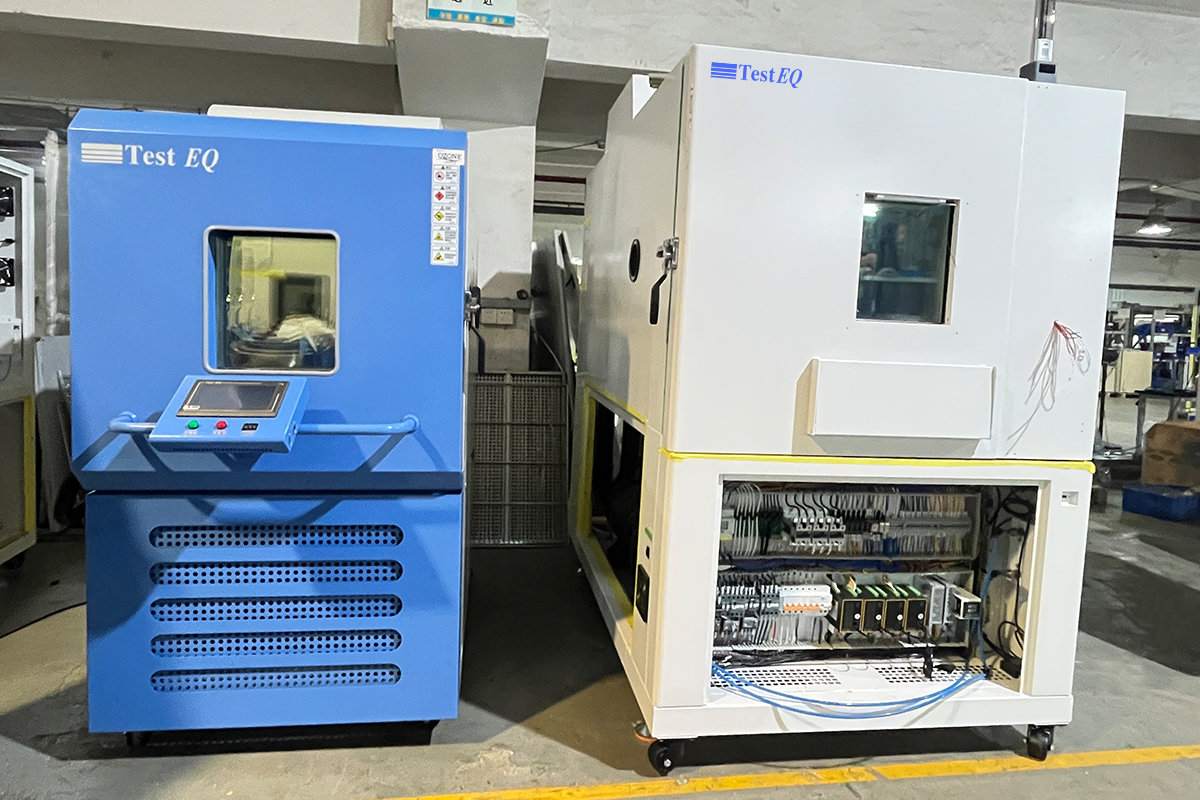
TestEQ designs and manufactures temperature humidity test chambers and customized environmental testing systems for semiconductor, electronic component and reliability testing laboratories.
For J-STD-020-related applications, TestEQ can configure temperature humidity chambers for controlled moisture conditioning according to the laboratory's specified test requirements.
Available configuration considerations include:
• Temperature and relative humidity control
• Programmable environmental test profiles
• Long-duration moisture conditioning operation
• Workspace and sample rack customization
• Temperature and humidity monitoring
• Data recording and export options
• Independent safety protection
• Customized chamber dimensions and system integration
TestEQ works with customers to define chamber capacity, environmental parameters, sample loading arrangements and control requirements according to their actual laboratory applications.
Important: TestEQ temperature humidity chambers support the environmental moisture conditioning stage. Reflow simulation and final MSL classification must be carried out using the appropriate reflow equipment, inspection methods and procedures specified by the applicable standard.
For customized chamber selection, engineers can provide the required temperature, RH, sample quantity, workspace dimensions and operating duration for technical evaluation.
Applications of J-STD-020 Moisture Sensitivity Classification
J-STD-020 is relevant to semiconductor package manufacturers, component suppliers, electronics manufacturers and reliability testing laboratories.
Typical application areas include:
• Integrated circuit (IC) package development
• Surface-mount semiconductor devices
• Semiconductor packaging and assembly
• Electronic component manufacturing
• Automotive electronics
• Consumer electronics
• Industrial electronic components
• Semiconductor quality control laboratories
• Package reliability and failure analysis laboratories
The MSL classification supports moisture-sensitive device handling and helps reduce the risk of moisture-related package damage during solder assembly.
Why Choose TestEQ for J-STD-020 Moisture Conditioning?
Selecting a temperature humidity chamber for semiconductor moisture conditioning requires more than choosing a standard environmental test chamber. Laboratories need equipment that can maintain specified temperature and relative humidity conditions, support long-duration operation and provide reliable environmental monitoring.
TestEQ is a manufacturer of environmental test chambers and customized reliability testing systems, providing engineering solutions for semiconductor, electronics and industrial testing applications.
Key reasons to consider TestEQ include:
Customized Chamber Engineering
Different semiconductor laboratories have different sample quantities, workspace requirements and environmental testing procedures. TestEQ can configure chamber dimensions, sample racks, control systems and other equipment features according to actual application requirements.
Temperature and Humidity Control
TestEQ temperature humidity chambers are designed for controlled environmental conditioning. Chamber configuration can be evaluated according to required temperature range, relative humidity, environmental stability and workspace uniformity.
Application-Oriented System Configuration
Rather than selecting equipment based only on nominal chamber volume, TestEQ considers the laboratory's test procedure, sample loading, operating duration and monitoring requirements when developing a chamber configuration.
Customized Equipment for Different Laboratory Requirements
For laboratories with specific installation conditions, sample arrangements or integration requirements, TestEQ can evaluate customized chamber dimensions, fixtures, shelves and control configurations.
Environmental Testing Equipment Manufacturing Experience
TestEQ designs and manufactures environmental test chambers and customized reliability testing systems for applications in semiconductor, automotive, electronics, aerospace and other industrial sectors.
Engineering Communication and Technical Support
TestEQ works with engineering and procurement teams to review application requirements, clarify technical specifications and recommend suitable equipment configurations before quotation.
Frequently Asked Questions About J-STD-020
1. What is the purpose of J-STD-020?
J-STD-020 establishes procedures for classifying the moisture/reflow sensitivity of non-hermetic surface-mount semiconductor packages. It helps determine the appropriate Moisture Sensitivity Level (MSL) for package handling and storage.
2. What does MSL mean in semiconductor packaging?
MSL stands for Moisture Sensitivity Level. It indicates the moisture sensitivity classification of a package and determines the applicable floor-life requirements under specified environmental and handling conditions.
3. How many MSL levels are defined in J-STD-020?
The MSL system includes Levels 1, 2, 2a, 3, 4, 5, 5a and 6. Each level has different moisture handling and floor-life requirements.
4. What is the difference between J-STD-020 and J-STD-033?
J-STD-020 defines the moisture/reflow sensitivity classification procedure for non-hermetic surface-mount devices. J-STD-033 addresses the handling, packing, shipping and use of moisture/reflow-sensitive devices, including moisture-barrier packaging and floor-life management.
5. Does J-STD-020 require a temperature humidity chamber?
A temperature humidity chamber is commonly used to provide the controlled moisture soak conditions required by the classification procedure. The chamber must be configured according to the applicable temperature, RH and exposure duration.
6. Can a temperature humidity chamber perform the complete J-STD-020 test?
Not by itself. The chamber supports the moisture conditioning stage. Reflow simulation requires suitable reflow equipment, while inspection and classification must follow the applicable standard procedures.
7. What is the difference between moisture soak and reflow simulation?
Moisture soak exposes semiconductor packages to specified temperature and humidity conditions so that they absorb moisture. Reflow simulation subsequently exposes the conditioned packages to a specified thermal profile to evaluate moisture-related damage.
8. What should engineers consider when selecting a J-STD-020 chamber?
Important considerations include temperature range, RH range, environmental stability, workspace uniformity, chamber capacity, continuous operating duration, programmable control, data logging and safety protection.
9. Is J-STD-020 the same as a general humidity reliability test?
No. J-STD-020 is specifically intended for moisture/reflow sensitivity classification of non-hermetic surface-mount devices. General damp heat or humidity reliability tests evaluate different environmental reliability objectives.
10. Which J-STD-020 edition should a laboratory follow?
Laboratories should verify the latest applicable edition and any relevant revisions through the official JEDEC or IPC standards sources. The test procedure, classification conditions and acceptance criteria should be based on the edition specified by the customer or qualification program.
Internal Linking Module
Related Standards
JESD22-A113 – Preconditioning of Nonhermetic Surface Mount Devices Prior to Reliability Testing
Description: Learn about semiconductor package preconditioning procedures before reliability testing, including moisture exposure and reflow simulation used to prepare surface-mount devices for subsequent qualification tests.
J-STD-033 – Handling, Packing, Shipping and Use of Moisture/Reflow Sensitive Surface Mount Devices
Description: Understand moisture-sensitive device handling requirements, including moisture-barrier packaging, floor-life control, storage conditions and baking procedures for semiconductor components.
IEC 60068-2-78 – Damp Heat, Steady State Testing
Description: Explore steady-state damp heat testing for evaluating the effects of high humidity and temperature on electronic components, materials and equipment.
Related Products
Temperature Humidity Test Chamber
Description: Designed for controlled temperature and relative humidity testing of semiconductor packages, electronic components and materials. Suitable for moisture conditioning and environmental reliability testing.
High Temperature Test Chamber
Description: Provides controlled high-temperature environments for semiconductor components, electronic materials and product reliability evaluation.
Rapid Temperature Change Test Chamber
Description: Designed for programmable temperature cycling and rapid temperature transition testing to evaluate thermal stress and reliability performance of electronic components.
CTA
J-STD-020 Temperature Humidity Chamber Solutions
Need a Temperature Humidity Chamber for J-STD-020 Moisture Conditioning?
TestEQ designs and manufactures customized temperature humidity chambers for semiconductor moisture conditioning and electronic component reliability testing.
Our engineering team can configure chamber capacity, temperature and humidity control, sample racks, programmable profiles and data monitoring according to your laboratory requirements.
Whether you need a standard chamber or a customized environmental testing solution, TestEQ can help evaluate the appropriate configuration for your application.
Send your testing requirements to our engineering team to discuss a suitable solution.
[Request a Custom Temperature Humidity Chamber →]