What Is JESD22-A113?
JESD22-A113, Preconditioning of Nonhermetic Surface Mount Devices Prior to Reliability Testing, is a JEDEC test method used to simulate the effects of typical multiple solder reflow operations on packaged semiconductor devices before reliability evaluation.
The method is intended for nonhermetic solid-state SMDs that undergo surface-mount assembly. Devices designed exclusively for socketed use fall outside the scope described in the standard.
The preconditioning sequence prepares packaged devices for subsequent reliability tests, helping manufacturers evaluate potential assembly-related damage before long-term reliability assessment.
The current published edition is JESD22-A113J (May 2026). Laboratories should consult the applicable official edition for the exact procedure, requirements, and referenced documents.
Why Is JESD22-A113 Preconditioning Important?
Preconditioning connects semiconductor package qualification with the thermal and moisture stresses associated with board assembly.
Without appropriate preconditioning, subsequent reliability results may not fully represent the effects of the intended assembly process.
Key objectives include:
• Simulating the thermal exposure associated with solder reflow.
• Evaluating the influence of package moisture on reflow-related damage.
• Preparing SMD samples for subsequent reliability qualification.
• Improving consistency between component manufacturing and board assembly conditions.
• Supporting failure analysis and reliability monitoring.
For component manufacturers and laboratories, the value of preconditioning lies in creating a controlled, documented starting condition for subsequent reliability testing.
Which Products Does JESD22-A113 Apply To?
JESD22-A113 is intended for nonhermetic solid-state surface mount devices that require preconditioning before reliability evaluation.
Typical applications include semiconductor packages used in:
• Automotive electronics and electronic control units.
• Power management integrated circuits.
• Analog and mixed-signal devices.
• Microcontrollers and processors.
• Memory and logic devices.
• Industrial electronic control systems.
• Communications and computing hardware.
The exact applicability depends on the device construction, intended mounting method, moisture sensitivity classification, and qualification plan.
JESD22-A113 should not be treated as a universal procedure for every electronic component. Confirm the applicable device category and requirements before defining the test sequence.
JESD22-A113 Preconditioning Procedure
The preconditioning workflow combines several controlled operations. The exact sequence and conditions must follow the applicable edition of JESD22-A113 and the relevant device classification.
Initial Inspection and Electrical Testing
Samples may undergo initial visual inspection and electrical testing to establish their baseline condition.
Record sample identification, device lot, applicable moisture sensitivity level (MSL), and initial test results so that any changes observed after conditioning can be assessed.
Optional Temperature Cycling
Where required by the applicable procedure, temperature cycling may be included as part of the preconditioning sequence.
The temperature limits, cycle count, dwell periods, and transfer requirements must be taken from the governing procedure rather than selected arbitrarily.
Dry Bake
Dry baking reduces moisture within the packaged device before subsequent moisture exposure.
The required temperature and duration depend on the applicable procedure and device requirements. Oven temperature uniformity, sample loading, airflow, and process records should be considered when selecting equipment.
Moisture Soaking
Moisture soaking exposes samples to specified temperature and humidity conditions to simulate moisture absorption before solder reflow.
This stage is particularly important for moisture-sensitive packages. The required soak condition depends on the applicable moisture sensitivity classification and the governing procedure.
A suitable temperature-humidity chamber should maintain the required environmental conditions throughout the exposure period and accommodate the sample fixtures without obstructing airflow.
Solder Reflow Simulation
Samples are exposed to the specified solder reflow profile to simulate the thermal stress associated with board assembly.
JESD22-A113 references the applicable reflow profiles in J-STD-020. The correct profile must be selected according to the applicable standard edition, package classification, and test plan.
A temperature-humidity chamber is not a substitute for a reflow oven. Reflow simulation generally requires suitable reflow equipment capable of reproducing and verifying the specified thermal profile.
Post-Conditioning Handling and Electrical Testing
After the specified conditioning sequence, samples proceed through the required handling, inspection, and electrical evaluation steps before subsequent reliability testing.
Depending on the procedure, additional operations may include flux application, cleaning, or drying.
Maintain traceable records of sample identity, process parameters, equipment, deviations, and electrical results.
JESD22-A113 Temperature and Humidity Requirements
Temperature and humidity control are important during the environmental conditioning stages of a JESD22-A113 workflow.
However, the standard should not be reduced to a single temperature or humidity setpoint. The actual requirements depend on the selected procedure, device classification, and applicable edition.
When evaluating an environmental chamber, engineers should consider:
Parameter | Engineering Consideration |
|---|---|
Temperature Range | Must cover the specified conditioning conditions. |
Relative Humidity | Must meet the required moisture-soak conditions. |
Temperature Uniformity | Helps maintain consistent exposure across the sample load. |
Humidity Uniformity | Supports repeatable moisture conditioning. |
Temperature and Humidity Stability | Limits unintended environmental variations during testing. |
Working Volume | Accommodates sample trays, fixtures, and the required sample load. |
Airflow | Supports consistent environmental conditions around loaded samples. |
Data Logging | Records temperature, humidity, and exposure duration. |
Calibration | Supports confidence in the accuracy of measured environmental conditions. |
Sample Traceability | Links conditioning records to device lots and subsequent test results. |
For procurement teams, chamber specifications should be evaluated under representative loaded conditions rather than relying exclusively on empty-chamber performance.
How to Select a JESD22-A113 Environmental Test Chamber
Selecting suitable equipment starts with identifying which parts of the preconditioning sequence the laboratory intends to perform in-house.
A temperature-humidity chamber may be appropriate for moisture soaking and other specified environmental conditioning stages. Dry baking and solder reflow simulation may require separate equipment, depending on the laboratory workflow.
Before requesting a quotation, define the following:
• Required temperature and relative humidity ranges.
• Sample quantity and loading configuration.
• Required exposure duration.
• Chamber working volume and sample fixture dimensions.
• Temperature and humidity uniformity requirements.
• Data logging and export requirements.
• Calibration and documentation expectations.
• Compatibility with laboratory sample-handling procedures.
• Applicable JESD22-A113 edition and associated test plan.
A clear equipment specification helps prevent overbuying, under-capacity, and mismatches between chamber capabilities and the laboratory's actual conditioning process.
JESD22-A113 and J-STD-020: What Is the Difference?
JESD22-A113 and J-STD-020 address different but closely related aspects of semiconductor package reliability.
• JESD22-A113: Defines preconditioning procedures for nonhermetic surface mount devices before subsequent reliability testing.
• J-STD-020: Establishes moisture/reflow sensitivity classification requirements and associated solder reflow profiles for applicable nonhermetic surface-mount devices.
In practice, J-STD-020 helps determine the applicable moisture sensitivity classification and reflow-related conditions, while JESD22-A113 defines the preconditioning sequence used before reliability evaluation.
For laboratory engineers, the key is to follow the applicable editions, device classification, and qualification plan rather than treating the two documents as interchangeable.
For equipment procurement, identify which stages require a temperature-humidity chamber, dry-bake oven, or solder reflow system before specifying the test setup.
What Environmental Test Equipment Does TestEQ Provide?
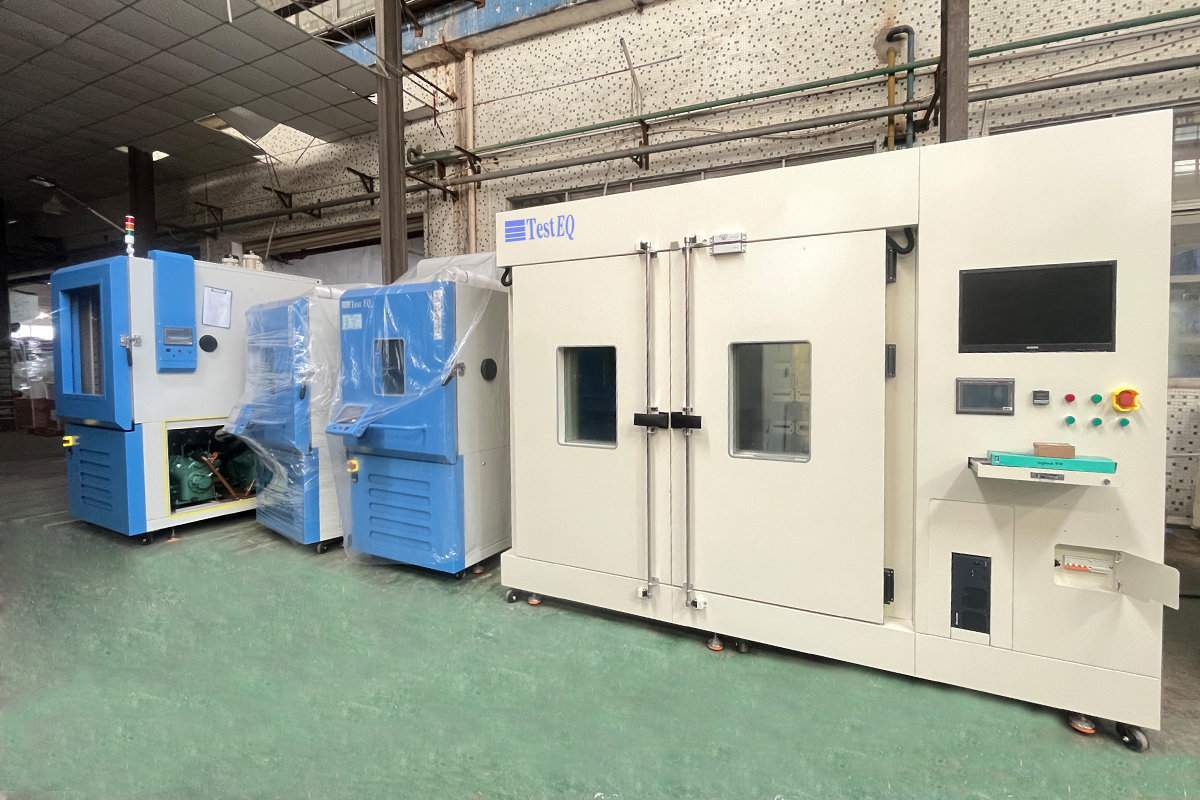
TestEQ provides configurable environmental simulation equipment for temperature and humidity conditioning applications used in electronics and reliability laboratories.
Depending on the project requirements, available chamber configurations can be evaluated for:
• Temperature and humidity conditioning.
• High- and low-temperature exposure.
• Controlled environmental soak testing.
• Custom working volumes and sample arrangements.
• Temperature and humidity monitoring.
• Programmable test profiles.
• Data recording and export.
• Customized cable access and laboratory integration.
For JESD22-A113 workflows, equipment selection should focus on the conditioning stages that require environmental control. Dry-bake and solder-reflow operations should be assessed separately where dedicated equipment is needed.
TestEQ chamber configuration should be confirmed against the laboratory's required conditions, sample load, instrumentation, and operating procedures. Equipment suitability does not itself establish compliance with the complete JEDEC test method.
Applications
JESD22-A113-related preconditioning supports semiconductor qualification and reliability programs in:
• Automotive semiconductor manufacturing.
• Integrated circuit design and production.
• Semiconductor packaging and assembly.
• Electronics component qualification.
• Reliability engineering laboratories.
• Failure analysis and quality assurance.
• Industrial and consumer electronics supply chains.
The method is particularly relevant when manufacturers need to evaluate whether simulated board-assembly stresses affect packaged-device reliability.
Why Choose TestEQ for Semiconductor Environmental Testing?
Selecting environmental test equipment requires more than matching temperature and humidity specifications. Laboratories also need to consider sample capacity, environmental stability, monitoring, and integration with their testing workflow.
TestEQ provides customized environmental simulation solutions for semiconductor and electronics reliability laboratories, with configurations tailored to specific testing requirements.
Application-Based Engineering: Chamber configurations based on required environmental conditions, sample dimensions, and test procedures.
Customized Chamber Design: Working volume, sample arrangement, and monitoring options tailored to laboratory needs.
Environmental Control: Temperature and humidity control options for applicable conditioning applications.
Laboratory Integration: Data logging, programmable profiles, and configuration options to support documented testing workflows.
Technical Consultation: Engineering discussions to help identify suitable equipment specifications before procurement.
For JESD22-A113 applications, TestEQ can help evaluate the environmental conditioning equipment required for your workflow, including temperature-humidity chambers for moisture soaking.
Contact TestEQ to discuss your semiconductor conditioning requirements.
Equipment selection should be verified against the applicable JEDEC edition and the complete laboratory test procedure.
FAQ: JESD22-A113 Preconditioning
1. What Is JESD22-A113 Preconditioning?
JESD22-A113 is a JEDEC test method for preconditioning nonhermetic surface mount devices (SMDs) before reliability testing. It simulates the effects of typical solder reflow assembly so that subsequent reliability evaluations can account for relevant moisture and thermal stresses. The applicable procedure should be selected according to the current standard edition and the device qualification plan.
2. What Is the Purpose of JESD22-A113 Testing?
The purpose is to prepare packaged semiconductor devices for subsequent reliability evaluation by simulating relevant stresses associated with surface-mount assembly. Preconditioning helps identify potential package damage, such as cracking or delamination, that may occur under moisture and reflow-related stresses. It does not replace the subsequent reliability tests required by the qualification plan.
3. What Is the Difference Between JESD22-A113 and J-STD-020?
JESD22-A113 defines the preconditioning process used before reliability testing, while J-STD-020 addresses moisture/reflow sensitivity classification for nonhermetic surface-mount devices and the associated reflow profile requirements. The two standards serve related but different purposes. Engineers should verify the applicable editions and device classification before establishing the preconditioning sequence.
4. Does JESD22-A113 Include Temperature and Humidity Testing?
The preconditioning workflow can include moisture soaking under specified temperature and relative humidity conditions, together with other preparation and reflow-related stages. The exact conditions depend on the applicable procedure and device moisture sensitivity classification. Laboratories should not assume that one temperature-humidity setting applies to every SMD package.
5. What Equipment Is Required for JESD22-A113 Preconditioning?
Equipment depends on the stages performed in the laboratory. A temperature-humidity chamber may be used for specified moisture-soak conditions, while dry baking and solder reflow simulation may require separate equipment. Depending on the test plan, laboratories may also need calibrated monitoring instruments, sample fixtures, data logging, and traceable process records.
6. How Do I Select a Temperature-Humidity Chamber for Semiconductor Preconditioning?
Select the chamber based on the required temperature and humidity range, sample quantity, working volume, exposure duration, environmental uniformity, data logging, and calibration requirements. Consider the chamber's performance under representative sample loading, not only its empty-chamber specifications. TestEQ can evaluate a customized configuration based on your laboratory's conditioning requirements.
7. How Does Moisture Sensitivity Level (MSL) Affect JESD22-A113?
The moisture sensitivity level helps determine the applicable handling and moisture exposure requirements for a nonhermetic surface-mount device. It is an important input when establishing the preconditioning sequence. Engineers should use the device's applicable classification and the governing standards to determine the required soak conditions and handling limits rather than relying on a generic recipe.
8. Can a Temperature-Humidity Chamber Perform the Complete JESD22-A113 Procedure?
Not necessarily. A temperature-humidity chamber can support specified environmental conditioning stages, but it does not automatically replace a dry-bake oven or a reflow system capable of reproducing the required solder reflow profile. Before purchasing equipment, define which stages must be performed in-house and evaluate each system against the applicable test procedure.
9. What Information Should I Provide When Requesting a JESD22-A113 Test Chamber Quote?
For an accurate equipment recommendation, provide the required temperature and relative humidity ranges, sample quantity, sample tray dimensions, exposure duration, working volume, monitoring requirements, data export needs, and applicable standard edition. It is also helpful to identify whether moisture soaking is the primary requirement or whether the laboratory needs equipment for additional conditioning stages. These details help TestEQ assess a suitable chamber configuration.
10. Does TestEQ Provide Customized Environmental Chambers for JESD22-A113 Applications?
TestEQ provides configurable temperature-humidity and environmental test chambers for semiconductor and electronics laboratory applications. Configurations can be evaluated according to the required environmental range, sample capacity, monitoring, data recording, and laboratory workflow. Final equipment suitability must be confirmed against the applicable JESD22-A113 procedure and the laboratory's complete preconditioning requirements.
Internal Linking Module
Related Resources
Semiconductor Preconditioning Guide
Learn how moisture exposure, drying and solder reflow simulation prepare surface-mount semiconductor devices for subsequent reliability testing.
Understand how temperature and humidity conditions affect electronic components and how engineers specify environmental conditioning requirements for laboratory testing.
Explore temperature uniformity, humidity stability, calibration and loaded-chamber performance when evaluating environmental equipment for repeatable laboratory testing.
Related Products
Explore configurable temperature-humidity chambers for controlled moisture exposure, environmental conditioning and electronics laboratory applications.
Review environmental chamber solutions for applications requiring controlled temperature transitions, repeatable thermal stress and reliability evaluation.
Discover configurable environmental test systems based on required temperature ranges, working volume, sample configuration, monitoring and laboratory integration.
Related Standards
Understand temperature cycling as a semiconductor reliability test method and its role in evaluating device durability under repeated temperature changes.
Learn how highly accelerated temperature-humidity stress testing supports semiconductor reliability assessment and how engineers evaluate the required test equipment.
J-STD-020 Moisture/Reflow Sensitivity Classification
Explore how moisture/reflow sensitivity classification relates to semiconductor package handling, reflow exposure and JESD22-A113 preconditioning workflows.
CTA
Need a Temperature-Humidity Chamber for JESD22-A113 Preconditioning?
TestEQ provides customized environmental test chambers for semiconductor and electronics reliability laboratories. Our systems can be configured for controlled temperature and humidity conditioning, moisture soaking, sample monitoring, and programmable test profiles.
When selecting a chamber for JESD22-A113-related applications, consider the required temperature and humidity ranges, sample capacity, exposure duration, environmental uniformity, and data logging requirements.
Share your test conditions and sample specifications with TestEQ to discuss a suitable chamber configuration for your laboratory workflow.
"Request a Custom Chamber Quote →"
Equipment selection should be verified against the applicable JESD22-A113 edition, device requirements, and laboratory test procedure.