What Is ECSS-E-ST-10-04?
ECSS-E-ST-10-04C Rev.1 is a European space engineering standard titled Space Environment, published on June 15, 2020.
Its purpose is to support consistent space environment engineering by describing relevant environmental conditions and providing methods, data and models for assessing their effects on space products.
The standard addresses two important categories:
Natural space environment: Environmental conditions arising from the physical environment in which a spacecraft operates.
Induced space environment: Conditions created or modified by the spacecraft, its operation or mission activities, such as contamination, spacecraft charging and secondary radiation.
The actual environment depends on the mission profile, orbit, spacecraft configuration, materials and operating conditions. Environmental assessment should therefore be based on mission-specific information rather than a generic assumption that all spacecraft experience the same conditions.
What Space Environments Do Spacecraft Encounter?
Thermal Environment
Spacecraft can experience substantial temperature variations as they move between direct solar illumination, shadow and different radiative conditions.
Thermal behavior depends on orbit, surface optical properties, spacecraft geometry, internal heat dissipation and thermal control design.
Potential engineering concerns include:
Temperature-sensitive electronics and payloads
Thermal expansion and contraction
Material and interface compatibility
Temperature-dependent component performance
Thermal control system effectiveness
Thermal balance between internal heat sources and radiative heat transfer
Thermal analysis helps establish expected operating temperatures and identify critical hardware locations. Environmental verification can then evaluate whether the hardware performs as required under the specified thermal conditions.
Vacuum Environment
The low-pressure environment of space changes heat transfer and can influence material behavior.
Under vacuum, gas convection becomes negligible compared with atmospheric conditions, making radiation and conduction through available thermal paths particularly important. Certain materials may also release volatile substances, potentially contaminating sensitive optical surfaces or instruments.
Engineers may need to consider:
Vacuum-compatible materials
Outgassing and contamination control
Thermal management under vacuum
Lubricant and mechanism behavior
Electrical interfaces and insulation
Pressure-dependent equipment performance
Thermal vacuum testing is useful when the verification objective requires controlled temperature and reduced pressure to be applied simultaneously.
Radiation and Energetic Particles
Solar activity, trapped radiation belts and galactic cosmic rays can expose spacecraft components to ionizing radiation and energetic particles.
Potential effects include electronic degradation, changes in semiconductor performance, single-event effects and cumulative radiation damage.
These risks generally require radiation-specific analysis and testing where applicable. A thermal vacuum chamber alone does not reproduce the full radiation environment of space.
Plasma and Spacecraft Charging
Interactions between a spacecraft and the surrounding plasma can produce electrical charging. Depending on the environment and spacecraft design, charging can create electrostatic discharge risks or interfere with sensitive electronics.
Assessment may need to consider conductive paths, surface materials, electrical bonding and mission-specific charging conditions.
Atomic Oxygen, Micrometeoroids and Space Debris
In relevant low Earth orbit environments, atomic oxygen can degrade susceptible surface materials. Micrometeoroids and orbital debris can cause erosion, impact damage or penetration.
These hazards require appropriate material selection, shielding, environmental analysis or specialized testing. They should not be assumed to be fully represented by conventional temperature or vacuum testing.
Why Space Environment Analysis Matters
Space environment analysis helps engineers establish the conditions a product may encounter throughout its mission.
A typical engineering process includes:
Define the mission, orbit and operating duration.
Identify relevant natural and induced environmental factors.
Select appropriate environmental data, models and assumptions.
Assess potential effects on spacecraft hardware.
Establish design margins and mitigation measures.
Define verification objectives and project-specific acceptance criteria.
Plan suitable analysis, inspection and environmental testing.
The resulting requirements provide a technical basis for selecting materials, designing thermal control systems and developing the pre-launch verification programme.
Why Is Thermal Vacuum Testing Important?
Thermal vacuum testing helps engineers evaluate spacecraft hardware under controlled temperature and pressure conditions representative of specified mission environments.
Compared with testing at atmospheric pressure, a thermal vacuum test can reveal issues associated with the combination of temperature and reduced pressure.
Depending on the project specification, the test programme may evaluate:
• Hardware operation across specified temperature limits
• Functional performance during thermal exposure
• Temperature-dependent electrical behavior
• Thermal stability and temperature distribution
• Component or assembly behavior under vacuum
• Thermal balance characteristics, where required
• Potential workmanship or design issues before launch
Thermal vacuum testing does not reproduce every aspect of the space environment. Radiation, atomic oxygen, plasma interactions and impact hazards require separate assessment or specialized verification when applicable.
The applicable temperature limits, pressure levels, cycle counts, stabilization criteria and acceptance requirements must be established from the mission analysis and project test documentation.
ECSS-E-ST-10-04 vs. ECSS-E-ST-10-03C Rev.1
These standards address complementary stages of spacecraft environmental engineering.
ECSS-E-ST-10-04C Rev.1 — Space Environment supports the characterization and modeling of environmental conditions relevant to space products.
ECSS-E-ST-10-03C Rev.1 — Testing establishes requirements for ground verification by testing of space segment elements and space segment equipment before launch.
Their relationship can be summarized as:
Mission Environment → Environmental Analysis → Verification Requirements → Test Specification → Environmental Testing → Test Results
For example, a mission-specific thermal analysis may identify critical temperature conditions for a satellite payload. The project verification programme then determines how those conditions should be assessed through thermal vacuum testing, thermal testing at mission pressure or other applicable methods.
The standards should not be treated as interchangeable. ECSS-E-ST-10-04 addresses the environment; ECSS-E-ST-10-03C Rev.1 addresses the testing framework.
How to Select a Thermal Vacuum Test Chamber
For procurement teams and laboratory engineers, the chamber should be selected against the actual verification requirements rather than a generic claim of ECSS compliance.
Important specification items include:
Working volume: Dimensions and mounting space required for the test article.
Temperature range: Required hot and cold conditions.
Vacuum capability: Target pressure, pump-down performance and pressure stability.
Thermal control: Temperature stability, uniformity and required thermal profiles.
Thermal balance: Additional capability when specified by the verification programme.
DUT interfaces: Electrical, signal, RF or other feedthroughs.
Instrumentation: Temperature sensors, pressure gauges and monitoring channels.
Data acquisition: Recording of environmental conditions and DUT performance.
Test control: Programmable sequences, alarms and interlocks.
Documentation: Calibration, measurement traceability and equipment acceptance records.
The chamber configuration should reflect the hardware's dimensions, thermal load, operating modes and measurement requirements. The specific verification programme determines which capabilities are essential.
What Thermal Vacuum Testing Solutions Does TestEQ Provide?
TestEQ provides configurable environmental simulation equipment for aerospace, electronics and reliability testing applications.
Depending on project requirements, thermal vacuum chamber configurations can be developed around:
Controlled temperature and vacuum environments
Thermal cycling under vacuum
Custom chamber dimensions and DUT fixtures
Electrical and signal feedthroughs
Temperature and pressure monitoring
Data acquisition and programmable test sequences
Thermal balance applications where specified
For ECSS-based projects, the equipment specification should be derived from the applicable standard, mission requirements and customer test documentation. A chamber supplier should evaluate the complete test profile rather than assume that one configuration satisfies every spacecraft verification programme.
Applications
ECSS space environment analysis and associated environmental verification can be relevant to:
• Satellite development and manufacturing
• Spacecraft payloads and scientific instruments
• Aerospace electronics and avionics
• Optical and imaging systems
• Space mechanisms and electromechanical assemblies
• Satellite communication equipment
• Spacecraft thermal control hardware
• Research laboratories and qualification facilities
The applicable environmental assessment and test methods depend on the mission, product configuration and project requirements.
Why Choose TestEQ for Space Environmental Testing?
TestEQ provides customized environmental simulation systems for engineering, reliability testing and laboratory applications. Our solutions can be configured around project-specific temperature profiles, vacuum requirements, DUT dimensions, instrumentation and test procedures.
With in-house manufacturing capabilities and environmental testing engineering experience, TestEQ works with customers to define chamber specifications based on their actual verification needs.
For spacecraft components, satellite payloads and aerospace electronics, our team can help evaluate thermal vacuum chamber configurations, measurement interfaces and environmental control requirements.
Looking for a thermal vacuum test chamber for your aerospace project? Share your test specification with TestEQ to discuss a suitable system configuration.
Frequently Asked Questions About ECSS-E-ST-10-04 and Space Environment Testing
1. What Is ECSS-E-ST-10-04?
ECSS-E-ST-10-04C Rev.1 is the European space engineering standard for space environment characterization. It addresses natural and induced space environments to support spacecraft design, environmental analysis and verification planning. It helps engineers identify mission-related environmental conditions that may affect spacecraft equipment and determine appropriate mitigation and verification measures.
2. What Space Environments Must Spacecraft Withstand?
Depending on the mission and orbit, spacecraft may encounter high vacuum, extreme thermal conditions, solar radiation, energetic particles, plasma, atomic oxygen, micrometeoroids and orbital debris. Spacecraft-generated effects, such as contamination and electrical charging, may also require assessment. The relevant environmental conditions should be identified through mission-specific analysis rather than assuming that every spacecraft faces the same exposure.
3. What Is the Difference Between ECSS-E-ST-10-04 and ECSS-E-ST-10-03C Rev.1?
ECSS-E-ST-10-04C Rev.1 addresses space environment characterization and modeling, while ECSS-E-ST-10-03C Rev.1 addresses ground testing of space segment elements and equipment. In a spacecraft verification programme, environmental analysis helps establish the conditions to be considered, while the applicable testing requirements and project specifications determine how the hardware is verified before launch.
4. Why Is Thermal Vacuum Testing Important for Spacecraft?
Thermal vacuum (TVAC) testing evaluates spacecraft hardware under controlled temperature and reduced-pressure conditions. It helps engineers assess thermal behavior, functional performance and potential issues associated with operating in a vacuum environment. TVAC testing is particularly relevant when atmospheric pressure would not adequately represent the intended operating environment. Test conditions and acceptance criteria must be defined by the applicable verification programme.
5. Does ECSS-E-ST-10-04 Specify Thermal Vacuum Test Temperature and Pressure?
ECSS-E-ST-10-04 is a space environment standard, not a universal thermal vacuum test procedure. It does not establish one temperature range, vacuum level or test duration suitable for every spacecraft. Engineers should derive the required test conditions from mission analysis, applicable verification and testing standards, equipment operating limits and project-specific requirements.
6. Can a Thermal Vacuum Chamber Reproduce the Complete Space Environment?
No. A thermal vacuum test chamber can reproduce specified temperature and reduced-pressure conditions, but it does not automatically reproduce radiation, plasma interactions, atomic oxygen exposure or micrometeoroid impacts. These environmental hazards may require separate analysis, specialized facilities or dedicated verification methods. The overall test programme should reflect the spacecraft's mission profile and identified risks.
7. How Do Engineers Determine the Thermal Vacuum Test Conditions?
Engineers typically consider the mission orbit, predicted thermal environment, hardware operating limits, internal heat dissipation, thermal control design and required verification objectives. The resulting test specification may define temperature limits, target pressure, thermal cycles, stabilization criteria, functional monitoring and acceptance requirements. These parameters should be approved through the project's verification process rather than selected from a generic chamber specification.
8. How Do You Select a Thermal Vacuum Test Chamber for Space Hardware?
Selecting a TVAC chamber requires evaluating the DUT dimensions and weight, temperature range, target vacuum level, thermal load, required temperature profiles, pumping performance, instrumentation and electrical feedthroughs. Engineers should also consider temperature measurement accuracy, data acquisition, test control and equipment integration. The final chamber configuration should match the actual test profile and project requirements.
9. What Information Should Buyers Provide When Requesting a TVAC Chamber Quotation?
For a meaningful quotation, procurement teams should provide the DUT dimensions and weight, required temperature range, target pressure, thermal load, test duration, temperature profile, electrical or signal feedthrough requirements and applicable project specification. Details about instrumentation, control interfaces and documentation requirements are also useful. These inputs help the supplier assess chamber volume, refrigeration capacity, vacuum-system configuration and measurement interfaces.
10. Can TestEQ Provide a Thermal Vacuum Test Chamber for ECSS-Based Space Projects?
TestEQ provides configurable environmental simulation equipment for aerospace and reliability testing applications, including thermal vacuum chamber solutions. Depending on the project requirements, configurations can be evaluated for temperature control, reduced-pressure operation, DUT interfaces, instrumentation and data acquisition. Customers should provide their applicable ECSS requirements and test specification so the proposed system can be assessed against the intended verification programme. Equipment suitability and compliance must be confirmed against the specific project requirements; a chamber should not be assumed to be ECSS-compliant solely because it can perform thermal vacuum testing.
Need a Thermal Vacuum Test Chamber? Contact TestEQ with your DUT specifications and test requirements to discuss a suitable system configuration.
Internal Linking Module
Related Standards
Explains the ground testing and verification requirements used to demonstrate that spacecraft equipment meets applicable project specifications. It complements ECSS-E-ST-10-04 by connecting space environment analysis with practical environmental testing.
Learn how NASA GEVS addresses environmental verification of spacecraft payloads, subsystems and components, including thermal vacuum testing and project-specific acceptance requirements.
Understand low-air-pressure testing methods for products exposed to reduced atmospheric pressure. This provides useful context when distinguishing terrestrial low-pressure testing from spacecraft thermal vacuum verification.
Related Products
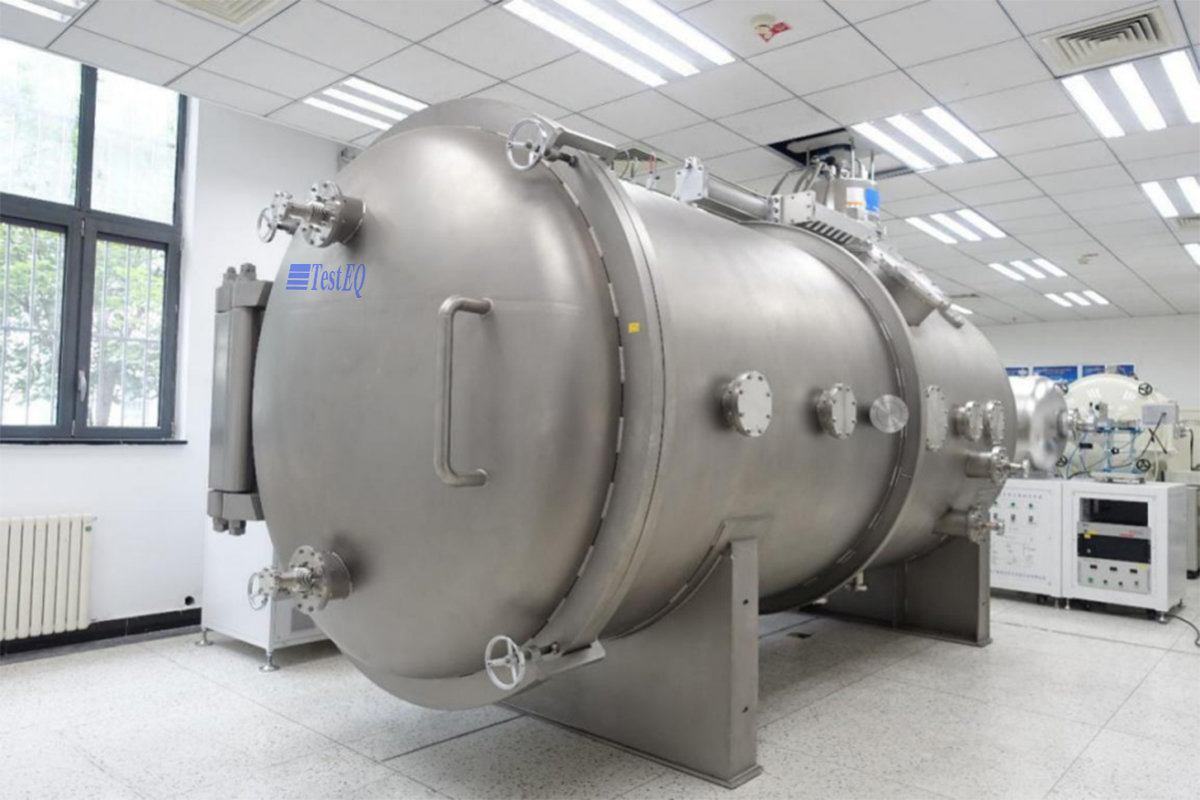
Designed for controlled temperature and vacuum testing of spacecraft components, satellite payloads and aerospace electronics.
Provides controlled environmental conditions for evaluating component performance and reliability under specified temperature and humidity requirements.
Supports testing applications that require controlled rapid temperature transitions to evaluate thermal stress and product durability.
Related Resources
Learn how temperature range, vacuum level, stabilization time and instrumentation influence a spacecraft thermal vacuum test programme.
Compare thermal vacuum and altitude test chambers, understand their differences in pressure control, temperature simulation, and testing applications, and choose the right system for your aerospace or environmental reliability testing requirements.
Identify key chamber specifications, including working volume, temperature range, vacuum capability, thermal load and instrumentation interfaces.
CTA:
Need a Thermal Vacuum Test Chamber for Space Hardware?
TestEQ provides customized thermal vacuum test chambers for spacecraft components, satellite payloads and aerospace electronics.
Our systems can be configured to meet project-specific requirements for temperature range, vacuum level, thermal load, DUT dimensions and data acquisition.
Whether you are planning spacecraft environmental verification or developing a new aerospace testing laboratory, TestEQ can help evaluate a suitable chamber configuration based on your test specifications.
"Request a Custom TVAC Chamber Quote →"
Contact TestEQ with your DUT specifications and test requirements to discuss your application.
Contact TestEQ
Final chamber configuration should be determined according to the applicable ECSS requirements and project-specific test specifications.