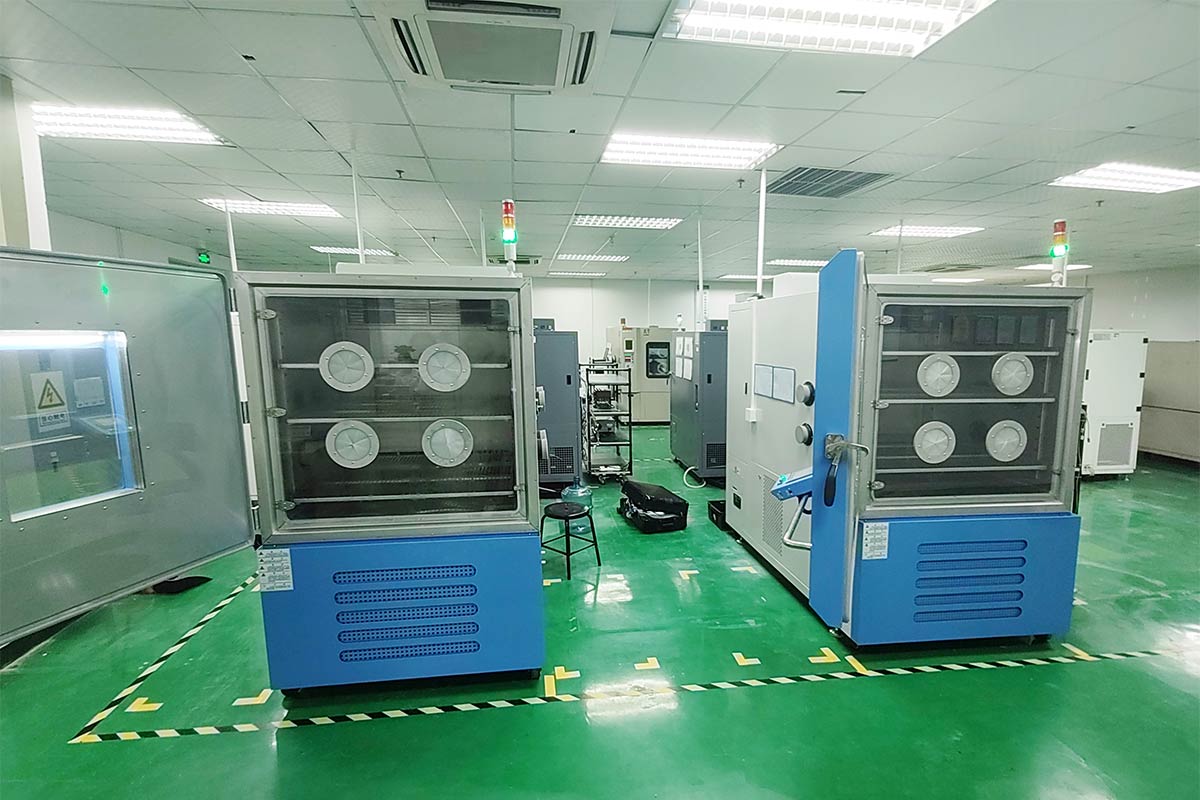
I. Temperature & Humidity Chamber
The temperature and humidity test chamber is the most commonly used type of environmental test chamber, mainly used to simulate the working performance of products under different temperature and humidity conditions. By precisely controlling the temperature and humidity environment, electronic components, automotive parts and new energy products can undergo cycle tests from high temperature and high humidity to low temperature and low humidity, thereby verifying their reliability.
Application scenarios:
Electronics industry: High-temperature and high-humidity reliability testing of PCBs, circuit boards and electronic components.
Automotive industry: Performance verification of in-vehicle electronics and plastic components in humid or dry environments.
New Energy and Batteries: Temperature and humidity cycle testing of battery energy storage systems to ensure safety and stable performance.
Technical features:
Modern temperature and humidity chambers are equipped with high-precision sensors and intelligent control systems, achieving temperature accuracy of ±0.5°C and humidity accuracy of ±2%RH, meeting the testing requirements of standards such as IEC, MIL, and ISO.
II. Thermal Shock Chamber
Thermal shock test chambers are used to simulate the reliability testing of products under rapid temperature change conditions. They are typically divided into single-chamber and two-chamber types. The two-chamber thermal shock chamber achieves rapid temperature changes by quickly switching between the high-temperature zone and the low-temperature zone, thereby exposing potential fault points.
Application scenarios:
Aerospace: Temperature cycling adaptability testing of satellite electronic devices and spaceflight components.
Automotive electronics: Stability verification of control modules and sensors in alternating cold and hot environments.
Consumer electronics: Rapid temperature cycling tests for smart phones, laptops and wearable devices.
Technical features:
The rapid heating and cooling capacity can reach 10–25°C/min, combined with an intelligent control system to achieve precise control of the temperature curve, ensuring that the test data is scientifically reliable.
III. Rapid Temperature Change / ESS Chamber
The **Rapid Temperature Change Test Chamber (ESS)** is a high-frequency application of thermal shock chambers, emphasizing the speed of temperature change and the number of cycles. It is mainly used for accelerating product aging and reliability assessment. It can complete multiple temperature cycles in a short time, reducing the R&D and testing cycle.
Application scenarios:
Reliability testing of large quantities of electronic components
Rapid aging test for batteries and energy storage products
Life assessment of aerospace components and parts
Technical features:
Optimized refrigeration and heating systems, along with improved air duct design, can achieve uniformity and repeatability in temperature cycling, while reducing thermal stress concentration and enhancing test accuracy.
IV. High-Low Temperature Chamber
High and low temperature test chambers are mainly used to verify the performance of products under extreme temperature conditions, with a temperature range generally reaching from -70°C to +180°C. Their core function is to ensure that electronic devices, automotive parts, aerospace components and new energy products can operate normally in extreme environments.
Application scenarios:
High and low temperature adaptability test for aerospace components
Reliability verification of automotive electronic control modules and batteries under extreme climate conditions
Long-term stability testing of consumer electronics and industrial electronics under high and low temperatures
Technical features:
The high and low temperature chamber is equipped with a high-efficiency refrigeration and heating system, combined with an intelligent temperature control algorithm, to achieve constant temperature and linear cooling, ensuring a stable and reliable test environment.
V. Key Factors for Selecting Environmental Test Chambers
When enterprises purchase environmental test chambers, they should pay close attention to the following indicators:
The accuracy of temperature and humidity control: directly affects the reliability of test data.
Ramp rate: It determines the test efficiency, especially for thermal shock and rapid temperature change.
Box capacity and space: It is necessary to match the product size and batch demand.
Intelligent control system: Supports curve editing, data recording and remote monitoring.
Industry standard compliance: Conforms to international standards such as IEC, MIL, and ISO.
VI. Future Development Trends
With the shortening of industrial product development cycles and the increasing requirements for reliability, the development of environmental test chambers shows the following trends:
Intelligence and Automation: Remote Monitoring, Automated Testing, Intelligent Data Analysis
High precision and high speed: rapid temperature change, high repeatability and control of minute temperature differences
Energy conservation and environmental protection: Optimize the refrigeration system to reduce energy consumption.
Modularization and scalability: Flexibly combine functional modules according to different testing requirements.