What Is an ESD Safe Thermal Cycling Chamber?
An ESD Safe Thermal Cycling Chamber is a specialized environmental test chamber designed to perform repeated temperature cycling tests while maintaining strict electrostatic discharge (ESD) control throughout the testing process.
Unlike conventional thermal cycling chambers, an ESD protected thermal cycling chamber integrates anti-static materials, grounding systems, electrical protection designs, and controlled testing environments to minimize the risk of electrostatic damage to sensitive electronic components during temperature variation tests.
During thermal cycling testing, products are exposed to repeated temperature changes between high and low temperature conditions to evaluate reliability, durability, and potential failure mechanisms. However, many modern electronic devices, including semiconductor components, IC packages, communication modules, automotive electronics, and battery control systems, are highly sensitive to electrostatic discharge. Even a small static discharge can cause latent damage, performance degradation, or unexpected product failures.
An ESD safe thermal cycling chamber provides a controlled environment where engineers can evaluate thermal reliability while reducing electrostatic risks.
How Does an ESD Safe Thermal Cycling Chamber Work?
An ESD controlled thermal cycling chamber combines temperature cycling technology with electrostatic protection systems.
The main working principles include:
1. Temperature Cycling Control
The chamber creates controlled temperature transitions according to defined test requirements, such as:
High temperature exposure
Low temperature exposure
Temperature ramp changes
Repeated thermal cycles
These conditions simulate real-world environmental stresses and help identify:
Component fatigue
Material expansion and contraction failures
Solder joint reliability issues
Electronic performance degradation
2. Electrostatic Discharge Protection System
To protect sensitive devices during testing, ESD safe thermal cycling chambers typically include:
Conductive interior materials
Anti-static fixtures and shelves
Reliable grounding systems
ESD-safe connection interfaces
Static monitoring solutions
These designs help control electrostatic potential differences between:
Test specimens
Chamber surfaces
Testing equipment
Operators
3. Controlled Testing Environment
Electronic reliability testing requires stable environmental conditions. An ESD protected thermal cycling chamber maintains:
Accurate temperature control
Stable airflow circulation
Controlled humidity conditions
Reliable grounding performance
This allows engineers to obtain repeatable and accurate thermal cycling test results.
Why Is ESD Protection Important During Thermal Cycling Testing?
Modern electronic products are becoming smaller, faster, and more sensitive. Semiconductor devices, communication equipment, and automotive electronics can be vulnerable to electrostatic events during reliability testing.
Without proper ESD protection, thermal cycling tests may introduce additional risks, including:
Semiconductor damage
IC performance degradation
False failure analysis results
Reduced product reliability
By integrating ESD protection into thermal cycling systems, manufacturers can ensure that failures are caused by environmental stress rather than uncontrolled electrostatic interference.
Applications of ESD Safe Thermal Cycling Chambers
ESD controlled thermal cycling chambers are widely used in industries requiring high reliability testing, including:
Semiconductor Reliability Testing
Used for:
IC packages
Semiconductor devices
Electronic modules
Wafer-level components
Common related standards:
JESD22-A104 Temperature Cycling Test
JESD22 reliability test methods
Telecommunications Equipment Testing
Used for:
5G communication devices
Network equipment
Electronic control modules
ESD protection helps maintain test accuracy for high-density electronic systems.
Automotive Electronics Testing
Used for:
ECU
Sensors
Battery management systems (BMS)
Power electronics
Thermal cycling combined with ESD control helps validate long-term reliability under harsh operating conditions.
ESD Safe Thermal Cycling Chamber vs Standard Thermal Cycling Chamber
| Feature | Standard Thermal Cycling Chamber | ESD Safe Thermal Cycling Chamber |
|---|---|---|
| Temperature cycling | Yes | Yes |
| Thermal reliability testing | Yes | Yes |
| ESD protection | Limited | Integrated |
| Anti-static materials | Optional | Standard design |
| Grounding system | Basic | Dedicated ESD grounding |
| Semiconductor testing suitability | Limited | High |
For applications involving sensitive electronic components, an ESD protected thermal cycling chamber provides a safer and more reliable testing solution.
Competitive Advantages vs Conventional Chambers
Compared with standard thermal cycling chambers, TestEQ’s solution offers:
Integrated ESD protection (not optional add-on)
Higher reliability for sensitive electronics
Reduced false failure rates caused by static discharge
Compliance with Huawei-level supplier requirements
Faster ROI through reduced testing errors and rework
Most conventional chambers focus only on temperature performance, ignoring electrostatic risks—this creates a gap in reliability validation for advanced electronics.
Core Technical Capabilities
High-Speed Thermal Cycling Performance
Temperature range: -70°C to +180°C
Ramp rate: up to 15–25°C/min
Uniformity: ≤ ±2.0°C
Fluctuation: ≤ ±0.5°C
This enables accelerated failure detection and significantly shortens product validation cycles. Rapid thermal cycling chambers are widely used to simulate extreme environmental stress and reveal latent defects early in the product lifecycle .
Anti-Static (ESD-Safe) Chamber Design
To meet Huawei-level requirements, the chamber integrates:
Full chamber grounding system
Anti-static interior materials (ESD-safe lining)
Controlled humidity environment to suppress static buildup
ESD-safe cable interfaces and test ports
Optional ionization neutralization system
These features ensure that electrostatic voltage remains within safe limits, preventing damage to sensitive ICs, PCBs, and RF modules during testing.
Precision Control for Semiconductor Testing
PID intelligent temperature control
High-resolution sensors for accurate feedback
Stable airflow design for uniform heat distribution
Repeatable thermal profiles for batch validation
This level of precision is essential for semiconductor and telecom applications, where even minor thermal deviation can affect reliability results.
Related Standards for ESD Thermal Cycling Testing
ESD safe thermal cycling applications are commonly associated with:
IEC 60068-2-14
Environmental testing standard for temperature change testing.
JESD22-A104
Temperature cycling reliability testing method for semiconductor devices.
ANSI/ESD S20.20
Standard for developing an electrostatic discharge control program.
MIL-STD-1686
Electrostatic discharge control requirements for military applications.
TestEQ ESD Safe Thermal Cycling Chamber Solution
TestEQ provides customized ESD safe thermal cycling chamber solutions for semiconductor, telecommunications, automotive electronics, and high-reliability product testing.
The systems can be configured with:
ESD-safe chamber interiors
Grounding protection systems
Precision temperature control
Customized fixtures
Reliability testing solutions based on IEC, JESD22, and other industry requirements
For electronics manufacturers requiring accurate thermal cycling validation with electrostatic protection, an ESD controlled thermal cycling chamber provides a reliable solution for improving product quality and reducing field failures.
Why Huawei-Level Compliance Matters for Your Business
Meeting Huawei’s ESD requirements is not just a technical upgrade—it is a market access strategy.
Suppliers that can demonstrate:
Controlled ESD testing environment
Standard-compliant validation processes
High repeatability and traceability
are significantly more competitive in:
Telecom supply chains
Semiconductor manufacturing
High-end electronics OEM projects
Cutting-Edge Technology Meets Industry-Specific Demands
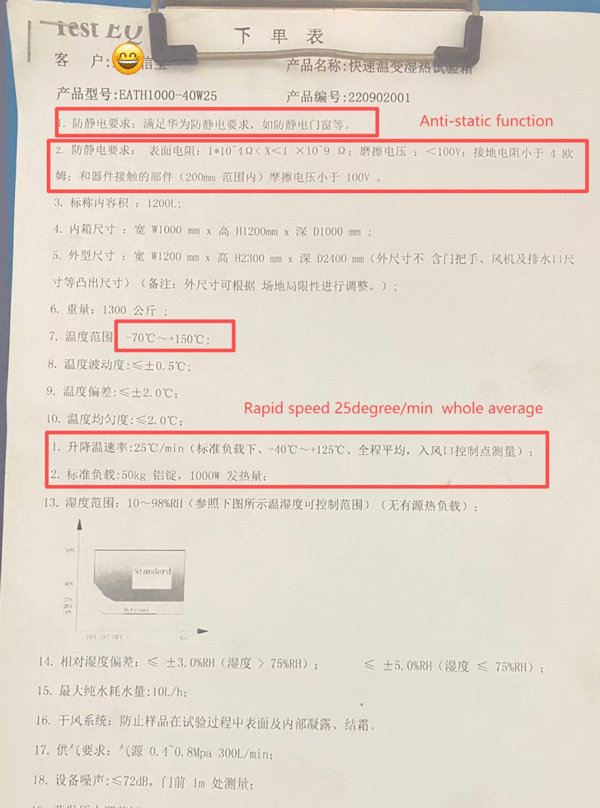
TESTEQ, a pioneer in high-precision environmental testing equipment, has unveiled its advanced anti-static rapid thermal cycling test chambers, engineered to meet the stringent requirements of industries ranging from consumer electronics to aerospace. With Huawei’s anti-static standards as a benchmark—including surface resistance (1×10⁴Ω < X < 1×10⁹Ω), friction voltage (<100V), and grounding resistance (<4Ω)—TESTEQ’s solutions ensure unparalleled reliability for sensitive components.
FAQ: ESD Safe Thermal Cycling Chamber
1. What is an ESD safe thermal cycling chamber?
An ESD safe thermal cycling chamber is an environmental test chamber designed to perform temperature cycling tests while controlling electrostatic discharge (ESD) risks. It combines precise temperature change capability with anti-static materials, grounding systems, and ESD protection features to protect sensitive electronic components during reliability testing.
2. Why is ESD protection important during thermal cycling testing?
ESD protection is important because semiconductor devices, IC components, communication modules, and electronic assemblies can be damaged by electrostatic discharge during environmental testing. An uncontrolled electrostatic environment may cause component failure, hidden defects, or inaccurate reliability test results.
3. What industries use ESD protected thermal cycling chambers?
ESD protected thermal cycling chambers are widely used in semiconductor, telecommunications, automotive electronics, aerospace, consumer electronics, and research laboratories. These industries require controlled thermal stress testing while protecting sensitive electronic devices from electrostatic damage.
4. What are the key features of an ESD safe thermal cycling chamber?
A typical ESD safe thermal cycling chamber includes conductive interior materials, reliable grounding systems, anti-static fixtures, ESD monitoring capability, precise temperature control, and safety protection functions. These features help maintain a stable testing environment for high-value electronic products.
5. Which standards are related to ESD thermal cycling testing?
ESD thermal cycling tests may involve multiple reliability and environmental testing standards, including IEC 60068-2-14 for temperature change testing, JESD22-A104 for semiconductor temperature cycling tests, ANSI/ESD S20.20 for electrostatic discharge control programs, and MIL-STD-1686 for ESD control requirements.
6. What is the difference between a standard thermal cycling chamber and an ESD safe thermal cycling chamber?
A standard thermal cycling chamber focuses mainly on temperature variation performance, while an ESD safe thermal cycling chamber adds electrostatic discharge protection features. ESD models are designed for sensitive electronic components where static electricity could affect product reliability or test accuracy.
7. Can an ESD thermal cycling chamber be customized for semiconductor and electronics testing?
Yes. ESD thermal cycling chambers can be customized according to product requirements, including chamber size, temperature range, cycling rate, ESD protection level, grounding configuration, test fixtures, monitoring systems, and integration with automated reliability testing platforms.
8. How does an ESD safe thermal cycling chamber improve product reliability testing?
An ESD safe thermal cycling chamber provides a controlled environment that combines thermal stress testing with electrostatic protection. This helps engineers identify potential failures caused by temperature changes while reducing the risk of ESD-related damage, improving the accuracy and repeatability of reliability validation.
Internal Linking Module
Recommended Equipment
Recommended Equipment for ESD Protected Thermal Cycling Testing
Explore TestEQ environmental testing systems designed for semiconductor, electronics, automotive and high-reliability product validation.
TestEQ Thermal Cycling Chamber provides precise temperature cycling control for reliability validation of electronic components, semiconductor devices and communication equipment. It supports demanding thermal cycling applications with stable temperature performance.
2. Temperature Humidity Chamber
Temperature Humidity Chambers simulate combined temperature and humidity conditions to evaluate electronic product durability, corrosion resistance and long-term reliability under environmental stress.
ESS Test Chambers are designed for accelerated stress screening to identify early product defects in electronics, automotive components and semiconductor-related applications before mass production.
Related Standards
Related Reliability Testing Standards
Understanding international reliability standards helps engineers select the correct environmental testing method and chamber configuration.
1. IEC 60068 Environmental Testing Standard
IEC 60068 defines internationally recognized environmental testing methods, including temperature change, humidity, cold and heat tests for electronic and industrial products.
2. JESD22 Thermal Cycling Test Standard
JESD22 thermal cycling standards are widely used in semiconductor reliability testing to evaluate package durability, thermal stress resistance and component lifetime.
3. ANSI/ESD S20.20 ESD Control Standard
ANSI/ESD S20.20 provides requirements for electrostatic discharge control programs to protect sensitive electronic devices during manufacturing and testing processes.
Related Resources
Related Technical Resources
Learn more about thermal cycling methods, reliability testing strategies and environmental chamber selection for engineering applications.
1. Thermal Cycling Test Guide: Procedure, Standards and Applications
This guide explains thermal cycling test principles, common procedures, applicable standards and how thermal cycling testing helps identify reliability risks in electronic products.
2. Thermal Shock vs Thermal Cycling: Key Differences and Applications
Learn the differences between thermal shock and thermal cycling tests, including temperature change rates, failure mechanisms and suitable applications for each method.
3. Semiconductor Reliability Testing Guide
This resource covers major semiconductor reliability testing methods, including thermal cycling, humidity testing and accelerated stress testing for electronic components.
Call to Action:
Need an ESD Safe Thermal Cycling Chamber Solution?
Reliable thermal cycling testing requires more than temperature control. For semiconductor, telecom, automotive electronics and high-reliability products, ESD protection is critical to prevent electrostatic damage and ensure accurate reliability test results.
TestEQ provides customized ESD safe thermal cycling chambers with anti-static materials, grounding systems, precise temperature control and reliability testing solutions based on your application requirements.
Whether you need a standard thermal cycling chamber or a customized ESD-controlled environmental test system, our engineering team can help you select the right solution.