What Is ECSS-E-ST-10-03C Rev.1?
ECSS-E-ST-10-03C Rev.1 is the ECSS standard for Testing within the European space engineering framework.
It defines requirements for performing verification by testing on space segment elements and space segment equipment before launch. The standard covers the organization and execution of test activities rather than defining a single universal test condition for every spacecraft or mission.
The standard applies to different test models and verification stages, including:
Qualification models
Flight models tested at acceptance level
Protoflight models
Environmental tests
Functional tests
Performance tests
Qualification testing
Acceptance testing
Protoflight testing
The applicable requirements are intended to be tailored to the characteristics and constraints of the specific space project.
Does ECSS-E-ST-10-03C Rev.1 Cover Thermal Vacuum Testing?
Yes. ECSS-E-ST-10-03C Rev.1 specifically includes requirements applicable to thermal vacuum testing.
The standard contains a dedicated section addressing thermal vacuum tests and thermal tests at mission pressure.
For space segment equipment that will operate in a non-vacuum environment after exposure to vacuum, the standard specifies that both thermal vacuum testing and thermal testing at the applicable mission pressure are to be considered.
This is important for engineers because a thermal vacuum test should not be treated simply as a chamber temperature-and-pressure test. The required test environment depends on the mission environment, hardware configuration, verification objective, and project-specific requirements.
ECSS also provides for thermal balance phases when required. The need can arise for equipment with significant internal dissipation or important temperature differences under vacuum or the applicable mission pressure.
ECSS Thermal Vacuum Testing: What Engineers Need to Understand
A thermal vacuum test combines environmental control with functional verification.
The engineering objective is generally to demonstrate that the hardware can meet applicable requirements under representative thermal and pressure conditions and to identify problems that may not appear under ambient laboratory conditions.
A TVAC verification programme may therefore involve several engineering factors:
| Engineering Factor | ECSS-Oriented Consideration |
|---|---|
| Vacuum Environment | Defined by the applicable mission requirements and project-specific test specifications. |
| Temperature Conditions | Based on the applicable verification requirements and hardware test objectives. |
| Test Model | May include qualification, acceptance, or protoflight models, depending on the verification programme. |
| Thermal Cycling | Determined by the applicable test specification, including temperature limits, cycles, and test sequence. |
| Functional Operation | Defined according to project requirements and the operational requirements of the test hardware. |
| Performance Monitoring | Based on the verification objectives and required functional or performance measurements. |
| Thermal Stabilization | Determined by the applicable test procedure and stabilization criteria. |
| Instrumentation | Selected according to measurement accuracy, verification objectives, and hardware test requirements. |
| Thermal Balance | Included when required by the equipment characteristics, mission requirements, and thermal verification objectives. |
| Test Documentation | Defined through the applicable ECSS testing process, including test specifications, procedures, records, and reports. |
The important engineering point is that ECSS-E-ST-10-03C Rev.1 should not be interpreted as a single fixed TVAC chamber recipe applicable to every project.
Actual temperature limits, pressure levels, dwell requirements, functional operations, cycling profiles, instrumentation, and acceptance criteria need to be established from the applicable project documentation and verification requirements.
Qualification, Acceptance and Protoflight Testing
One of the important aspects of ECSS-E-ST-10-03C Rev.1 is its treatment of different verification models and test levels.
Qualification Testing
Qualification testing is intended to demonstrate that the design and manufacturing approach can withstand the specified qualification environment and applicable margins.
For thermal testing, qualification conditions can include margins above the expected operational or acceptance environment according to the applicable project requirements.
The qualification level is therefore not simply the same as the expected mission operating condition.
Acceptance Testing
Acceptance testing is associated with the flight hardware verification process and is intended to demonstrate that the delivered hardware meets the applicable requirements without introducing unacceptable degradation.
Acceptance testing normally uses conditions and durations defined by the project verification programme.
Protoflight Testing
A protoflight approach combines characteristics of qualification and flight hardware testing.
The applicable thermal vacuum conditions, margins, durations, and functional requirements must therefore be established within the project verification and test programme.
For procurement teams, this distinction matters because a TVAC chamber specification suitable for acceptance testing may not automatically be sufficient for a qualification programme.
Thermal Vacuum Test Conditions Under ECSS
A common procurement mistake is to ask only:
“What vacuum level can the chamber reach?”
For an ECSS-oriented TVAC programme, the chamber should instead be evaluated against the complete test requirement.
Important parameters can include:
1. Temperature Range
The chamber should provide sufficient temperature capability for the required qualification, acceptance, or protoflight profile.
The required range should be based on the project test specification rather than a generic TVAC temperature range.
2. Vacuum Capability
The vacuum system should be capable of achieving and maintaining the pressure required by the test programme.
The relevant specification should consider:
• Target pressure
• Pump-down time
• Ultimate pressure
• Pressure stability
• Leakage rate
• Outgassing management
• Instrumentation accuracy
• Pressure measurement range
3. Thermal Uniformity
Temperature uniformity across the test article and chamber working zone is important when the hardware contains multiple thermal interfaces or temperature-sensitive components.
4. Thermal Stability
The chamber should maintain the required thermal condition for the specified stabilization and functional testing periods.
5. Thermal Transition Capability
Where thermal cycling is part of the verification programme, the system should provide the required transition profile without compromising temperature control or vacuum performance.
6. Thermal Balance Capability
Some space hardware requires thermal balance testing to characterize the relationship between applied thermal conditions and the hardware's internal temperature distribution.
The chamber design should therefore allow appropriate thermal control, measurement, instrumentation, and operational access.
ECSS Thermal Vacuum Testing Is Project-Specific
A critical principle for engineers is that ECSS-E-ST-10-03C Rev.1 does not replace the project-specific verification plan or test specification.
The standard provides the testing framework, while the actual test programme is established for the particular space project and hardware.
Depending on the project, engineers may need to define:
• Test objectives
• Test model
• Test sequence
• Temperature limits
• Pressure requirements
• Thermal cycling profile
• Stabilization criteria
• Functional operating modes
• Performance measurements
• Test margins
• Test duration
• Instrumentation
• Data acquisition
• Acceptance criteria
• Test report requirements
This distinction is especially important when selecting a thermal vacuum test chamber.
A chamber supplier should therefore evaluate the customer's actual test specification instead of recommending equipment based only on a generic “ECSS compliant” label.
ECSS-E-ST-10-03C Rev.1 and Thermal Vacuum Chamber Selection
For aerospace and satellite programmes, TVAC chamber procurement should start with the verification requirements and then translate those requirements into equipment specifications.
A typical engineering review should include:
Test Requirement → Environmental Condition → Chamber Capability → Measurement System → DUT Interface → Data Acquisition → Test Documentation
The chamber specification may need to address:
• Vacuum chamber volume
• Working-zone dimensions
• Temperature range
• Thermal control system
• Vacuum pumping system
• Pressure measurement
• Thermal shroud configuration
• Thermal balance capability
• Electrical feedthroughs
• RF or signal feedthroughs
• Instrumentation ports
• DUT support fixtures
• Safety interlocks
• Data acquisition
• Control software
• Leak detection
• Contamination control
• Calibration and traceability
The correct configuration depends on the hardware and verification programme.
ECSS Thermal Vacuum Testing vs. Thermal Cycling at Ambient Pressure
| Engineering Factor | Thermal Cycling at Ambient Pressure | Thermal Vacuum Testing (TVAC) |
|---|---|---|
| Primary Environment | Temperature cycling under ambient pressure | Temperature cycling or thermal exposure under controlled vacuum / mission pressure |
| Pressure Condition | Ambient atmospheric pressure | Controlled low-pressure or mission-pressure environment |
| Primary Purpose | Evaluate the response of hardware to repeated temperature changes | Verify hardware performance and behavior under thermal and reduced-pressure conditions relevant to the mission environment |
| Main Stress Mechanism | Repeated thermal expansion and contraction | Combined thermal stress and reduced-pressure environment |
| Temperature Profile | Defined by the applicable thermal cycling specification | Defined by the applicable TVAC / mission verification requirements |
| Vacuum Requirement | Not required | Required when the verification programme specifies thermal vacuum conditions |
| Functional Operation | May be performed during selected temperature stages | Functional and performance operation can be performed under vacuum according to the test specification |
| Thermal Stabilization | Based on the applicable thermal cycling procedure | Established according to the applicable TVAC test procedure and verification requirements |
| Thermal Balance | Generally not the primary objective | May be required for equipment where thermal balance characterization is applicable |
| Typical Engineering Focus | Thermal fatigue, CTE mismatch, solder/interconnect durability, material and assembly response | Thermal performance, vacuum-environment behavior, heat transfer, thermal stability, functional operation and mission-representative verification |
| Typical Applications | Electronics, components, assemblies, automotive and general reliability testing | Satellites, spacecraft, payloads, avionics, space electronics and other space hardware |
| Space Environment Representation | Does not reproduce the vacuum environment of space | Can reproduce a controlled thermal and pressure environment representative of applicable space conditions |
| ECSS Context | Room-pressure thermal cycling is not automatically equivalent to an ECSS thermal vacuum test | ECSS-E-ST-10-03C Rev.1 specifically addresses thermal vacuum testing and thermal testing at mission pressure |
| Test Selection | Selected when the verification objective focuses on temperature cycling effects | Selected when the verification objective requires thermal and reduced-pressure environmental verification |
| Equipment | Thermal Cycling Chamber / Environmental Test Chamber | Thermal Vacuum Test Chamber / TVAC Chamber |
| Key Procurement Considerations | Temperature range, ramp rate, uniformity, stability, cycle count and fixture configuration | Vacuum level, temperature range, thermal control, thermal balance capability, feedthroughs, instrumentation, DUT interface and data acquisition |
Engineering Note:
Thermal cycling at ambient pressure and thermal vacuum testing serve different verification objectives and should not be treated as interchangeable by default. Under ECSS-E-ST-10-03C Rev.1, the applicable thermal test approach should be established according to the space hardware, mission environment, verification objective, and project-specific test requirements. A room-pressure thermal cycling test should therefore not be described as an automatic substitute for a thermal vacuum test.
ECSS-E-ST-10-03C Rev.1 and Test Documentation
Testing under ECSS is not limited to the physical test itself.
The standard provides documentation requirements and includes dedicated Data Requirement Document structures for testing activities.
The current Rev.1 documentation framework includes:
• Assembly, Integration and Test Plan (AITP)
• Test Specification (TSPE)
• Test Report (TPRO)
This is important for both customers and equipment suppliers because a TVAC chamber is part of a broader verification system.
The equipment must support the required measurement, control, data acquisition, test execution, and documentation process.
ECSS-E-ST-10-03C Rev.1 vs. ECSS-E-HB-10-03A
| Comparison Factor | ECSS-E-ST-10-03C Rev.1 | ECSS-E-HB-10-03A |
|---|---|---|
| Document Type | ECSS Standard | ECSS Handbook |
| Document Title | Testing | Testing Guidelines |
| Primary Purpose | Defines requirements for testing and verification by testing | Provides additional guidance for applying the testing standard |
| Requirements | Contains applicable testing requirements | Does not contain requirements |
| Contractual Use | Can be invoked as an applicable project requirement when specified | Cannot be made applicable as a contractual requirement in the same way as the standard |
| Application | Defines the formal testing framework for space segment elements and equipment | Helps engineers understand and apply testing principles and practices |
| Thermal Vacuum Testing | Contains requirements applicable to thermal vacuum and thermal testing at mission pressure | Provides supporting guidance for applying testing concepts |
| Qualification Testing | Defines applicable requirements and framework | Provides additional explanatory guidance |
| Acceptance Testing | Defines applicable requirements and framework | Provides additional guidance |
| Protoflight Testing | Defines applicable requirements and framework | Provides supporting information |
| Test Planning | Establishes requirements for the testing process and documentation | Helps engineers develop and interpret testing approaches |
| Engineering Role | Primary reference for establishing project testing requirements | Supporting reference for engineering interpretation and implementation |
| If Documents Differ | Takes precedence | The standard takes |
Use ECSS-E-ST-10-03C Rev.1 as the primary requirements reference. Use ECSS-E-HB-10-03A as supplementary guidance when developing and implementing the test programme.
Related ECSS Standards for Space Testing
ECSS-E-ST-10-03C Rev.1 should also be considered within the broader ECSS verification framework.
Relevant standards include:
ECSS-E-ST-10-02C Rev.1 — Verification
Provides the broader verification framework within ECSS.
ECSS-E-ST-10-04C Rev.1 — Space Environment
Addresses the space environment relevant to spacecraft and space products.
ECSS-E-HB-10-03A — Testing Guidelines
Provides additional guidance for applying the testing standard.
This creates an important relationship:
Space Environment → Verification → Testing → Thermal Vacuum / Environmental Test → Test Documentation
ECSS Thermal Vacuum Testing for Spacecraft and Satellite Hardware
ECSS-E-ST-10-03C Rev.1 is particularly relevant to organizations involved in:
• Satellite manufacturing
• Spacecraft development
• Space payload development
• Aerospace electronics
• Space optical systems
• Avionics
• Communication payloads
• Scientific instruments
• Space mechanisms
• Power electronics
• Flight hardware qualification
For these applications, thermal vacuum testing can form part of a larger environmental verification programme.
The appropriate chamber configuration depends on the hardware size, thermal load, operating modes, temperature range, vacuum requirement, instrumentation, and project verification plan.
What Should a Buyer Ask a Thermal Vacuum Chamber Supplier?
Before purchasing a TVAC chamber for an ECSS-oriented programme, procurement and engineering teams should request technical information covering the complete system.
Recommended RFQ checklist
1. Chamber
• Working volume
• Internal dimensions
• Material and surface treatment
• Access configuration
• DUT mounting provisions
2. Vacuum System
• Ultimate pressure
• Pumping capacity
• Pump-down performance
• Pressure stability
• Leak-rate specification
• Vacuum instrumentation
3. Thermal System
• Temperature range
• Temperature uniformity
• Temperature stability
• Ramp capability
• Thermal shroud configuration
• Thermal balance capability
4. DUT Interface
• Electrical feedthroughs
• Signal feedthroughs
• RF interfaces
• Fluid interfaces where required
• Instrumentation ports
• Custom fixtures
5. Control and Measurement
• Temperature sensors
• Pressure sensors
• Data acquisition
• Alarm management
• Interlocks
• Test profile programming
• Data export
6. Verification and Documentation
• Calibration
• Measurement traceability
• Factory acceptance testing
• Site acceptance testing
• Test records
• Equipment documentation
• Customer-specific verification support
A supplier should be able to map these capabilities to the customer's test specification rather than simply state that the chamber is “ECSS compliant.”
Engineering Takeaway
ECSS-E-ST-10-03C Rev.1 should be treated as a testing and verification framework rather than a generic thermal vacuum chamber specification.
For engineers, the key point is:
ECSS Requirement → Project Verification Plan → Test Specification → TVAC Test Profile → Chamber Configuration → Measurement & Data → Test Report
For procurement teams, the most important question is not simply whether a supplier claims an “ECSS-compliant TVAC chamber.”
The better question is:
Can the proposed thermal vacuum test system reproduce, control, measure, and document the specific conditions required by our ECSS-based verification programme?
A properly engineered TVAC system should therefore be configured around the actual spacecraft hardware, thermal load, pressure requirement, temperature profile, instrumentation, functional operation, and project verification requirements.
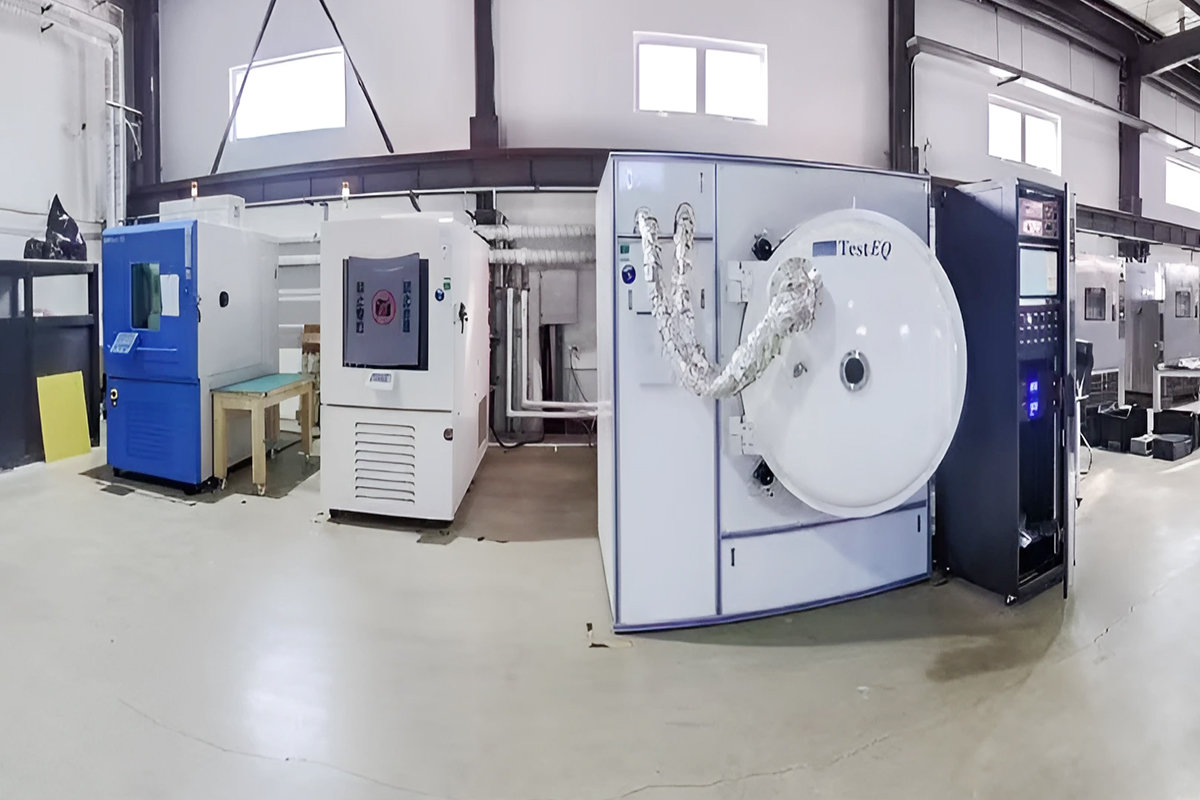
TestEQ Thermal Vacuum Testing Solutions
TestEQ provides engineered thermal vacuum testing solutions for aerospace, spacecraft, satellite, electronics, and research applications.
The system can be configured according to application-specific requirements, including:
• Thermal vacuum testing
• Thermal cycling under vacuum
• Thermal balance testing
• Custom chamber dimensions
• Controlled vacuum environments
• Temperature control
• DUT instrumentation
• Electrical and signal feedthroughs
• Data acquisition and monitoring
• Custom fixtures and interfaces
For projects based on ECSS, NASA, MIL, or customer-specific verification requirements, the chamber configuration should be developed from the applicable test specification rather than from a generic chamber model.
Why Choose TestEQ for Thermal Vacuum Testing?
1. Requirement-Based Engineering
TestEQ configures TVAC systems according to the customer's actual test requirements, DUT conditions, and verification objectives.
2. Custom TVAC Solutions
Chamber size, temperature range, vacuum system, fixtures, feedthroughs, and instrumentation can be customized for specific applications.
3. ECSS-Oriented Testing
TestEQ can develop TVAC systems around ECSS-based test specifications and project-specific verification requirements.
4. Aerospace & Space Applications
TVAC solutions can be configured for spacecraft, satellite components, payloads, aerospace electronics, optical systems, and research hardware.
5. Integrated Temperature & Vacuum Control
The system integrates thermal control, vacuum control, pressure measurement, temperature monitoring, and test sequencing.
6. Thermal Cycling & Thermal Balance
Depending on project requirements, the system can support thermal vacuum testing, thermal cycling, and thermal balance applications.
7. Customized DUT Interfaces
Electrical feedthroughs, signal interfaces, sensors, fixtures, and other DUT connections can be engineered for the test article.
8. Measurement & Data Acquisition
Test systems can integrate temperature, pressure, functional monitoring, data acquisition, alarms, and test data recording.
9. Engineered-to-Order Manufacturing
TestEQ focuses on application-specific environmental testing systems rather than relying only on standard chamber configurations.
10. Complete Testing System Support
From test requirement review and system design to manufacturing, testing, delivery, and technical support, TestEQ can support the complete TVAC equipment development process.
ECSS-E-ST-10-03C Rev.1: Common Questions About Testing
1.What is ECSS-E-ST-10-03C Rev.1?
ECSS-E-ST-10-03C Rev.1 is the ECSS Testing standard for verification by testing of space segment elements and space segment equipment on the ground before launch.
2.Is ECSS-E-ST-10-03C Rev.1 an active standard?
Yes. ECSS currently lists ECSS-E-ST-10-03C Rev.1 – Testing, dated 31 May 2022, among its active standards.
3.Does ECSS-E-ST-10-03C Rev.1 cover thermal vacuum testing?
Yes. The standard includes requirements applicable to thermal vacuum testing and thermal testing at mission pressure.
4.Does ECSS specify one universal TVAC pressure and temperature?
No. The applicable conditions depend on the project, hardware, mission environment, verification objective, and applicable test documentation.
5.Is thermal vacuum testing the same as thermal cycling?
No. Thermal vacuum testing introduces a controlled vacuum environment in addition to thermal conditions. The applicable test method depends on the verification objective.
6.Does ECSS thermal vacuum testing apply to satellites?
Yes. The standard is intended for testing space segment elements and equipment before launch and can be relevant to satellite and spacecraft hardware verification programmes.
7.What is the difference between ECSS-E-ST-10-03C Rev.1 and ECSS-E-HB-10-03A?
ECSS-E-ST-10-03C Rev.1 defines testing requirements. ECSS-E-HB-10-03A provides additional testing guidance and does not itself contain applicable requirements.
8.What should I specify when purchasing an ECSS-oriented TVAC chamber?
Specify the complete test requirement, including temperature range, vacuum level, thermal profile, stabilization criteria, DUT dimensions, thermal load, instrumentation, feedthroughs, data acquisition, safety requirements, and applicable verification documentation.
Internal Linking Module
Recommended Equipment
Explore thermal vacuum chamber configurations for spacecraft, satellite, aerospace, and electronic hardware testing. Review temperature range, vacuum capability, thermal control, instrumentation, and custom DUT interfaces.
Review TVAC chamber solutions designed for controlled vacuum and thermal environments, including custom chamber sizes, thermal cycling, feedthroughs, and test monitoring systems.
Related Standards
Review major thermal vacuum testing standards and frameworks, including ECSS, NASA, and military aerospace requirements, and understand how they relate to different verification programmes.
ECSS-E-ST-10-04C Rev.1 — Space Environment
Learn how the ECSS space environment standard relates to environmental conditions that may need to be considered when developing spacecraft and space hardware verification programmes.
Engineering Resources
Understand the key parameters used to define a thermal vacuum test, including temperature, pressure, thermal cycling, stabilization, DUT configuration, instrumentation, and project-specific verification requirements.
Review NASA-oriented thermal vacuum testing concepts and environmental verification considerations for aerospace and spacecraft hardware.
Learn how a thermal vacuum chamber combines controlled temperature and vacuum environments for aerospace, satellite, electronics, and research testing.
Need a Thermal Vacuum Test System for an ECSS-Based Test Programme?
Planning thermal vacuum testing for spacecraft, satellite, payload, or other space hardware?
TestEQ provides engineered thermal vacuum test chamber solutions configured around your actual verification requirements. Our team can review the applicable ECSS requirements, project test specification, DUT dimensions, thermal load, temperature profile, and vacuum requirements to help define the appropriate TVAC system configuration.
Send Us Your Test Requirements
For a technical evaluation or RFQ, provide:
• Applicable standard or project specification
• Required temperature range
• Required vacuum level
• DUT dimensions and weight
• Thermal load or heat dissipation
• Thermal cycling or TVAC test profile
• Required stabilization criteria
• Electrical, signal, or RF feedthrough requirements
• Instrumentation and data acquisition requirements
TestEQ can help translate your ECSS-based test requirements into a practical thermal vacuum chamber configuration for engineering validation and procurement.
"Request a Technical Consultation or TVAC Chamber Proposal →"
Whether you are preparing an ECSS qualification test, acceptance test, protoflight test, thermal vacuum test, or thermal balance programme, send us your requirements for a technical review.
TestEQ Environment Instruments
Reliability Testing System Provider for Environmental Simulation Solutions