What Is RTCA DO-160 Section 4?
RTCA DO-160 is an environmental testing standard developed by RTCA for airborne equipment.
Section 4 specifically addresses temperature and altitude testing. Its purpose is to determine the performance characteristics of equipment under the applicable temperature categories and atmospheric pressure conditions.
The selection of an equipment category depends on several factors:
Equipment installation location within or on the aircraft.
Maximum operating altitude of the aircraft.
Whether the installation area is temperature controlled.
Whether the installation area is pressure controlled.
Applicable operating and survival temperature limits.
An important engineering consideration is that not every aircraft installation experiences the same environmental conditions.
For example, avionics installed inside a pressurized cabin may experience different pressure and temperature conditions from equipment installed in an unpressurized equipment compartment.
Therefore, the applicable DO-160 Section 4 category should be established according to the actual aircraft installation environment and equipment specification.
What Equipment Does DO-160 Section 4 Apply To?
DO-160 Section 4 is relevant to airborne equipment requiring environmental qualification for aircraft installation.
Typical applications include:
Avionics Systems
Flight control computers
Flight management systems
Navigation equipment
Communication systems
Aircraft data acquisition units
Electronic Components
Aerospace electronic modules
Sensors and transducers
Power supply units
Electronic control units
Signal processing equipment
Aircraft Electrical Systems
Power distribution units
Electrical control modules
Circuit protection devices
Aircraft wiring and connectors
Other Aerospace Equipment
Unpressurized compartment electronics
Engine-related electronic equipment
Aerospace monitoring systems
Aircraft instrumentation
The actual test category and procedure must be determined from the applicable qualification plan.
RTCA DO-160 Section 4 Equipment Categories
DO-160G defines equipment categories according to the environmental conditions associated with different aircraft installation locations.
The categories consider temperature control, pressure control and maximum operating altitude.
The category families include:
Category | General installation consideration |
|---|---|
A | Pressurized or controlled/partially controlled environments |
B | Unpressurized installations with applicable altitude limits |
C | Unpressurized installations at higher altitude ranges |
D | Unpressurized installations at higher operating altitudes |
E | Applications involving very high altitude conditions |
F | Specific temperature-controlled or uncontrolled installation environments |
The detailed category designation, including numerical suffixes, defines the applicable environmental limits and should not be selected based on the letter alone.
Engineering note: DO-160G Table 4-1 and Table 4-2 provide the applicable temperature and pressure conditions. Engineers should consult the controlled standard rather than assume that one temperature or altitude profile applies to all categories.
For test laboratories, the category determines the required chamber temperature range, pressure capability, test sequence and operating conditions of the equipment under test (EUT).
RTCA DO-160 Section 4 Temperature Test Requirements
Temperature testing evaluates whether airborne equipment can operate or survive exposure to specified high- and low-temperature environments.
The main temperature test procedures include the following.
1. Ground Survival Low Temperature Test
This test evaluates whether equipment can withstand low temperatures during ground exposure without necessarily operating throughout the exposure.
After the specified exposure, equipment may be required to return to an operating condition for functional evaluation.
2. Operating Low Temperature Test
This test evaluates equipment functionality at the specified low operating temperature.
Engineers monitor whether the EUT maintains its required electrical and functional performance under low-temperature conditions.
3. Ground Survival High Temperature Test
This procedure evaluates equipment resistance to high-temperature exposure during ground conditions.
It is particularly relevant to equipment installed in locations that may experience elevated temperatures while the aircraft is parked or exposed to ground environmental conditions.
4. Short-Time Operating High Temperature Test
This test evaluates equipment operation under specified short-duration high-temperature conditions.
The test sequence and exposure duration depend on the applicable equipment category and standard requirements.
5. Operating High Temperature Test
This test determines whether equipment can maintain its required functionality during high-temperature operation.
Potential engineering concerns include:
Electronic component temperature rise
Power supply stability
Semiconductor operating limits
Sensor measurement accuracy
Internal heat accumulation
Cooling system effectiveness
6. In-Flight Loss-of-Cooling Test
For equipment relying on dedicated cooling, loss of cooling can create a significant thermal stress condition.
This test evaluates equipment behavior when its normal cooling capability is interrupted under the specified conditions.
It is particularly relevant to high-power avionics and electronic systems with dedicated cooling arrangements.
RTCA DO-160 Section 4 Altitude Testing
Altitude testing evaluates equipment performance under reduced atmospheric pressure.
As aircraft altitude increases, atmospheric pressure and air density decrease. These changes can affect equipment cooling, electrical insulation, mechanical structures and sealed components.
Typical engineering concerns include:
Reduced convective heat transfer
Increased component operating temperatures
Electrical insulation performance
Internal and external pressure differences
Enclosure sealing
Connector and component reliability
Thermal management performance
An altitude test chamber recreates reduced atmospheric pressure so engineers can evaluate the EUT under controlled conditions.
Altitude Simulation
Altitude simulation is achieved by controlling chamber absolute pressure to represent the required atmospheric altitude.
Engineers should distinguish between:
Simulated altitude
Absolute pressure
Gauge pressure
Pressure transition rate
For repeatable qualification testing, absolute pressure is a critical measurement parameter.
The chamber control system should maintain the specified pressure profile while monitoring the EUT operating condition.
DO-160 Decompression Testing
Decompression testing evaluates equipment behavior during a specified reduction in atmospheric pressure.
This test is relevant to equipment that may experience rapid pressure changes during aircraft operation or abnormal cabin-pressure conditions.
Engineering considerations include:
Initial and final absolute pressure
Pressure reduction rate
Pressure transition duration
Equipment operating status
Enclosure integrity
Functional performance after decompression
The chamber must be capable of achieving the required pressure transition profile while maintaining reliable pressure measurement and data recording.
DO-160 Overpressure Testing
Overpressure testing evaluates equipment under pressure conditions above normal atmospheric pressure.
The test helps assess the ability of equipment enclosures and assemblies to withstand specified pressure differences without unacceptable damage or functional failure.
Important considerations include:
Required absolute pressure
Pressure stabilization
Exposure duration
Enclosure construction
Sealing performance
Post-test functional inspection
Overpressure testing requires a chamber and pressure system specifically engineered for the applicable pressure conditions. It should not be assumed that every conventional vacuum altitude chamber supports overpressure testing.
Temperature and Altitude Combined Testing
In actual aircraft environments, temperature and atmospheric pressure can affect equipment simultaneously.
Testing these parameters independently may not fully represent the combined environmental conditions experienced during flight.
Combined temperature-altitude testing allows engineers to evaluate equipment under controlled thermal and low-pressure conditions.
Typical combined test applications include:
Avionics operating under low pressure and low temperature
Aerospace electronics exposed to high-temperature conditions at altitude
Power electronics operating under reduced air density
Sensors requiring temperature and pressure stability
Electronic assemblies installed in unpressurized aircraft compartments
For combined testing, the environmental chamber must coordinate its refrigeration system and pressure-control system.
The most important design parameters include temperature range, pressure range, temperature uniformity, pressure stability, transition rate and EUT heat load.
Environmental Test Chamber Requirements for DO-160 Section 4
A DO-160 Section 4 temperature-altitude chamber should be designed according to the applicable equipment category and test sequence.
Engineering Parameter | Requirement to Evaluate | Engineering Considerations |
|---|---|---|
Temperature Range | Applicable operating and survival temperatures | Confirm required high- and low-temperature limits |
Altitude Simulation | Required simulated altitude | Define the maximum test altitude and corresponding pressure |
Absolute Pressure | Minimum and maximum test pressure | Verify pressure range and measurement accuracy |
Temperature Stability | Stability under specified test conditions | Maintain consistent temperature throughout the test |
Temperature Uniformity | Temperature distribution around the EUT | Ensure uniform environmental conditions within the working space |
Pressure Control | Accurate and repeatable pressure regulation | Maintain the required absolute pressure profile |
Decompression | Required pressure reduction profile | Verify pressure reduction rate and transition time |
Overpressure | Required positive pressure capability, if applicable | Confirm maximum pressure and chamber structural requirements |
Chamber Volume | EUT dimensions and test fixtures | Allow sufficient space for the EUT, fixtures and instrumentation |
Cable Ports | Power and signal connections | Provide suitable access for power, communication and sensor cables |
Heat Load | EUT operating power and thermal dissipation | Ensure sufficient heating and cooling capacity under operating conditions |
Data Acquisition | Temperature, pressure and functional data | Support synchronized monitoring, recording and test data analysis |
A critical design consideration is that temperature performance can change under reduced pressure.
As air density decreases, convective heat transfer becomes less effective. Consequently, equipment that generates heat during operation may require additional thermal engineering consideration.
How to Select a DO-160 Temperature Altitude Test Chamber
For aerospace procurement teams and laboratory engineers, chamber selection should begin with the actual qualification requirements.
The following parameters should be defined before requesting a quotation.
Define the DO-160 Category
Identify the applicable equipment category and the relevant Section 4 test procedures.
Confirm Temperature Requirements
Specify operating low temperature, operating high temperature and ground survival conditions as applicable.
Determine Altitude and Pressure
Provide the required simulated altitude and corresponding absolute pressure.
Define Pressure Transition Requirements
Confirm whether altitude, decompression or overpressure testing is required.
Calculate EUT Heat Load
Consider the power consumption and heat generated by the equipment during operation.
Confirm Chamber Dimensions
Include the EUT, fixtures, cable connections and required airflow clearance.
Define Monitoring Requirements
Determine the required temperature sensors, pressure measurement, power interfaces and data acquisition channels.
Confirm Laboratory Safety Requirements
Evaluate vacuum system protection, pressure protection, electrical safety and emergency shutdown.
A properly specified chamber should reproduce the required environmental profile while allowing engineers to monitor equipment performance throughout the test.
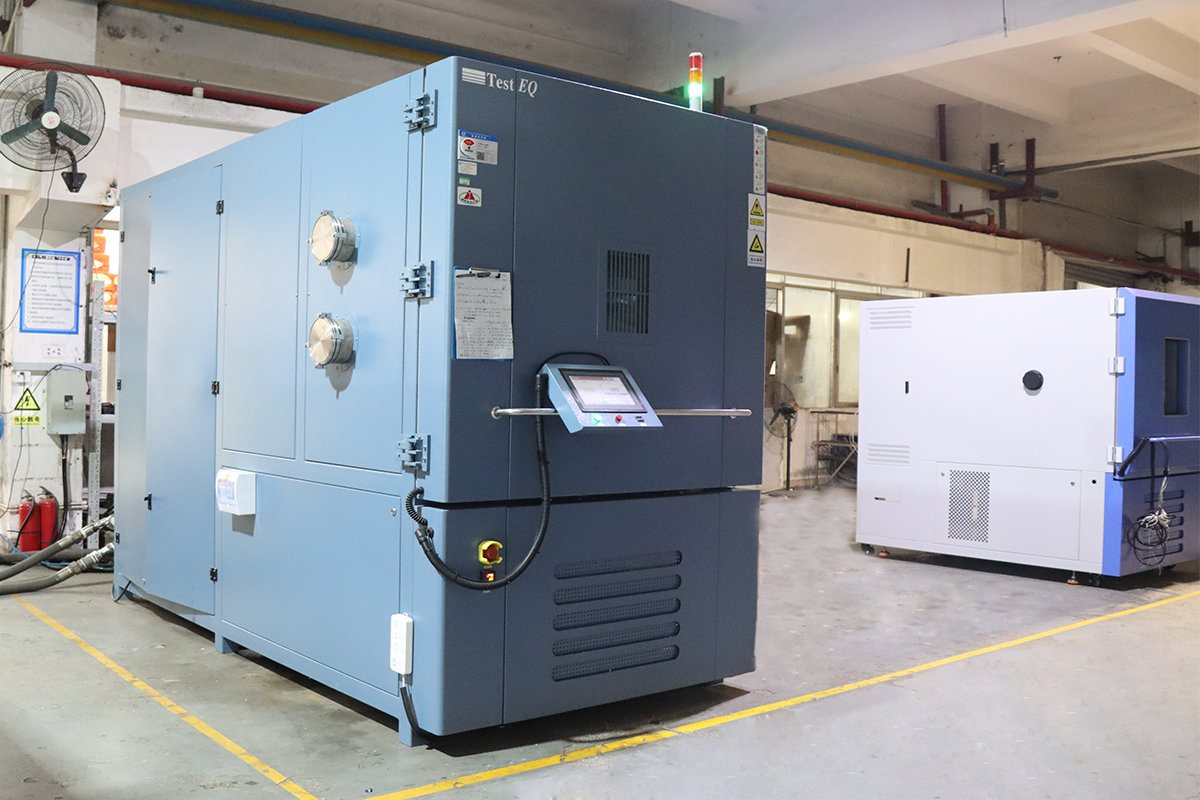
What Temperature Altitude Test Chamber Does TestEQ Provide?
TestEQ provides customized environmental simulation equipment for aerospace, avionics and electronic reliability testing.
Its temperature altitude chambers combine controlled temperature and reduced-pressure simulation for applications requiring combined environmental testing.
TestEQ temperature-altitude chamber configurations include:
Temperature range: −70°C to +150°C
Pressure control: 101 kPa to ≤0.5 kPa on the applicable configuration
Chamber capacities: 0.125 to 8.9 m³ in listed configurations
Programmable temperature and pressure profiles
Combined temperature and low-pressure simulation
Customized chamber dimensions
Pressure and temperature monitoring
Optional data acquisition and laboratory integration
These are published product configuration specifications, not universal DO-160 requirements. Final performance depends on chamber model, test load and engineering configuration.
Combined Temperature & Low-Pressure Testing
For aerospace applications, TestEQ can evaluate chamber requirements based on the EUT dimensions, temperature limits, simulated altitude, pressure transition profile and operating heat load.
Why Choose TestEQ for RTCA DO-160 Testing?
Choosing a temperature altitude test chamber requires more than meeting temperature and pressure specifications. It requires an engineering solution that matches the actual equipment configuration and aerospace testing requirements.
Why Work with TestEQ?
• Customized Engineering: Chamber dimensions, temperature ranges and pressure configurations tailored to specific test requirements.
• Combined Environmental Simulation: Integrated temperature and low-pressure control for aerospace and avionics applications.
• Application-Based Design: System configuration based on equipment dimensions, heat load, altitude profiles and test conditions.
• Proven Manufacturing Experience: Experience in customized environmental test chambers and complex reliability testing systems.
• Flexible System Integration: Options for programmable controls, data monitoring, cable feedthroughs and laboratory integration.
• Technical Support: Engineering assistance from requirement evaluation to chamber configuration.
TestEQ focuses on customized environmental simulation systems that help aerospace manufacturers, avionics developers and testing laboratories address their specific qualification requirements.
Applications
RTCA DO-160 Section 4 testing is relevant to several aerospace and aviation industries.
Commercial Aviation
Avionics control systems
Flight management equipment
Aircraft communication devices
Navigation electronics
Aerospace Electronics
Electronic control modules
Sensors and transducers
Power management systems
Aerospace connectors
Aircraft Electrical Systems
Power distribution modules
Electrical protection devices
Signal processing equipment
Aerospace Research Laboratories
Environmental qualification
Temperature-altitude simulation
Equipment reliability verification
Aircraft electronic component development
FAQ
1.What is RTCA DO-160 Section 4?
RTCA DO-160 Section 4 is the Temperature and Altitude section of the environmental qualification standard for airborne equipment. It defines applicable temperature and altitude test procedures according to equipment categories.
2.What tests are included in DO-160 Section 4?
The section includes low- and high-temperature operating and survival tests, short-time operating temperature tests, in-flight loss-of-cooling testing, altitude testing, decompression testing and overpressure testing.
3.What is the difference between DO-160 Section 4 and Section 5?
Section 4 addresses temperature and altitude conditions. Section 5 addresses temperature variation testing, which evaluates equipment response to specified temperature transitions.
4.What is a DO-160 altitude test chamber?
It is an environmental testing system that simulates reduced atmospheric pressure corresponding to specified aircraft operating altitudes. Depending on its configuration, it can also provide controlled temperature conditions.
5.Does DO-160 Section 4 require combined temperature and altitude testing?
The applicable test procedures depend on the equipment category and qualification plan. Combined temperature and low-pressure capability is important when the specified test sequence requires both environmental parameters to be controlled.
6.What is the difference between altitude and decompression testing?
Altitude testing evaluates equipment under specified reduced-pressure conditions. Decompression testing evaluates equipment response during a defined pressure reduction.
7.Can TestEQ provide a customized DO-160 temperature altitude chamber?
Yes. TestEQ can configure temperature-altitude chambers according to required temperature range, absolute pressure, chamber volume, pressure transition profile, EUT heat load and instrumentation requirements.
8.What information is needed to request a DO-160 chamber quotation?
Provide the applicable equipment category, temperature range, simulated altitude or absolute pressure, EUT dimensions, operating power, heat load and required test sequence.
Internal Linking Modules
Related Standards
Explore low-pressure and high-altitude testing methods for military and aerospace equipment.
Understand low-air-pressure test conditions, pressure control and environmental qualification requirements.
Learn about international altitude testing standards and high-altitude chamber engineering requirements.
Engineering Resources & Case Studies
Understand how temperature, humidity and reduced atmospheric pressure interact during combined environmental testing.
Explore chamber working principles, pressure simulation and engineering selection criteria.
Discover practical altitude simulation applications for aerospace and low-pressure reliability testing.
Related Test Chambers
Environmental simulation equipment for controlled low-pressure and high-altitude testing.
Combined temperature and low-pressure simulation systems for aerospace and avionics applications.
Explore customized environmental simulation systems for aerospace, automotive, electronics and reliability laboratories.
Custom RTCA DO-160 Temperature Altitude Test Chamber
Need a Temperature Altitude Chamber for Aerospace Testing?
TestEQ designs customized temperature altitude test chambers for aerospace, avionics and airborne electronic equipment testing.
Solutions can be configured for temperature control, low-pressure simulation, altitude profiles, decompression testing and customized chamber dimensions.
Contact TestEQ with your DO-160 category, temperature range, required altitude, chamber size and test requirements.
Our engineering team can recommend a suitable environmental simulation system for your application.