What Is ASTM E595?
ASTM E595 is officially titled:
Standard Test Method for Total Mass Loss and Collected Volatile Condensable Materials from Outgassing in a Vacuum Environment.
The method evaluates how materials behave when exposed to elevated temperatures under vacuum conditions.
The ASTM E595-15 edition specifies a typical test condition of:
Specimen temperature: 125°C
Collector temperature: 25°C
Vacuum pressure: Below 7 × 10⁻³ Pa
Exposure duration: 24 hours
The standard also specifies temperature and humidity controls for specimen conditioning and weighing.
ASTM E595 is primarily a material screening method. It helps laboratories compare material outgassing characteristics, rather than directly predicting the actual contamination level of a complete spacecraft or assembled system.
The current ASTM catalog identifies E595-15R21 as the active designation. Laboratories should verify the applicable edition and any contractual requirements before testing.
What Does ASTM E595 Measure?
ASTM E595 focuses on three important measurement parameters.
Total Mass Loss (TML)
TML measures the total mass lost by a specimen after exposure to the specified vacuum and temperature conditions.
It provides an indication of the volatile substances released from the material during testing.
The calculation is:
Where:
(M0) = Initial specimen mass
(M1) = Specimen mass after vacuum exposure
A higher TML indicates greater overall mass loss under the specified test conditions.
However, TML alone does not indicate how much released material will condense on nearby surfaces.
Collected Volatile Condensable Materials (CVCM)
CVCM measures the amount of material that leaves the specimen and condenses on a collector maintained at a specified temperature.
The calculation is:
CVCM(%)=(Mc - Mc0)/ M0 × 100
Where:
- (Mc0) = Initial collector mass
- (Mc) = Collector mass after testing
- (M0) = Initial specimen mass
CVCM is particularly important for spacecraft and optical applications because condensed volatile substances can contaminate sensitive surfaces.
Water Vapor Regained (WVR)
WVR measures the amount of moisture regained by the specimen after vacuum exposure and subsequent humidity conditioning.
This parameter helps engineers understand how much of the measured mass loss may be associated with absorbed water.
For material evaluation, TML less WVR is often used in aerospace material screening requirements.
The exact calculation and conditioning procedure should follow the applicable ASTM method.
What Materials Does ASTM E595 Apply To?
ASTM E595 can be used to evaluate various organic, polymeric and inorganic materials exposed to vacuum environments.
Common material categories include:
Material Category | Typical Applications |
|---|---|
Adhesives | Aerospace structural bonding |
Epoxy Compounds | Electronic encapsulation |
Elastomers | Seals and gaskets |
Polymer Films | Insulation and protective layers |
Coatings | Surface protection |
Foams | Thermal insulation |
Lubricants | Mechanical assemblies |
Electrical Insulation | Aerospace electronics |
Tapes | Harness and component protection |
Potting Compounds | Electronic assemblies |
Material selection is particularly important when components are positioned near contamination-sensitive surfaces.
Examples include:
Satellite optical lenses
Spacecraft windows
Solar panels
Infrared sensors
Star trackers
Thermal radiators
Precision scientific instruments
Even a small amount of condensable material can become a concern when deposited on sensitive optical or thermal-control surfaces.
ASTM E595 Test Requirements
ASTM E595 uses controlled test conditions to ensure repeatable measurement of material outgassing behavior.
The main test parameters are summarized below.
Test Parameter | ASTM E595 Condition |
|---|---|
Specimen Temperature | 125°C |
Collector Temperature | 25°C |
Vacuum Pressure | Below 7 × 10⁻³ Pa |
Exposure Duration | 24 hours |
Temperature Tolerance | ±1°C at 125°C and 25°C |
Conditioning Environment | 23°C, 50% RH |
Conditioning Duration | 24 hours |
Humidity Tolerance | ±5% RH |
These are the standard method's specified conditions, not universal operating requirements for every vacuum chamber.
The test apparatus must maintain the specified vacuum and thermal conditions while allowing released volatile substances to reach the collector.
An important engineering consideration is that the collector geometry, surface characteristics and temperature affect CVCM measurements. Therefore, test configurations must be controlled for meaningful comparisons.
How Is the ASTM E595 Outgassing Test Performed?
ASTM E595 testing follows a controlled procedure to minimize measurement uncertainty and prevent external contamination.
Step 1: Specimen Preparation
Material specimens are prepared according to the applicable test procedure.
The specimen should be clean and representative of the actual material condition, including any specified curing or processing treatment.
Step 2: Initial Weighing
The initial specimen mass and collector mass are measured using an appropriate precision balance.
Accurate weighing is essential because the measured mass changes may be very small.
Step 3: Specimen Conditioning
Specimens are conditioned under controlled temperature and humidity conditions before testing.
This helps establish a consistent initial moisture condition.
Step 4: Vacuum Exposure
The specimens are placed in the test apparatus and exposed to:
125°C specimen temperature
Vacuum pressure below 7 × 10⁻³ Pa
24-hour exposure
Step 5: Volatile Collection
Volatile substances released from the specimens travel toward the collector.
The collector is maintained at 25°C to capture condensable materials.
Step 6: Final Measurements
After the exposure, the specimen and collector are weighed again.
The results are used to calculate TML and CVCM. WVR can also be determined following the applicable moisture-reconditioning procedure.
Step 7: Material Evaluation
Engineers compare the measured results against the material acceptance criteria established by the spacecraft manufacturer, laboratory or applicable aerospace specification.
ASTM E595 Acceptance Criteria: TML and CVCM
Two commonly referenced historical screening thresholds for spacecraft materials are:
1.00% TML Historical screening threshold
0.10% CVCM Historical screening threshold
These values are widely used in aerospace material screening, but they should not be treated as universal acceptance limits imposed by ASTM E595 itself.
For example, NASA-STD-6016B specifies CVCM ≤0.1% and TML minus WVR ≤1.0% for applicable nonmetallic materials exposed to space vacuum, subject to stated exceptions and application-specific considerations.
NASA requirements, customer specifications and project contamination-control plans may impose different or more stringent criteria. Engineering recommendation: Always confirm whether the project requires TML, CVCM, TML-WVR or additional contamination-control evaluation before approving a material.
ASTM E595 Test Equipment Requirements
A reliable ASTM E595 test system requires more than a vacuum chamber capable of reaching a low pressure.
The apparatus must support controlled specimen heating, vacuum exposure and condensable-material collection.
Important equipment considerations include:
Equipment Requirement | Engineering Purpose |
|---|---|
Vacuum System | Maintains the required low-pressure environment during testing. |
Specimen Heating Assembly | Maintains the specimen temperature at 125°C. |
Temperature Controller | Controls and records specimen temperature throughout the test. |
Cold Collector | Maintains the collector temperature at 25°C to capture condensable volatile materials. |
Vacuum Measurement | Monitors and records chamber pressure to verify vacuum conditions. |
Specimen Holders | Securely position specimens and minimize contamination risks. |
Temperature Sensors | Monitor and verify specimen and collector temperatures. |
Data Acquisition System | Records temperature, vacuum pressure and test profiles for traceability. |
Clean Internal Surfaces | Minimize background outgassing and unwanted contamination during testing. |
Why Is the Cold Collector Important?
The cold collector is a defining part of ASTM E595.
While the specimen is heated, volatile materials are released into the vacuum environment. Condensable substances can then deposit on the collector maintained at 25°C.
Without a properly controlled collector, CVCM measurement cannot be performed as specified.
Why Is Vacuum Stability Important?
Insufficient vacuum performance can affect the outgassing environment and the comparability of test results.
The vacuum system must be designed to maintain the specified pressure throughout the exposure period, with consideration given to:
Initial pump-down time
Outgassing from internal surfaces
Leakage rate
Vacuum pumping capacity
Specimen quantity
Internal fixture materials
The apparatus configuration and cleanliness are important factors in repeatable testing.
How to Select an ASTM E595 Outgassing Test System
For laboratories and aerospace manufacturers planning an outgassing test facility, equipment selection should begin with the actual test method and specimen requirements.
Consider the following factors.
Vacuum Performance
Verify that the system can maintain pressure below 7 × 10⁻³ Pa under the specified test load.
Temperature Control
The specimen heating assembly must maintain 125°C within the specified tolerance.
Collector Temperature
The collector must maintain 25°C with appropriate temperature monitoring.
Contamination Control
Internal materials, fixtures, seals and surfaces should be evaluated to minimize unwanted background outgassing.
Specimen Capacity
Determine the required number of specimens and whether multiple samples need simultaneous testing.
Measurement Accuracy
The weighing equipment and handling procedure must support reliable TML and CVCM measurements.
Data Recording
Temperature, vacuum pressure and test duration should be documented for traceability.
System Integration
Consider vacuum pumping, specimen heating, collector cooling, sensors, controls and data acquisition as one coordinated test system.
Important procurement note: A general thermal vacuum chamber is not automatically an ASTM E595-compliant test apparatus. Confirm the required specimen fixture, heating configuration, collector geometry, temperature control and measurement procedure before specifying equipment.
ASTM E595 vs Thermal Vacuum Testing
ASTM E595 and thermal vacuum testing are related to vacuum environments, but they have different engineering objectives.
Comparison | ASTM E595 | Thermal Vacuum Testing |
|---|---|---|
Primary Objective | Material outgassing screening | Product performance under vacuum and temperature |
Test Subject | Material specimens | Components, assemblies or complete products |
Main Measurements | TML, CVCM and optional WVR | Temperature, vacuum pressure and functional behavior |
Thermal Condition | Specified specimen and collector temperatures | Application-specific thermal profiles |
Vacuum Condition | Controlled low-pressure exposure | Application-specific vacuum levels |
Main Concern | Volatile release and material condensation | Operational performance and environmental durability |
For spacecraft development, both types of testing may be required.
ASTM E595 helps engineers screen material outgassing characteristics, while thermal vacuum testing evaluates the behavior of hardware under simulated space environmental conditions.
What Thermal Vacuum Equipment Does TestEQ Provide?
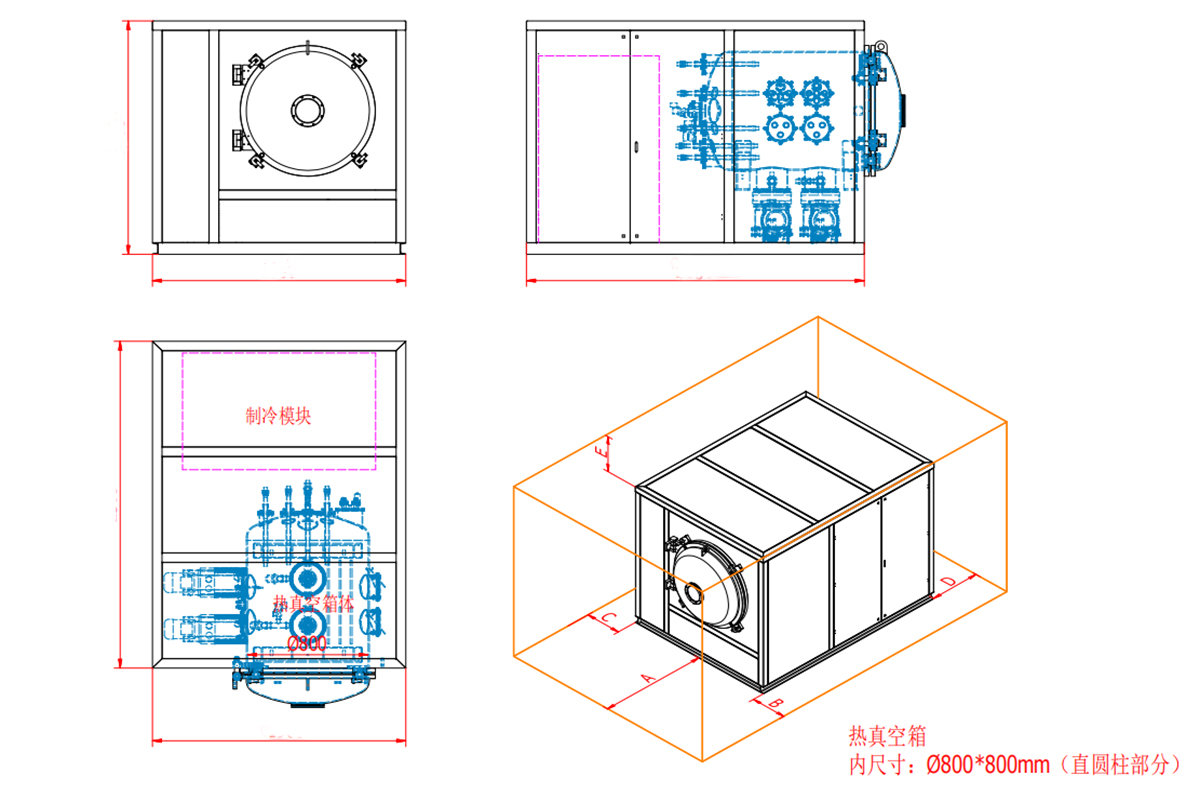
TestEQ designs thermal vacuum test chambers and environmental simulation systems for aerospace, satellite, semiconductor and precision engineering applications.
Its thermal vacuum systems can be configured around:
High-vacuum environments
Controlled temperature profiles
Thermal cycling under vacuum
Custom payload fixtures
Temperature monitoring
Vacuum pressure monitoring
Data acquisition
Optional residual gas analysis (RGA)
Customized chamber dimensions
For ASTM E595-related laboratory projects, the engineering scope should be defined separately to establish whether the required specimen heating, cold collector, vacuum configuration and measurement apparatus are included.
TestEQ also provides thermal vacuum cleaning systems for applications involving vacuum-assisted contaminant removal.
The appropriate system depends on whether the objective is material outgassing measurement, thermal vacuum qualification or vacuum-assisted cleaning.
Applications of ASTM E595 Testing
ASTM E595 is particularly relevant to industries where materials are exposed to vacuum and contamination-sensitive environments.
Aerospace and Satellites
Satellite structural materials
Spacecraft internal materials
Thermal insulation
Adhesives and sealants
Optical and Precision Instruments
Optical coatings
Lens assemblies
Infrared sensors
Precision measurement equipment
Electronics
PCB materials
Electronic encapsulation
Insulating materials
Component adhesives
Space Research Laboratories
Material screening
Vacuum compatibility evaluation
Contamination control
Aerospace material qualification
Semiconductor and Advanced Materials
Vacuum-compatible polymers
Precision coatings
High-purity materials
Vacuum processing components
Why Choose TestEQ for Thermal Vacuum Testing?
TestEQ is a thermal vacuum and environmental test equipment manufacturer based in Dongguan, China, specializing in customized reliability testing systems for aerospace, satellite and advanced engineering applications.
Key advantages include:
• Custom Engineering: Chamber dimensions, vacuum configurations, temperature profiles and payload fixtures tailored to specific testing requirements.
• Integrated System Design: Vacuum, thermal control, monitoring and data acquisition integration.
• Application Flexibility: Solutions for thermal vacuum testing, thermal cycling and aerospace environmental simulation.
• Manufacturing Capability: In-house equipment manufacturing and customized system development.
From laboratory-scale testing to customized aerospace environmental simulation systems, TestEQ helps engineering teams develop equipment configurations based on their actual test conditions.
FAQ — ASTM E595 Outgassing Testing
1.What is ASTM E595 used for?
ASTM E595 is used to screen materials for outgassing characteristics under controlled vacuum and elevated-temperature conditions by measuring TML and CVCM.
2.What are the standard ASTM E595 test conditions?
The typical specified conditions are 125°C specimen temperature, 25°C collector temperature, vacuum below 7 × 10⁻³ Pa and a 24-hour exposure.
3.What is the difference between TML and CVCM?
TML measures the total percentage of specimen mass lost during testing. CVCM measures the percentage of the original specimen mass collected as condensable material on the collector.
4.What does WVR mean in ASTM E595?
WVR stands for Water Vapor Regained. It measures moisture regained by the specimen after vacuum exposure and subsequent humidity conditioning.
5.What are the common ASTM E595 acceptance limits?
Historically, TML of 1.00% and CVCM of 0.10% have been used as spacecraft material screening thresholds. Actual acceptance criteria depend on the applicable NASA, customer or project specification.
6.Is ASTM E595 a thermal vacuum test?
No. ASTM E595 is a material outgassing screening method conducted under vacuum. General thermal vacuum testing evaluates the environmental and functional behavior of hardware under simulated space conditions.
7.Can ASTM E595 be used for adhesives and polymers?
Yes. The method covers many organic, polymeric and inorganic materials, including adhesives, elastomers, films, foams, coatings and potting compounds.
8.Does TestEQ provide thermal vacuum chambers for aerospace testing?
Yes. TestEQ provides configurable thermal vacuum chambers for aerospace and satellite applications. ASTM E595-specific specimen heating and collector configurations should be confirmed separately according to the required test apparatus.
Internal Linking Module
Related Standards
Explore NASA environmental verification requirements for spacecraft and aerospace equipment, including thermal vacuum and environmental testing.
Understand European space engineering test requirements for spacecraft and aerospace equipment environmental verification and qualification.
Explore relevant thermal vacuum testing standards, environmental conditions and qualification requirements for aerospace applications.
Related Test Chambers
Simulate high-vacuum and extreme-temperature environments for satellite, spacecraft and aerospace component testing.
Provide controlled thermal and vacuum environments for spacecraft qualification and thermal vacuum testing.
Simulate combined temperature and low-pressure conditions for aerospace electronics and environmental reliability testing.
Related Resources
Learn the principles, test objectives and applications of thermal vacuum testing for spacecraft and aerospace equipment.
Understand key thermal vacuum testing parameters, including temperature range, vacuum level, exposure duration and equipment configuration.
Explore thermal vacuum chamber operating principles, system configurations and equipment selection considerations.
CTA
ASTM E595 Thermal Vacuum Testing Solutions
Need a Thermal Vacuum System for Aerospace Material Testing?
TestEQ provides customized thermal vacuum chambers and environmental simulation systems for aerospace, satellite and precision material testing.
Our engineering solutions can be configured around vacuum performance, temperature control, thermal cycling, custom fixtures, monitoring and data acquisition.
Contact TestEQ with your vacuum level, temperature range, specimen configuration and testing requirements to discuss a suitable system for your laboratory.