What Is UL 2580?
UL 2580, Batteries for Use In Electric Vehicles, is a safety standard covering electrical energy storage assemblies such as battery packs, combination battery pack-electrochemical capacitor assemblies, and the modules or subassemblies that make up these systems for electric-powered vehicles.
The standard focuses on whether the energy storage assembly can safely withstand simulated abuse conditions and prevent hazardous exposure to people.
An important distinction for engineers is that UL 2580 does not simply establish a general battery performance test. The UL Standards & Engagement scope specifically states that the standard evaluates the assembly's ability to withstand simulated abuse conditions and does not evaluate the performance or reliability of the device as such.
This makes UL 2580 particularly relevant when the engineering objective is:
EV battery safety validation
Battery pack and module abuse testing
Environmental stress evaluation
Electrical protection verification
Thermal safety evaluation
Mechanical durability and abuse assessment
Battery management and protection-related evaluation
Product certification preparation
UL Solutions also describes UL 2580 as addressing electrical, mechanical, environmental and thermal runaway-related risks in EV battery systems.
What Products Does UL 2580 Apply To?
UL 2580 primarily addresses electrical energy storage assemblies for electric-powered vehicles.
Typical products and configurations can include:
EV battery packs
Battery modules
Rechargeable energy storage assemblies
Battery pack assemblies
Battery pack/electrochemical capacitor combinations
Components or subassemblies forming part of an EV energy storage system
Typical vehicle applications include:
Battery electric vehicles (BEVs)
Passenger EVs
Commercial electric vehicles
Electric buses
Trucks and heavy-duty vehicles
Industrial electric vehicles
Certain off-road and mobility applications
UL Solutions identifies applications extending beyond passenger vehicles to commercial vehicles and industrial/off-road mobility equipment.
However, scope must always be checked against the current edition of the standard and the actual DUT.
For example, the UL 2580 scope specifically excludes batteries for certain light electric vehicles covered by UL/ULC 2271.
UL 2580 EV Battery Test Requirements
UL 2580 testing is not a single test. The applicable program can combine different categories of evaluation according to the battery design, intended application and test configuration.
Common evaluation areas include:
Electrical Safety
Potential evaluations include:
Overcharge
Short circuit
Over-discharge protection
Imbalanced charging
Dielectric voltage withstand
Insulation resistance
Continuity
Cooling or thermal-control system failure
Mechanical Safety
Depending on the applicable test program, battery assemblies can be evaluated for:
Vibration
Mechanical shock
Drop
Crush
Rotation
Other simulated abuse conditions
Environmental Testing
Environmental evaluations can include:
Thermal cycling
Temperature exposure
Humidity-related conditions
Immersion
Salt spray
External fire exposure
UL Solutions' current EV battery testing information identifies thermal cycling, salt spray, immersion and external fire exposure among environmental testing areas, while also identifying electrical and mechanical abuse testing.
Thermal Safety
Thermal safety is particularly important for lithium-ion EV batteries because abnormal electrical, mechanical or thermal conditions can potentially lead to cell failure and thermal propagation.
Testing may therefore need to consider:
Temperature rise
Thermal stability
Cooling system failure
Thermal propagation
Single-cell failure behavior
Fire exposure
Gas generation and safety monitoring
UL Solutions describes thermal runaway and propagation testing at cell, module and pack levels as part of broader EV battery safety testing.
UL 2580 Environmental Test Conditions
Environmental testing places the battery under controlled physical conditions that simulate potential vehicle operating or abuse environments.
For engineers, the important issue is not simply whether a chamber can reach a specified temperature. The chamber must maintain the required environmental condition while the battery is operating, charging, discharging or being monitored.
Important environmental parameters include:
| Parameter | Engineering consideration |
|---|---|
| Temperature range | Must cover the required DUT test envelope |
| Temperature stability | Prevents environmental variation from influencing test results |
| Temperature uniformity | Important for large battery packs and modules |
| Ramp rate | Determines how rapidly the DUT experiences environmental change |
| DUT heat load | Battery charging/discharging can generate substantial heat |
| Humidity | Required when the test program specifies moisture exposure |
| Chamber volume | Must accommodate the battery and required instrumentation |
| Cable ports | Required for power, CAN, thermocouple and DAQ connections |
| Safety interlocks | Prevent unsafe operation during abnormal conditions |
| Exhaust/ventilation | Important for gas and thermal-event management |
| Data acquisition | Enables traceable recording of temperature and test behavior |
For large EV battery packs, DUT heat load is one of the most important chamber-selection factors.
A chamber that can reach −40°C without load may not maintain −40°C when a high-power battery pack is charging or discharging.
UL 2580 Temperature Testing
Temperature testing is a critical part of EV battery environmental validation.
The purpose is to determine whether the battery assembly can maintain safe operation when exposed to specified temperature conditions or rapid environmental changes.
Temperature testing can involve:
High-temperature exposure
Low-temperature exposure
Temperature cycling
Rapid environmental changes
Temperature-dependent charging/discharging
Cooling-system evaluation
Thermal stability assessment
For a chamber manufacturer, the engineering challenge is to maintain environmental control while managing the heat generated by the DUT.
Why DUT Heat Load Matters
Consider a battery pack operating inside a chamber.
The chamber cooling system must remove:
Battery electrical/chemical heat + charger heat + auxiliary equipment heat + chamber heat leakage
Therefore, selecting a chamber only by its empty-chamber temperature range can result in an undersized system.
For battery testing, TestEQ recommends evaluating:
Battery maximum charging power
Battery maximum discharging power
Estimated heat generation
Battery dimensions and weight
Cable and fixture configuration
Required temperature ramp rate
Required temperature uniformity
Required test duration
Safety requirements
Required data acquisition channels
UL 2580 Battery Safety Testing
Environmental testing is only one component of the overall UL 2580 evaluation.
Battery safety testing can involve several failure modes.
Electrical Failure
Examples include:
Overcharge
Short circuit
Over-discharge
Abnormal charging
Loss of cooling
Electrical insulation failure
Mechanical Failure
Examples include:
Crush
Drop
Shock
Vibration
Rotation
Thermal Failure
Examples include:
Abnormal temperature rise
Thermal runaway initiation
Thermal propagation
Fire exposure
Cooling-system failure
Environmental Failure
Examples include:
Thermal cycling
Immersion
Salt exposure
High/low temperature
Environmental shock
The key engineering objective is not simply to determine whether the battery still operates.
The test must determine whether the test condition can produce a hazardous event, such as fire, explosion, dangerous electrical exposure or other unsafe behavior.
UL Solutions describes UL 2580 testing as part of a broader EV battery safety program covering abuse, environmental, thermal and electrical testing.
Battery Test Chamber Requirements for UL 2580
A battery chamber used for UL 2580-related testing should be designed around the actual battery test system rather than selected only from a standard temperature range.
1. Temperature Capability
The chamber should provide sufficient temperature range for the specified test program.
For EV battery applications, common engineering requirements can extend into:
Sub-zero testing
High-temperature testing
Temperature cycling
Rapid temperature transition
TestEQ environmental chambers can be configured according to the required temperature range, ramp rate, volume and battery heat load.
2. High Heat-Load Capability
EV battery packs can release significant heat during charge and discharge.
The refrigeration system should therefore be selected based on:
temperature + DUT heat load + chamber volume + ramp requirement
rather than temperature range alone.
3. Battery Cable Access
Battery testing often requires:
Power cables
CAN communication
Thermocouples
Voltage/current measurement
BMS communication
Data acquisition wiring
The chamber should therefore include appropriately positioned cable ports and sealing systems.
4. Safety Protection
Battery testing requires additional safety engineering compared with conventional component environmental testing.
Depending on the application, the system may integrate:
Over-temperature protection
Independent temperature limit
Door interlock
Emergency stop
Electrical interlock
Smoke detection
Gas detection
Fire detection
Exhaust system
Pressure relief
Automatic shutdown
Remote alarm
Data logging
The exact safety package should be determined by the battery chemistry, DUT energy, test method and laboratory risk assessment.
How to Select a UL 2580 Test Chamber
For procurement teams, the most common mistake is selecting a chamber based only on temperature range and chamber volume.
A better RFQ should specify at least the following:
| Procurement item | What to specify |
|---|---|
| DUT type | Cell / module / battery pack |
| Maximum DUT size | L × W × H |
| Maximum DUT weight | kg |
| Temperature range | °C |
| Temperature ramp | °C/min |
| Heat load | kW |
| Charging power | kW |
| Discharging power | kW |
| Humidity | Required / not required |
| Temperature uniformity | °C |
| Temperature stability | °C |
| Cable ports | Quantity and diameter |
| Power feedthrough | Voltage/current requirement |
| Safety system | Required protection level |
| Data acquisition | Temperature / voltage / current / CAN |
| Chamber volume | L or m³ |
| Door configuration | Single / double / walk-in |
| Test duration | Hours / cycles |
| Standard | UL 2580 + OEM/internal specification |
A Practical Selection Rule
If the battery is:
large + high-power + actively charging/discharging + rapidly changing temperature
then the chamber should be engineered as a battery environmental simulation system, not treated as a conventional environmental chamber.
This distinction is important when comparing suppliers.
UL 2580 vs UN 38.3 vs IEC 62619
These standards are often grouped together in battery testing discussions, but they serve different purposes.
| Standard | Primary purpose | Typical focus |
|---|---|---|
| UL 2580 | EV battery safety | EV battery assemblies and simulated abuse |
| UN 38.3 | Transport safety | Lithium battery transport classification/testing |
| IEC 62619 | Industrial battery safety | Secondary lithium cells/batteries for industrial applications |
| IEC 62660 | EV cell performance/safety | Lithium-ion cells for electric road vehicle propulsion |
UN 38.3 belongs to the UN Manual of Tests and Criteria framework for dangerous-goods classification and transport. The current UN Manual Revision 8 and Amendment 1 were published by UNECE, including provisions addressing lithium cells and batteries.
IEC 62619, by contrast, specifies safety requirements and tests for secondary lithium cells and batteries used in industrial applications, including stationary applications, with specific road-vehicle standards such as the IEC 62660 series taking precedence where applicable.
Engineering Interpretation
If the question is:
“Can this battery be safely transported?”
→ Look at UN 38.3.
If the question is:
“Does this industrial lithium battery meet the applicable safety requirements?”
→ Consider IEC 62619.
If the question is:
“How does this EV battery assembly withstand simulated abuse and safety-related conditions?”
→ UL 2580 may be applicable.
UL 2580 vs IEC 62660
UL 2580 and IEC 62660 are complementary rather than interchangeable.
UL 2580 focuses on the safety evaluation of electrical energy storage assemblies for electric-powered vehicles.
IEC 62660 focuses on lithium-ion cells used for propulsion of electric road vehicles.
IEC 62660-1, for example, specifies performance and life testing for secondary lithium-ion cells used for vehicle propulsion, including characteristics such as capacity, power density, energy density, storage life and cycle life.
This creates an important engineering distinction:
UL 2580 → battery assembly safety
IEC 62660 → EV propulsion cell performance/life testing
A battery development program can therefore require both environmental/safety testing at assembly level and cell-level performance characterization.
What Battery Test Chamber Does TestEQ Provide?
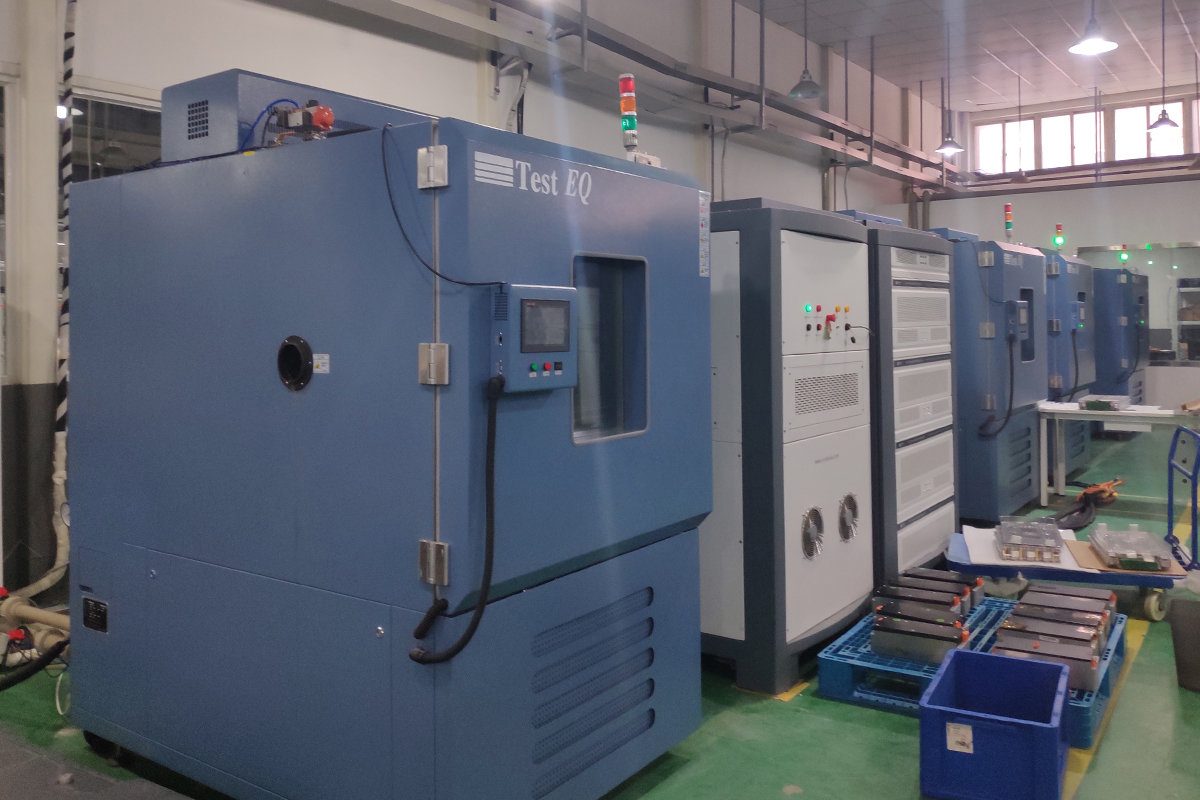
TestEQ provides environmental simulation systems for battery, automotive and reliability testing, including configurable environmental chambers for EV battery cells, modules and larger battery assemblies.
Depending on the test requirement, TestEQ systems can be engineered around:
High/low temperature testing
Temperature cycling
Rapid temperature change
Battery environmental simulation
High-temperature endurance
Low-temperature endurance
Temperature-humidity testing
Large-volume battery testing
Custom battery test chambers
Integrated power and signal feedthrough
Battery test instrumentation
Safety monitoring and interlock integration
For high-power battery testing, chamber design should be based on the actual DUT heat load and electrical operating profile, rather than relying solely on nominal chamber specifications.
TestEQ can also customize:
Chamber dimensions
Temperature range
Temperature change rate
Refrigeration capacity
Cable ports
Battery power interfaces
Observation windows
Data acquisition
Safety monitoring
Exhaust configuration
Emergency shutdown
Walk-in configurations
For Battery Laboratory Procurement
Before requesting a quotation, provide TestEQ with:
DUT dimensions + DUT weight + temperature range + ramp rate + charging/discharging power + heat load + test standard + safety requirements.
This allows the chamber configuration to be evaluated against the actual test condition rather than simply matching a catalog temperature range.
Why Choose TestEQ for UL 2580 Battery Testing?
Selecting a test chamber for UL 2580-related battery testing requires more than matching a temperature range. EV battery testing can involve high DUT heat loads, electrical connections, environmental cycling and additional safety requirements.
TestEQ provides custom environmental testing systems designed around the actual battery test condition.
Engineering-Based Chamber Design
TestEQ evaluates key parameters before chamber configuration, including:
Battery cell, module or pack dimensions
Temperature range and ramp rate
DUT heat load and charge/discharge power
Temperature uniformity and stability
Cable and electrical feedthroughs
Data acquisition and monitoring
Safety and emergency shutdown requirements
Custom Battery Test Systems
TestEQ can configure environmental chambers for battery cells, modules, EV battery packs and automotive components. Systems can be customized with refrigeration capacity, chamber dimensions, cable ports, electrical interfaces and safety monitoring according to the laboratory's test requirements.
Designed for Real Test Conditions
For high-power battery testing, maintaining the required temperature under actual DUT heat load is critical. TestEQ designs the refrigeration and environmental control system around the real operating condition, rather than relying only on no-load chamber specifications.
Built for B2B Laboratory Requirements
TestEQ supports engineers, laboratories and procurement teams with a complete approach covering environmental control, DUT integration, monitoring and safety requirements.
If you are planning a UL 2580-related EV battery test program, provide your DUT size, heat load, temperature range, ramp rate and electrical requirements to TestEQ for a customized chamber recommendation.
Applications
UL 2580-related battery environmental and safety testing can support a wide range of EV and electrified mobility applications.
Electric Vehicles
BEV battery packs
Passenger EVs
Commercial EVs
Electric buses
Electric trucks
Battery Development
Lithium-ion battery modules
Battery pack development
BMS validation
Thermal management development
Battery safety engineering
Automotive Components
Battery cooling systems
Battery enclosures
High-voltage components
Battery connectors
Thermal management components
Research & Laboratory
Battery failure analysis
Environmental qualification
Reliability research
Thermal behavior studies
Battery abuse testing
OEM validation
Frequently Asked Questions About UL 2580 EV Battery Testing
1. What Is UL 2580 and What Does It Require for EV Battery Safety Testing?
UL 2580 is a safety standard for electrical energy storage assemblies used in electric-powered vehicles. It evaluates the ability of applicable battery assemblies to withstand specified simulated abuse conditions and helps identify electrical, mechanical, environmental and thermal safety risks.
2. Which EV Battery Packs, Modules, and Energy Storage Assemblies Are Covered by UL 2580?
UL 2580 applies to applicable electrical energy storage assemblies used in electric-powered vehicles, including battery packs, modules and related assemblies. The exact scope should be confirmed against the current standard and the specific battery configuration being tested.
3. What Tests Are Included in a UL 2580 EV Battery Testing Program?
A UL 2580 test program can include electrical, mechanical, environmental and thermal safety evaluations. Depending on the applicable test procedure, testing may involve temperature exposure, thermal cycling, vibration, mechanical abuse, electrical abuse, immersion, salt spray and thermal-event-related evaluations.
4. Does UL 2580 Require Environmental and Temperature Testing for EV Batteries?
Applicable UL 2580 test programs can include environmental and temperature-related testing. The required temperature profile depends on the test method, battery design, operating conditions and laboratory test plan, so the environmental chamber should be selected based on the actual test requirements.
5. What Are the Key Requirements for Selecting a UL 2580 Battery Test Chamber?
Important specifications include temperature range, temperature stability, uniformity, temperature change rate, chamber volume and DUT heat-load capacity. Battery charging and discharging, cable ports, electrical feedthroughs, data acquisition and safety systems should also be considered.
6. Why Is Battery Heat Load Important When Selecting a UL 2580 Environmental Test Chamber?
EV batteries can generate significant heat during charging and discharging. The chamber therefore needs sufficient cooling capacity to maintain the required temperature while removing the heat generated by the battery and associated equipment.
7. What Safety Features Should an EV Battery Test Chamber Have for UL 2580 Testing?
Depending on the battery energy level and test program, a battery chamber may require over-temperature protection, emergency stop, door and electrical interlocks, smoke or gas detection, exhaust, pressure relief and automatic shutdown. The safety configuration should be engineered according to the specific DUT and laboratory risk assessment.
8. What Is the Difference Between UL 2580, UN 38.3, IEC 62619, and IEC 62660?
These standards address different battery testing objectives. UL 2580 focuses on applicable EV electrical energy storage assembly safety, UN 38.3 addresses lithium battery transport testing, IEC 62619 addresses industrial lithium battery safety, and IEC 62660 covers testing of lithium-ion cells used for electric road vehicle propulsion.
9. What Information Should Engineers and Buyers Provide When Requesting a UL 2580 Test Chamber?
A chamber RFQ should include DUT dimensions, maximum weight, temperature range, temperature ramp rate, charging and discharging power, estimated heat load, test duration, cable requirements, electrical feedthroughs and safety requirements. Providing these parameters allows the manufacturer to size the chamber and refrigeration system correctly.
10. Can TestEQ Provide a Customized Battery Test Chamber for UL 2580 Testing?
TestEQ can engineer customized battery environmental simulation systems around the required temperature range, DUT size, heat load, temperature change rate, electrical interfaces, monitoring and safety requirements. Solutions can be configured for battery cells, modules, packs and larger automotive battery assemblies.
Internal Linking Module
Related Standards
Understand the testing framework used to evaluate lithium cells and batteries for transportation. UN 38.3 serves a different purpose from UL 2580, making this comparison useful for battery manufacturers, logistics teams and compliance engineers.
Understand the environmental conditions and testing methods of electrical and electronic equipment in road vehicles, and provide supplementary references for automotive environmental reliability testing.
Understand the reliability certification testing requirements for automotive electronic ICs, as well as the differences between these tests and the system-level tests of EV batteries.
Related Battery Test Chambers
Explore configurable battery test chambers for EV battery cells, modules and packs. The systems can be engineered around temperature range, DUT heat load, charging and discharging conditions, cable interfaces and laboratory safety requirements.
Designed for applications requiring controlled and repeatable temperature transitions, rapid temperature change chambers help engineers evaluate battery components under accelerated thermal environmental conditions.
For large EV battery packs, automotive components and high-volume test programs, walk-in environmental chambers provide the internal space and environmental control required for larger DUTs and complex battery test setups.
Related Resources
Learn the engineering principles behind thermal cycling, including temperature transitions, environmental stress and the factors engineers should consider when selecting a thermal cycling test system.
Understand the differences between thermal cycling and thermal shock testing, including temperature transition characteristics, test objectives and typical applications in battery and automotive reliability testing.
Explore how combined temperature, humidity and altitude conditions can be used to simulate demanding vehicle and electronics environments. This resource is useful when EV battery validation extends beyond temperature-only testing
CTA — UL 2580 Battery Test Chamber Engineering
Need a Battery Test Chamber for UL 2580 Testing?
TestEQ provides customized environmental test chambers for EV battery cells, modules and battery packs, engineered around the actual test requirements.
Our battery test systems can be configured for high/low temperature testing, thermal cycling, rapid temperature change, high DUT heat loads, battery charging and discharging, cable feedthroughs, data acquisition and safety interlocks.
When selecting a UL 2580 battery test chamber, key parameters include DUT size, temperature range, temperature ramp rate, charging/discharging power, heat load and required safety functions.
Send your battery specifications and test requirements to TestEQ. Our engineers can recommend a suitable chamber configuration for your EV battery testing program.
"Request a Custom Battery Test Chamber →"
TestEQ provides environmental simulation equipment for UL 2580-related battery testing. Final system configuration should be determined according to the applicable test program and laboratory requirements.