What Is NASA GSFC-STD-7000B?
NASA GSFC-STD-7000B is the current Version B of the General Environmental Verification Standard for GSFC Flight Programs and Projects. It was approved on April 28, 2021 and supersedes GSFC-STD-7000A.
The standard provides guidance for environmental verification programs covering NASA GSFC payloads, subsystems, and components. It describes methods for demonstrating, through testing and analysis, that flight hardware can perform satisfactorily in expected mission environments.
The standard covers multiple environmental verification disciplines, including:
• Structural and mechanical verification
• Thermal verification
• Thermal vacuum verification
• Thermal balance verification
• Contamination verification
• Leakage and integrity verification
• Cryogenic systems verification
• Electromagnetic compatibility and related environmental testing
For TVAC engineers, Section 2.6 is particularly important because it establishes the framework for thermal verification and thermal vacuum verification.
Does NASA GEVS Include Thermal Vacuum Testing?
Yes.
NASA GSFC-STD-7000B contains a dedicated Thermal Vacuum Verification section.
The standard identifies thermal vacuum testing as part of the environmental verification process used to demonstrate that flight hardware can meet performance and workmanship requirements under simulated mission thermal and pressure conditions.
The thermal vacuum verification section includes:
1. Thermal vacuum requirements
2. Test parameters
3. Test demonstration
4. Special tests
5. Thermal-vacuum environment simulation
6. Acceptance requirements
The standard also addresses thermal balance verification, which can be performed as part of thermal vacuum testing when required to verify the thermal design and thermal control system.
This distinction is important: NASA GEVS is broader than a simple thermal vacuum chamber specification. It is a verification framework in which TVAC, thermal balance, functional testing, thermal analysis, and other verification activities can work together.
NASA GEVS Thermal Vacuum Testing: Engineering Objective
The primary objective of thermal vacuum verification is not simply to expose a product to low pressure and extreme temperatures.
The engineering objective is to demonstrate that the hardware can:
• Operate within applicable mission thermal limits
• Maintain required performance under thermal extremes
• Tolerate the applicable vacuum environment
• Demonstrate functional performance at required thermal conditions
• Withstand repeated thermal transitions
• Reveal latent workmanship or design problems
• Provide data for correlation with thermal models
• Support qualification, protoflight, or acceptance objectives
Thermal vacuum testing therefore combines environmental simulation with hardware performance verification.
For spacecraft and payloads, the test programme should be developed from the mission thermal environment and the hardware verification requirements rather than selected from a generic chamber temperature or vacuum rating.
NASA GEVS Thermal Vacuum Test Parameters
GSFC-STD-7000B identifies several engineering parameters that should be considered when establishing a thermal vacuum verification programme.
Temperature Limits
The hot and cold test conditions should be derived from the applicable mission thermal analysis and hardware requirements.
The test programme may apply defined temperature margins beyond predicted mission conditions depending on the test level and hardware configuration.
For example, the standard's thermal verification framework uses different margins for protoflight/qualification and acceptance testing. For passive thermal-control hardware, the commonly referenced thermal-vacuum margin is:
• Protoflight / qualification: ±10°C beyond predicted limits
• Acceptance: ±5°C beyond predicted limits
The applicable margin must always be interpreted in the context of the relevant hardware, test level, thermal-control approach, and project verification plan.
Thermal Vacuum Cycle Quantity
Thermal vacuum cycling is intended to evaluate hardware performance at stabilized hot and cold conditions while introducing thermal transitions that can reveal latent defects.
For non-cryogenic flight hardware, GSFC-STD-7000B provides baseline cycle quantities that vary with the level of assembly.
The standard's thermal verification framework distinguishes between:
• Unit/component level
• Subsystem/instrument level
• System/payload or spacecraft level
The exact test programme should therefore be established according to the applicable hardware level and project requirements rather than applying one cycle count to every TVAC programme.
Temperature Transition Rate
Thermal transition rate is another important chamber selection parameter.
The GEVS baseline thermal vacuum verification parameters include a maximum transition rate of approximately 1°C/min for the referenced non-cryogenic test configuration.
This does not mean that every NASA TVAC programme requires exactly 1°C/min.
The required transition rate should be determined from:
• Hardware thermal characteristics
• Thermal analysis
• Test objective
• Payload configuration
• Mission requirements
• Applicable verification plan
Thermal Stabilization
Thermal stabilization is essential because chamber temperature alone does not necessarily represent the temperature of the test article.
Engineers should establish appropriate stabilization criteria based on:
• DUT temperature
• Critical component temperature
• Thermal interfaces
• Thermal gradients
• Heat dissipation
• Functional test requirements
A TVAC chamber should therefore be evaluated for its ability to maintain stable thermal conditions under vacuum and under the actual thermal load of the test article.
Functional Performance
Functional testing is an important part of environmental verification.
For many spacecraft and aerospace systems, the test article must demonstrate required performance during selected hot and cold conditions.
This can require:
• Electrical feedthroughs
• Signal feedthroughs
• Power interfaces
• Data acquisition
• In-chamber instrumentation
• Communication interfaces
• Functional test equipment
• Automated monitoring
For procurement teams, this means that a TVAC chamber should be evaluated as a complete test system, rather than simply as a vacuum vessel.
NASA GEVS Qualification, Protoflight and Acceptance Testing
One of the important engineering concepts in GSFC thermal verification is the distinction between different verification levels.
Protoflight Testing
The GSFC approach places significant emphasis on protoflight verification for flight hardware.
Protoflight testing combines qualification-level environmental stress with hardware intended for flight, subject to the applicable programme requirements and margins.
For thermal vacuum testing, the objective is to demonstrate that the flight hardware can withstand the specified environmental conditions while remaining available for the mission.
Qualification Testing
Qualification testing is generally intended to demonstrate that the design and manufacturing approach can withstand environmental conditions more severe than normal mission exposure.
The applicable temperature margins, cycle quantities, duration, and functional requirements should be established by the project verification programme.
Acceptance Testing
Acceptance testing is intended to identify workmanship and manufacturing defects without necessarily applying the full qualification/protoflight environmental severity.
NASA GEVS distinguishes acceptance conditions from qualification/protoflight conditions, including thermal margins.
The exact acceptance programme should be established by the applicable project specification and verification plan.
Does NASA GEVS Specify One Universal Vacuum Level?
No.
This is one of the most important points for engineers and procurement teams.
GSFC-STD-7000B should not be interpreted as requiring every thermal vacuum test to use one universal pressure value.
The applicable pressure condition depends on factors such as:
• Mission environment
• Hardware configuration
• Test objective
• Thermal analysis
• Test article outgassing
• Required heat-transfer conditions
• Project verification requirements
• Applicable environmental specification
Therefore, a procurement specification should not simply state:
"NASA GEVS compliant – 10⁻⁵ Torr"
without identifying the applicable project requirement.
Instead, the TVAC chamber should be specified according to the actual pressure requirement, payload configuration, pump-down performance, pressure stability, leak-rate requirements, and thermal load.
NASA GEVS and Thermal Balance Testing
Thermal vacuum testing and thermal balance testing are related but have different engineering objectives.
A thermal vacuum test primarily verifies hardware performance under applicable thermal and vacuum conditions.
A thermal balance test is used to verify the adequacy of the thermal design and thermal-control system and to generate temperature and power data for correlation with thermal analytical models.
Thermal balance testing can involve:
• Thermal shroud control
• Heater operation
• Radiator performance
• Heat-transfer paths
• Temperature measurement
• Power measurement
• Thermal model correlation
• Hot and cold mission cases
For spacecraft and payloads with significant internal heat dissipation or complex thermal-control systems, thermal balance capability can therefore become an important TVAC chamber procurement requirement.
NASA GEVS and Thermal Vacuum Chamber Requirements
A chamber designed for NASA-oriented TVAC programmes should be configured around the complete verification requirement.
Important procurement parameters include:
| Engineering Parameter | Procurement Consideration |
|---|---|
| Vacuum Level | Required pressure, pump-down performance, and pressure stability |
| Leak Rate | Vacuum integrity under the actual test configuration |
| Temperature Range | Mission-derived hot and cold conditions |
| Temperature Margin | Qualification, protoflight, or acceptance requirements |
| Transition Rate | Required thermal profile under vacuum |
| Thermal Stability | DUT and chamber stabilization capability |
| Thermal Load | Heat dissipation of the payload |
| Thermal Shroud | Radiative thermal environment simulation |
| Payload Size | DUT dimensions, mass, and fixture configuration |
| Feedthroughs | Power, signal, communication, and instrumentation interfaces |
| Data Acquisition | Temperature, pressure, power, and functional test data |
| Thermal Balance | Capability required for applicable spacecraft thermal verification |
| Contamination Control | Materials, cleanliness, and outgassing management |
| RGA | Residual Gas Analysis capability when required by the project |
| Safety | Vacuum, electrical, thermal, and hardware protection |
| Documentation | Test procedures, records, calibration, traceability, and verification support |
The chamber should therefore be selected from the test requirement backwards, rather than from the chamber catalogue forwards.
NASA GEVS Thermal Vacuum Testing vs. Conventional Thermal Cycling
Thermal vacuum testing should not be treated as a direct substitute for conventional thermal cycling.
| Engineering Factor | Thermal Cycling | NASA-Oriented Thermal Vacuum Testing |
|---|---|---|
| Environment | Temperature cycling at atmospheric pressure | Controlled thermal conditions under vacuum or applicable pressure |
| Vacuum | Not required | Required when specified by the verification programme |
| Main Objective | Thermal stress and reliability evaluation | Environmental verification and functional performance |
| Heat Transfer | Convection + conduction + radiation | Primarily conduction and radiation under vacuum |
| Functional Operation | Application dependent | Often performed at defined thermal conditions |
| Thermal Balance | Usually not the primary objective | May be required |
| Typical Applications | Electronics, automotive, industrial components | Spacecraft, payloads, satellite subsystems and aerospace hardware |
| Procurement Focus | Temperature range, ramp rate, uniformity | Vacuum, thermal control, thermal load, feedthroughs, instrumentation and stability |
A room-pressure thermal cycling chamber should therefore not automatically be described as a NASA TVAC solution.
NASA GEVS, Outgassing and Contamination Control
Thermal vacuum verification is closely connected with contamination control for spacecraft hardware.
In a vacuum environment, materials can release volatile compounds that may condense on sensitive surfaces such as:
• Optical instruments
• Detectors
• Sensors
• Thermal-control surfaces
• Solar-facing components
• Precision mechanisms
NASA GEVS includes contamination verification within its broader environmental verification framework.
For materials qualification, separate outgassing standards such as ASTM E595 may also be applicable depending on the programme.
This creates an important engineering relationship:
NASA GEVS → Thermal Vacuum → Contamination Control → Material Outgassing → ASTM E595
A TVAC chamber specification should therefore consider cleanliness, material selection, vacuum compatibility, and contamination-control requirements where applicable.
How to Select a Thermal Vacuum Chamber for NASA GEVS Testing
For procurement teams, the most effective approach is to create a requirement matrix before selecting the chamber.
Step 1: Define the Test Article
Specify:
Payload dimensions
Mass
Mounting configuration
Power consumption
Heat dissipation
Electrical interfaces
Instrumentation requirements
Step 2: Define the Thermal Environment
Specify:
Hot temperature
Cold temperature
Mission temperature limits
Qualification/protoflight margin
Acceptance margin
Ramp rate
Stabilization criteria
Number of cycles
Step 3: Define the Vacuum Environment
Specify:
Target pressure
Pump-down time
Pressure stability
Allowable pressure rise
Leak-rate requirement
Outgassing load
Vacuum measurement range
Step 4: Define Functional Testing
Determine whether the DUT must operate during:
Hot plateau
Cold plateau
Thermal transitions
Nominal conditions
Power-on/off sequences
Communication tests
Performance verification
Step 5: Define Thermal Balance Requirements
If thermal balance testing is required, specify:
Thermal shroud configuration
Heater capability
Cold-source capability
Temperature sensors
Power measurement
Thermal model correlation requirements
Step 6: Define Documentation and Verification
The chamber system should support:
Test procedures
Test data
Calibration
Alarm records
Pressure records
Temperature records
Functional performance data
Test reports
Traceability
Why NASA GEVS Matters When Purchasing a TVAC Chamber
For aerospace procurement teams, the phrase "NASA GEVS compliant" should not be treated as a complete technical specification.
A more useful procurement approach is to translate the applicable GEVS and project requirements into measurable chamber capabilities.
For example:
Requirement
NASA GEVS thermal vacuum verification
↓
Engineering Parameters
Temperature + pressure + cycle quantity + stabilization + functional operation
↓
Chamber Requirements
Vacuum system + thermal shroud + heating/cooling + instrumentation + feedthroughs
↓
Verification
Factory testing + calibration + commissioning + customer acceptance testing
This approach reduces the risk of purchasing a chamber with an impressive nominal vacuum level or temperature range that does not actually support the required payload and verification programme.
TestEQ Thermal Vacuum Testing Solutions
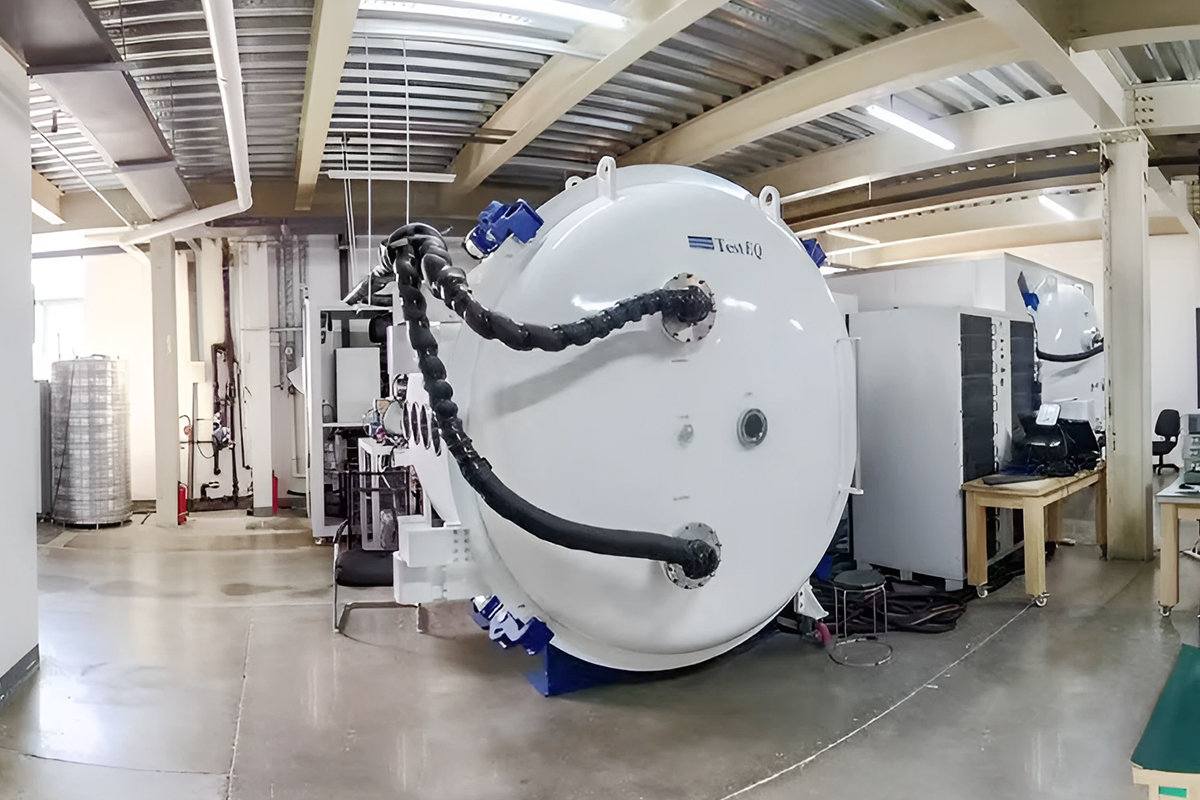
TestEQ provides configurable Thermal Vacuum Test Chambers for aerospace, spacecraft, satellite, optical, electronics, semiconductor, defense, and research applications.
A TVAC system can be engineered around the applicable project requirements, including:
• High-vacuum pumping systems
• Thermal shrouds
• Heating and cooling systems
• Cold plates
• Custom payload fixtures
• Electrical feedthroughs
• Signal feedthroughs
• Temperature sensors
• Pressure monitoring
• Data acquisition
• Functional test interfaces
• Thermal balance configurations
• Optional residual gas analysis
• Custom chamber dimensions
For NASA GEVS-oriented projects, TestEQ can develop the chamber configuration from the customer's applicable verification specification, payload characteristics, thermal profile, vacuum requirement, and functional testing requirements.
Why Choose TestEQ for NASA GEVS-Oriented TVAC Testing?
Requirement-Based Engineering
TVAC systems are configured around the actual test article and verification objectives rather than a generic chamber model.
Integrated Vacuum and Thermal Control
Vacuum pumping, thermal control, temperature monitoring and pressure measurement are integrated into one test platform.
Custom Payload Configuration
Chamber dimensions, fixtures, feedthroughs and instrumentation can be adapted to spacecraft components, payloads and subsystem testing.
Thermal Vacuum and Thermal Balance Capability
The system can be configured for thermal vacuum testing and applicable thermal balance programmes.
Functional Testing Under Vacuum
Electrical and signal interfaces can be integrated for monitoring and functional verification during thermal exposure.
Aerospace Engineering Support
TestEQ supports the conversion of project-level TVAC requirements into practical chamber architecture and test-system specifications.
NASA GEVS Thermal Vacuum Testing FAQ
1. What is NASA GEVS?
NASA GEVS is the General Environmental Verification Standard for GSFC Flight Programs and Projects. GSFC-STD-7000B provides guidance and verification methods for payloads, subsystems and components exposed to applicable mission environments.
2. What is GSFC-STD-7000B?
GSFC-STD-7000B is the Version B of the NASA Goddard Space Flight Center General Environmental Verification Standard. It was approved on April 28, 2021 and supersedes GSFC-STD-7000A.
3. Does GSFC-STD-7000B cover thermal vacuum testing?
Yes. Section 2.6.3 is dedicated to Thermal Vacuum Verification and includes requirements, test parameters, demonstration, special tests, environment simulation and acceptance requirements.
4. What vacuum level is required by NASA GEVS?
There is no single universal TVAC pressure that applies to every NASA GEVS project. The applicable vacuum condition depends on the mission, hardware, test objective and project-level verification requirements.
5. What temperature margin is used for NASA GEVS thermal vacuum testing?
For the applicable passive thermal-control verification framework, GSFC-STD-7000B distinguishes between qualification/protoflight and acceptance margins. A commonly referenced baseline is ±10°C for qualification/protoflight and ±5°C for acceptance, subject to the applicable hardware and project requirements.
6. How many thermal vacuum cycles are required?
The required number of cycles depends on the hardware level and applicable verification programme. GSFC-STD-7000B provides baseline parameters for unit, subsystem/instrument and system/payload testing rather than one universal cycle count.
7. Does NASA GEVS require functional testing during TVAC?
Functional and performance verification can be performed at defined thermal conditions as part of the environmental verification programme. The exact functional test sequence should be established by the applicable project test specification.
8. Is thermal balance the same as thermal vacuum testing?
No. Thermal balance testing is used to verify the thermal design and thermal-control system and to generate data for thermal model correlation. It can be performed as part of a thermal vacuum programme when required.
9. Is ASTM E595 the NASA TVAC standard?
No. ASTM E595 is an outgassing test method for evaluating material mass loss and condensable volatile material in a vacuum environment. It can be relevant to spacecraft material and contamination-control programmes but does not replace a complete thermal vacuum verification standard.
10. What should I specify when purchasing a NASA GEVS-oriented TVAC chamber?
Define the payload dimensions, mass, thermal load, hot and cold conditions, vacuum requirement, cycle profile, stabilization criteria, functional interfaces, thermal balance requirements, instrumentation, feedthroughs, data acquisition, safety requirements and applicable project verification documents before selecting the chamber.
Internal Linking Module
Recommended Equipment
Thermal vacuum test chambers simulate controlled temperature and vacuum environments for spacecraft, payload, aerospace and electronic hardware verification.
Explore configurable TVAC chamber systems for thermal vacuum testing, functional verification, thermal balance and aerospace environmental testing.
Designed for applications requiring controlled temperature and low-pressure or altitude simulation for aerospace and environmental verification.
Related Standards
Learn how the ECSS testing framework addresses environmental verification of spacecraft hardware, including thermal vacuum testing.
Explore major thermal vacuum testing standards and verification frameworks for aerospace, spacecraft and environmental testing applications.
Review temperature change testing principles and requirements relevant to thermal cycling and environmental qualification.
Engineering Resources
A practical engineering guide to NASA-oriented thermal vacuum testing, test objectives, environmental simulation and hardware verification.
Learn how to translate temperature, vacuum, thermal load, stabilization and functional requirements into a practical TVAC test specification.
A procurement-focused guide to selecting a TVAC chamber based on payload size, temperature range, vacuum performance and testing requirements.
CTA
Related Thermal Vacuum Standards and Resources
For a complete spacecraft thermal vacuum verification programme, engineers may need to evaluate NASA GEVS together with other applicable standards and project requirements.
Recommended technical resources include:
NASA Thermal Vacuum Testing Requirements
ECSS-E-ST-10-03C Rev.1 Testing Standard
Thermal Vacuum Test Requirements
Thermal Vacuum Test Chamber
ASTM E595 Outgassing Testing
Spacecraft Environmental Testing
Thermal Balance Testing
Request a Thermal Vacuum Chamber Configuration
If you are planning a NASA GEVS, spacecraft, satellite, payload or aerospace thermal vacuum test, provide the following information:
Payload size + payload mass + temperature range + vacuum requirement + thermal load + test cycles + functional interfaces + applicable standard
TestEQ can use these parameters to develop a preliminary TVAC chamber configuration and identify the required vacuum, thermal-control, instrumentation and fixture architecture.
"Contact TestEQ for a project-specific Thermal Vacuum Test Chamber solution."