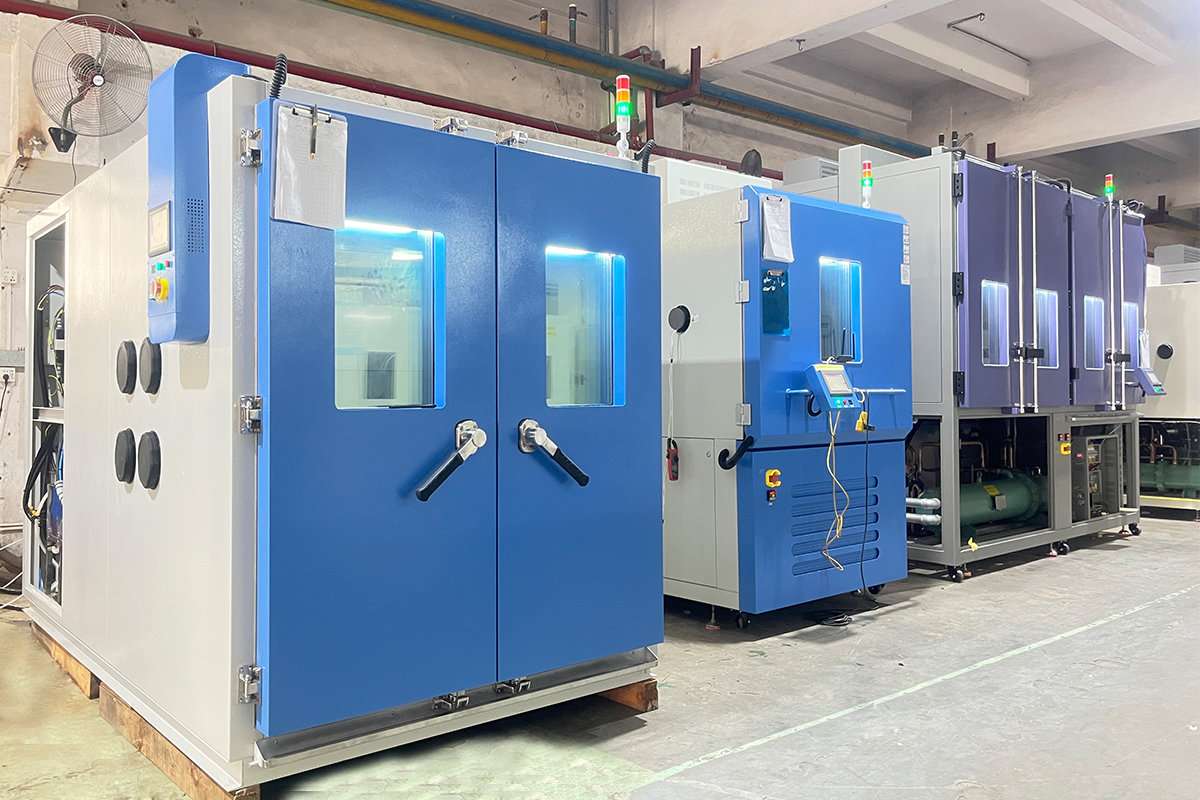
What Is JESD22-A101 THB Testing?
JESD22-A101 defines a steady-state temperature-humidity-bias life test for evaluating the reliability of non-hermetic packaged IC devices in humid environments.
The test accelerates moisture penetration through external protective materials or interfaces surrounding the device and combines this environmental stress with electrical bias.
The basic THB concept is:
Temperature + Humidity + Electrical Bias → Accelerated Moisture-Related Reliability Stress
The environmental chamber provides the controlled temperature and humidity environment, while the bias system applies the specified electrical stress to the DUT.
This distinction is important when specifying equipment.
A conventional temperature-humidity chamber may be capable of producing 85°C / 85%RH, but a production-ready JESD22-A101 THB test system must also accommodate DUT fixtures, electrical feedthroughs, bias connections, contamination control, long-duration operation, monitoring, and stable environmental conditions.
The JESD22-A101 method specifies that temperature, relative humidity, and duration are used together with an electrical bias configuration appropriate to the device.
JESD22-A101 THB Test Conditions
A commonly referenced JESD22-A101 condition is:
| Parameter | Typical JESD22-A101 Condition |
|---|---|
| Temperature | 85 ± 2°C |
| Relative Humidity | 85 ± 5%RH |
| Wet-Bulb Temperature | Approximately 81°C |
| Vapor Pressure | Approximately 49.1 kPa |
| Typical Duration | 1000 hours |
| Bias | Device-specific electrical bias |
| Test Type | Steady-state temperature-humidity-bias |
| DUT | Non-hermetic packaged IC / semiconductor devices |
The JESD22-A101D.01 material identifies 85 ±2°C and 85 ±5%RH as the specified temperature and humidity condition and gives a typical duration of 1000 +168/−24 hours.
The exact test plan should always be confirmed against the applicable revision, qualification specification, customer requirement, and device-specific electrical conditions.
Important engineering point
85°C / 85%RH alone does not define a complete THB test.
THB also requires an appropriate bias configuration and controlled test procedure.
Therefore, when purchasing a THB system, engineers should evaluate both:
Environmental control capability
Electrical bias capability
rather than selecting a chamber based only on temperature and humidity range.
How Does the JESD22-A101 THB Test Work?
The THB test places devices under controlled high-temperature and high-humidity conditions while applying electrical bias.
The environmental stress promotes moisture penetration into the package and toward sensitive internal structures.
The electrical bias then creates electrical potential differences across device structures.
Depending on the device design and bias configuration, this combination can accelerate mechanisms including:
Corrosion
Electrochemical migration
Insulation degradation
Increased leakage current
Electrical instability
Metallization degradation
Moisture-related package failure
Dielectric degradation
The purpose is not simply to expose the DUT to a humid environment.
The objective is to create a controlled accelerated reliability stress that can reveal failure mechanisms that may otherwise require much longer field exposure.
JESD22-A101 Bias Requirements
Electrical bias is one of the most important differences between THB and conventional damp-heat testing.
JESD22-A101 provides biasing guidelines intended to make the stress relevant to the device under evaluation.
The bias configuration should consider:
Minimizing unnecessary power dissipation
Alternating pin bias where appropriate
Distributing potential differences across chip metallization
Maximizing voltage within the applicable operating range
Device-specific failure mechanisms
Continuous versus cycled bias
The standard allows either continuous or cycled bias depending on the device and stress mechanism.
Continuous Bias
With continuous bias, DC electrical stress is applied continuously during the test.
This configuration can be appropriate when continuous electrical stress produces the intended reliability mechanism without excessive self-heating.
Cycled Bias
With cycled bias, the electrical stress is periodically interrupted.
This can be useful when device self-heating during powered operation would reduce moisture-related stress.
For some devices, cycling allows moisture to accumulate during the unpowered period and can create a more severe moisture-related stress condition.
Therefore, bias strategy should be determined from the DUT characteristics rather than simply selecting the most convenient configuration.
Why Die Temperature Matters in THB Testing
One frequently overlooked engineering consideration is the temperature of the DUT itself.
Electrical power dissipation can increase the die temperature above the chamber ambient temperature.
This can affect the actual stress experienced by the semiconductor.
For example:
Chamber temperature ≠ necessarily DUT die temperature
If the device dissipates significant power, the resulting temperature rise may influence moisture-related acceleration mechanisms.
JESD22-A101 therefore includes guidance concerning die temperature and recommends reporting the temperature difference when the die temperature exceeds the chamber ambient by the specified amount.
For high-power devices, engineers should therefore consider:
DUT power dissipation
Fixture thermal characteristics
Airflow around the DUT
Bias duty cycle
Actual DUT temperature
Chamber temperature uniformity
This is particularly important when THB is used for automotive electronics, power semiconductor devices, and other devices with meaningful self-heating.
THB Chamber Requirements for JESD22-A101
A THB chamber should not be evaluated only by its nominal temperature and humidity range.
For long-duration semiconductor reliability testing, the equipment should provide stable and repeatable environmental conditions throughout the entire test area.
Important engineering requirements include:
1. Stable 85°C / 85%RH Operation
The chamber must maintain the specified temperature and relative humidity over long test durations.
2. Temperature Uniformity
The usable test area should maintain controlled temperature distribution so that DUTs experience comparable environmental stress.
3. Humidity Uniformity
Humidity distribution is equally important because local humidity differences can alter moisture stress.
4. Condensation Prevention
Condensation on electrically biased DUTs, sockets, boards, or fixtures can create test artifacts and potentially compromise the test.
JESD22-A101 specifically addresses avoiding condensation during environmental transitions.
5. Electrical Feedthroughs
The chamber should accommodate the required bias wiring and electrical connections without compromising environmental control.
6. Fixture Compatibility
The DUT fixture, socket, PCB, wiring and supporting materials should be compatible with long-duration high-temperature/high-humidity exposure.
7. Contamination Control
Ionic contamination can introduce artificial failure mechanisms.
The JESD22-A101 method specifically emphasizes controlling contamination from boards, sockets, wiring, fixtures and related test hardware.
8. Long-Duration Reliability
THB qualification can require approximately 1000 hours of continuous environmental exposure.
The chamber therefore needs to be designed for stable long-term operation rather than short laboratory demonstrations.
What Is the Difference Between THB and HAST?
THB and HAST are both used for accelerated moisture reliability testing, but they use different environmental stress levels and test strategies.
| Factor | THB | HAST |
|---|---|---|
| Standard | JESD22-A101 | JESD22-A110 |
| Temperature | Typically 85°C | Higher temperature |
| Humidity | Typically 85%RH | Typically high RH |
| Pressure | Atmospheric | Elevated pressure |
| Bias | Device-specific | Device-specific depending on method |
| Typical duration | Around 1000 h | Much shorter |
| Main purpose | Long-duration moisture-bias reliability | Highly accelerated moisture stress |
| Equipment | Temperature-humidity chamber + bias | Pressure vessel/HAST chamber + electrical system |
HAST is designed to accelerate moisture-related stress more aggressively through elevated temperature and pressure. TestEQ's JESD22-A110 page covers HAST as a separate high-pressure accelerated stress method.
THB is therefore not simply “slow HAST.”
The two methods should be selected according to the qualification program, device technology, failure mechanism, and applicable customer or industry requirement.
THB vs Temperature Humidity Testing
A standard temperature-humidity test exposes a product to controlled temperature and humidity.
THB adds an electrical bias condition.
This difference is critical for semiconductor reliability.
Temperature-Humidity Test
Temperature + Humidity
Typical objective:
Moisture resistance
Material aging
Environmental durability
Corrosion evaluation
THB
Temperature + Humidity + Electrical Bias
Typical objective:
Semiconductor package reliability
Moisture-induced electrical degradation
Corrosion under electrical potential
Leakage and insulation degradation
Electrochemical migration-related mechanisms
For semiconductor qualification, simply purchasing a general climatic chamber may not be sufficient if the test requires integrated electrical biasing and long-duration semiconductor reliability testing.
JESD22-A101 THB Test Procedure
A typical THB workflow includes the following stages.
1. DUT Preparation
Prepare the semiconductor devices, boards, sockets, fixtures and electrical connections according to the applicable qualification plan.
2. Chamber Preparation
Verify chamber cleanliness, environmental control, water quality, electrical connections and fixture configuration.
JESD22-A101 specifies the use of deionized water with a minimum resistivity requirement in the test apparatus.
3. DUT Installation
Install the devices so that they are exposed to the specified temperature and humidity conditions and connected to the required electrical bias.
DUT placement should minimize temperature gradients.
4. Environmental Stabilization
Ramp the chamber to the specified temperature and humidity while avoiding condensation.
5. Bias Verification
Verify that the intended electrical bias is correctly applied before the formal test period begins.
6. THB Exposure
Maintain the specified environmental conditions and bias configuration for the required duration.
7. Monitoring
Record relevant environmental and electrical information throughout the test.
Depending on the qualification system, monitoring may include:
Temperature
Relative humidity
Bias voltage
Current
Alarm status
Test time
DUT electrical parameters
8. Test Completion
Verify the bias condition and environmental state before removing the DUT.
9. Electrical Readout
Perform the required electrical measurements within the applicable test window.
The JESD22-A101 procedure includes specific requirements concerning post-test electrical readout timing.
10. Failure Analysis
Devices exceeding specified parametric limits or failing to demonstrate required functionality may be classified as failures according to the applicable procurement document or device specification.
Common Failure Mechanisms Evaluated by THB
JESD22-A101 THB can help expose moisture-related reliability weaknesses such as:
Corrosion
Moisture combined with electrical potential can accelerate corrosion of metallic structures.
Electrochemical Migration
Electrical potential in the presence of moisture can contribute to migration-related failure mechanisms.
Insulation Degradation
Moisture can reduce insulation resistance and contribute to electrical leakage.
Leakage Current Increase
Electrical parameters may shift as moisture interacts with sensitive device structures.
Package Moisture Penetration
The test evaluates the ability of non-hermetic packages and protective structures to withstand humid environments.
Metallization Degradation
Moisture and electrical stress can accelerate degradation of conductive structures.
These failure mechanisms make THB particularly relevant to semiconductor qualification and long-term reliability engineering.
Applications of JESD22-A101 THB Testing
THB testing is particularly relevant to:
Semiconductor devices
IC packages
Automotive electronics
Power electronics
Sensors
Microcontrollers
Analog ICs
Logic devices
Communication devices
Industrial electronics
High-reliability electronic components
For automotive and semiconductor manufacturers, THB can be integrated into broader reliability qualification programs together with temperature cycling, HAST, HTOL, ESD and other device-level tests.
How to Select a JESD22-A101 THB Test Chamber
For engineers and procurement teams, the following checklist can be used when evaluating suppliers.
Environmental Capability
Confirm:
85°C / 85%RH operating capability
Temperature stability
Humidity stability
Temperature uniformity
Humidity uniformity
Condensation control
Long-duration operation
DUT Capacity
Consider:
Number of DUTs
Fixture dimensions
PCB size
Socket arrangement
Required test volume
Airflow around samples
Electrical Integration
Confirm:
Number of bias channels
Voltage range
Current requirements
Feedthrough configuration
Continuous/cycled bias capability
Electrical monitoring
Data logging
Reliability and Maintenance
Evaluate:
Water management
Humidification system
Dehumidification capability
Corrosion-resistant chamber construction
Controller reliability
Alarm system
Remote monitoring
Long-duration data recording
Compliance Documentation
Ask the supplier for:
Temperature mapping
Humidity mapping
Calibration records
Uniformity data
Test reports
Equipment specifications
Applicable standard references
A technically suitable THB chamber should be selected based on the complete reliability test system, not simply the chamber's maximum temperature and humidity specifications.
TestEQ JESD22-A101 THB Testing Solutions
TestEQ provides temperature-humidity environmental test systems designed for semiconductor, electronics, automotive and laboratory reliability applications.
TestEQ's temperature-humidity chamber portfolio includes standard laboratory chambers, benchtop systems and customized walk-in environmental chambers. The current product range supports high-humidity testing and long-duration environmental simulation, with configurable temperature, humidity, chamber volume, monitoring and fixture requirements.
For semiconductor THB applications, the chamber can be engineered around the actual test program, including:
85°C / 85%RH long-duration operation
DUT fixture requirements
Electrical access and feedthroughs
Bias-system integration
Temperature and humidity monitoring
Data logging
Alarm and protection systems
Custom chamber dimensions
Semiconductor reliability laboratory workflows
TestEQ also provides HAST equipment for accelerated moisture reliability testing based on JESD22-A110, allowing laboratories to configure different moisture-stress methods according to their qualification requirements.
Important: Equipment compliance should be evaluated against the actual test specification and qualification plan. A chamber being capable of reaching 85°C / 85%RH does not by itself establish complete JESD22-A101 compliance.
THB Chamber Selection Checklist for Procurement
Before issuing an RFQ, procurement teams should provide the supplier with the following information:
| Requirement | Information to Specify |
|---|---|
| Standard | JESD22-A101 |
| Test Type | THB / Temperature-Humidity-Bias |
| Temperature | 85°C typical |
| Relative Humidity | 85%RH typical |
| Duration | Approximately 1000 h or project-specific |
| DUT Type | IC / semiconductor / package |
| DUT Quantity | Number of samples |
| Fixture | PCB / socket / custom fixture |
| Bias | Continuous or cycled |
| Voltage | Device-specific |
| Current | Device-specific |
| Monitoring | Temperature / RH / electrical |
| Data Logging | Required / optional |
| Chamber Volume | Based on fixture and DUT quantity |
| Electrical Feedthrough | Number and type |
| Condensation Control | Required |
| Calibration | Required |
| Qualification | Customer / internal / industry specification |
This information allows the supplier to configure the chamber around the actual reliability test instead of providing a generic temperature-humidity chamber quotation.
Why Choose TestEQ for JESD22-A101 THB Testing?
1. Stable 85°C / 85%RH Operation
TestEQ THB systems are engineered for stable temperature and humidity control during long-duration JESD22-A101 testing.
2. Integrated Bias System
Configure electrical feedthroughs, DUT fixtures and bias-system integration according to the required THB test setup.
3. Semiconductor Reliability Focus
TestEQ designs environmental test systems for semiconductor, IC package and electronics reliability applications.
4. Long-Duration Test Capability
Designed for extended reliability testing, including typical JESD22-A101 THB qualification periods of around 1000 hours.
5. Precise Environmental Control
Temperature, humidity, uniformity and environmental stability are considered as part of the complete THB system configuration.
6. DUT & Fixture Customization
Chamber capacity, PCB fixtures, sockets and sample quantity can be configured around the actual DUT requirements.
7. Monitoring & Data Logging
Test systems can include temperature, humidity, alarm status and test-condition monitoring for long-duration qualification.
8. Condensation & Contamination Considerations
TestEQ considers airflow, humidity control, fixture arrangement and chamber materials to support reliable THB testing.
9. Engineered-to-Order Solutions
Custom chamber dimensions, electrical interfaces and laboratory integration are available for application-specific requirements.
10. One Partner for Reliability Testing
TestEQ provides related environmental reliability solutions including THB, HAST, uHAST, temperature cycling and thermal shock testing.
JESD22-A101 THB FAQ
1.What is JESD22-A101?
JESD22-A101 is a JEDEC test method for Steady-State Temperature-Humidity Bias Life Testing of non-hermetic packaged semiconductor devices.
2.What does THB stand for?
THB stands for Temperature-Humidity-Bias.
It combines elevated temperature, high relative humidity and electrical bias to accelerate moisture-related reliability degradation.
3.What is the typical THB condition?
A commonly specified condition is 85 ±2°C and 85 ±5%RH. The typical duration in JESD22-A101D.01 is approximately 1000 hours, with the documented tolerance of +168/−24 hours.
4.Does THB require electrical bias?
Yes. Electrical bias is an integral part of the THB method. The specific bias configuration depends on the DUT and intended failure mechanism.
5.Is 85/85 testing the same as THB?
No.
85°C / 85%RH describes an environmental condition. THB additionally applies an electrical bias to the DUT.
6.What is the difference between THB and HAST?
THB normally uses steady-state temperature and humidity at atmospheric pressure, while HAST uses elevated pressure and more aggressive accelerated stress conditions.
7.How long does a THB test take?
The JESD22-A101D.01 method identifies approximately 1000 hours as a typical duration, although the applicable qualification plan may specify a different duration.
8.What products are tested with THB?
Typical applications include ICs, semiconductor packages, automotive electronics, sensors, power electronics and other non-hermetic electronic devices where moisture-related reliability is important.
9.Can a normal temperature-humidity chamber perform THB?
A chamber may provide the required temperature and humidity, but a complete THB setup also needs appropriate DUT fixtures, electrical feedthroughs, bias equipment, contamination control, monitoring and long-duration reliability capability.
10.What should I ask a THB chamber manufacturer?
Ask for temperature/humidity uniformity data, long-duration stability, DUT capacity, electrical feedthrough configuration, bias integration options, condensation control, data logging, calibration documentation and project-specific compliance information.
Recommend related products
Recommended Equipment
Designed for controlled temperature and humidity testing, including 85°C/85%RH applications, semiconductor reliability testing, and long-duration environmental exposure.
Explore HAST equipment for accelerated temperature-humidity stress testing under elevated pressure, suitable for semiconductor and electronic component reliability qualification.
Designed for repeated temperature transitions to evaluate thermal fatigue, CTE mismatch, solder reliability, and other temperature-cycling failure mechanisms.
Related Standards
Learn how JESD22-A110 uses highly accelerated temperature and humidity stress to evaluate moisture-related reliability in semiconductor devices.
Explore the JEDEC uHAST method for accelerated temperature-humidity stress testing under elevated pressure for semiconductor package reliability.
Explore related JEDEC reliability test methods and understand how THB, HAST, temperature cycling, and other qualification tests fit into semiconductor reliability programs.
Recommended Resources
Learn how temperature-humidity chambers control temperature, relative humidity, stability, uniformity, and long-duration environmental test conditions.
Compare THB and HAST in terms of temperature, humidity, pressure, electrical bias, acceleration level, test duration, and typical semiconductor applications.
A practical guide for engineers and procurement teams covering chamber capacity, temperature range, humidity control, uniformity, monitoring, and application requirements.
THB Testing: Engineering Takeaway
A reliable THB qualification system must control the complete stress environment:
Temperature + Humidity + Electrical Bias + DUT Fixture + Contamination Control + Monitoring + Long-Duration Stability
For semiconductor reliability engineers, the key consideration is not simply whether a chamber can reach the nominal 85°C/85%RH condition. The system must maintain a stable, repeatable, and well-controlled environment around the DUT throughout the complete qualification period.
For procurement teams, the correct approach is to evaluate the complete THB test system—including the environmental chamber, electrical feedthroughs, bias configuration, DUT fixtures, monitoring, data logging, and qualification documentation—before comparing suppliers.
For laboratories, TestEQ can engineer temperature-humidity testing systems for JESD22-A101 THB applications based on DUT type, sample quantity, fixture configuration, environmental conditions, electrical integration, and long-duration reliability requirements.
Need a JESD22-A101 THB Test Chamber?
Contact TestEQ for a project-specific THB testing solution.
When requesting a quotation, provide:
• DUT type and package
• Number of test samples
• Required temperature and humidity condition
• Bias voltage and current
• Continuous or cycled bias requirement
• DUT fixture dimensions
• Required chamber capacity
• Test duration
• Monitoring and data-logging requirements
"Request a JESD22-A101 THB Test Chamber Quote →" TestEQ can help configure the chamber and testing system around your semiconductor reliability qualification requirements.