What Is IEC 60749-25 Temperature Cycling?
IEC 60749-25 is an international test standard for semiconductor devices covering mechanical and climatic temperature cycling.
The standard provides a test procedure for determining whether semiconductor devices, components, board assemblies and solder interconnections can withstand mechanical stresses caused by repeated exposure to high and low temperature extremes. These temperature transitions can produce thermal expansion and contraction, potentially resulting in permanent electrical or physical changes.
IEC 60749-25 is particularly relevant to:
Semiconductor packages
Integrated circuits (ICs)
Electronic components
PCB assemblies
Solder interconnections
Automotive electronics
Consumer electronics
Aerospace and high-reliability electronics
The standard is generally aligned with IEC 60068-2-14, but introduces requirements specifically applicable to semiconductor devices and interconnections.
For laboratories and semiconductor manufacturers, the objective is not simply to expose a device to high and low temperatures. The test must provide controlled, repeatable and measurable thermal stress.
Why Is Temperature Cycling Important for Semiconductor Reliability?
Semiconductor packages and solder joints contain materials with different coefficients of thermal expansion (CTE).
During temperature cycling:
Heating → thermal expansion → mechanical stress
Cooling → thermal contraction → mechanical stress
Repeated cycling can gradually accumulate fatigue damage.
Typical failure mechanisms include:
Solder joint fatigue
Package cracking
Die attach degradation
Interfacial delamination
Electrical discontinuity
Metallization damage
Interconnection fatigue
Material deformation
Changes in electrical characteristics
For automotive and semiconductor applications, temperature cycling is therefore an important reliability qualification and design-validation method.
IEC 60749-25 Test Methods
IEC 60749-25 recognizes different temperature cycling configurations depending on the test system and application.
Single-Chamber Temperature Cycling
The test specimens remain inside a stationary chamber while hot, ambient or cold air is introduced to change the temperature.
This configuration provides a programmable temperature profile and is suitable for many semiconductor and component reliability applications.
Dual-Chamber Temperature Cycling
The specimens are transferred between two chambers maintained at different temperatures.
This approach can achieve rapid transitions between temperature extremes and is useful when the test objective requires faster thermal transitions.
Triple-Chamber Temperature Cycling
A three-chamber system uses separate hot, ambient and cold environments.
The DUT is transferred between chambers to create controlled temperature cycling conditions.
The IEC 60749-25 standard specifically covers single-, dual- and triple-chamber approaches.
IEC 60749-25 Temperature Cycling Test Procedure
A typical IEC 60749-25 test sequence includes several controlled stages.
1. Initial Measurements
Electrical and/or physical characteristics of the test specimens are measured before cycling.
These baseline measurements provide a reference for evaluating degradation after testing.
2. Conditioning
The samples are installed in the appropriate test configuration and conditioned according to the applicable test requirements.
3. Temperature Cycling
The DUT is repeatedly exposed to defined high- and low-temperature conditions.
Important parameters include:
Upper temperature
Lower temperature
Temperature ramp rate
Soak time
Cycle rate
Cycle duration
Load transfer time
Number of cycles
Test specimen configuration
The standard specifically addresses cycle rates, upper and lower soak temperatures, soak modes, cycle time, ramp rate and load transfer time.
4. Recovery
After completion of cycling, the specimens are allowed to recover under the specified conditions.
5. Final Measurements
Electrical and physical characteristics are measured again and compared with the initial results.
6. Failure Evaluation
The final results are evaluated against the applicable failure criteria.
This makes IEC 60749-25 more than a simple temperature exposure test—it is a repeatable reliability evaluation of semiconductor devices and interconnections.
What Parameters Should Engineers Consider?
When developing an IEC 60749-25 test specification, engineers should evaluate the complete thermal profile rather than focusing only on the chamber's maximum and minimum temperature.
Temperature Range
The required high and low temperatures should be selected according to the applicable qualification specification and DUT operating environment.
Ramp Rate
Ramp rate affects the thermal stress experienced by the DUT.
A faster ramp is not automatically better. The required rate should correspond to the applicable test specification, sample thermal mass and reliability objective.
Soak Time
The DUT must remain at the specified temperature long enough to achieve the intended thermal condition.
Cycle Rate
The number and frequency of cycles directly affect total test duration and accumulated thermal fatigue.
Load and Fixture
The thermal mass of the DUT, fixture and rack can significantly influence actual chamber performance.
For this reason, engineers should evaluate chamber performance under representative loading conditions, not only under empty-chamber specifications.
IEC 60749-25 vs IEC 60068-2-14
IEC 60749-25 and IEC 60068-2-14 are closely related but should not automatically be treated as interchangeable.
| Feature | IEC 60749-25 | IEC 60068-2-14 |
|---|---|---|
| Main application | Semiconductor devices | General environmental testing |
| Test focus | Semiconductor thermal/mechanical reliability | Temperature change |
| Components | ICs, packages, assemblies | Broad range of products |
| Solder interconnections | Specifically covered | General environmental application |
| Chamber configuration | Single, dual and triple chamber | Multiple test methods |
| Typical industries | Semiconductor, electronics, automotive | Electronics, automotive, aerospace, industrial |
IEC 60749-25 states that its method is generally in accordance with IEC 60068-2-14 while applying additional semiconductor-specific requirements.
For engineers: select the standard according to the actual qualification requirement rather than choosing a chamber based only on temperature range.
How to Select an IEC 60749-25 Temperature Cycling Chamber
For semiconductor reliability laboratories and procurement teams, the most important equipment specifications include:
1. Temperature Range
Choose a chamber capable of achieving the required upper and lower test temperatures with adequate margin.
2. Temperature Ramp Rate
The chamber should maintain the required temperature change rate under the actual DUT load.
TestEQ thermal cycling systems offer configurable rates from 5°C/min to 30°C/min, depending on chamber configuration.
3. Temperature Uniformity
Uniformity is critical when multiple semiconductor devices are tested simultaneously.
Poor uniformity can cause different samples to experience different thermal stresses.
4. Temperature Stability
Stable control helps ensure repeatable test conditions throughout long-duration cycling.
5. DUT Capacity
Chamber volume should be selected based on:
Number of samples
Fixture dimensions
Product size
Thermal mass
Required airflow
Future testing capacity
6. Data Logging and Monitoring
For reliability laboratories, test records should allow engineers to verify the actual temperature profile and identify abnormal events during long cycling sequences.
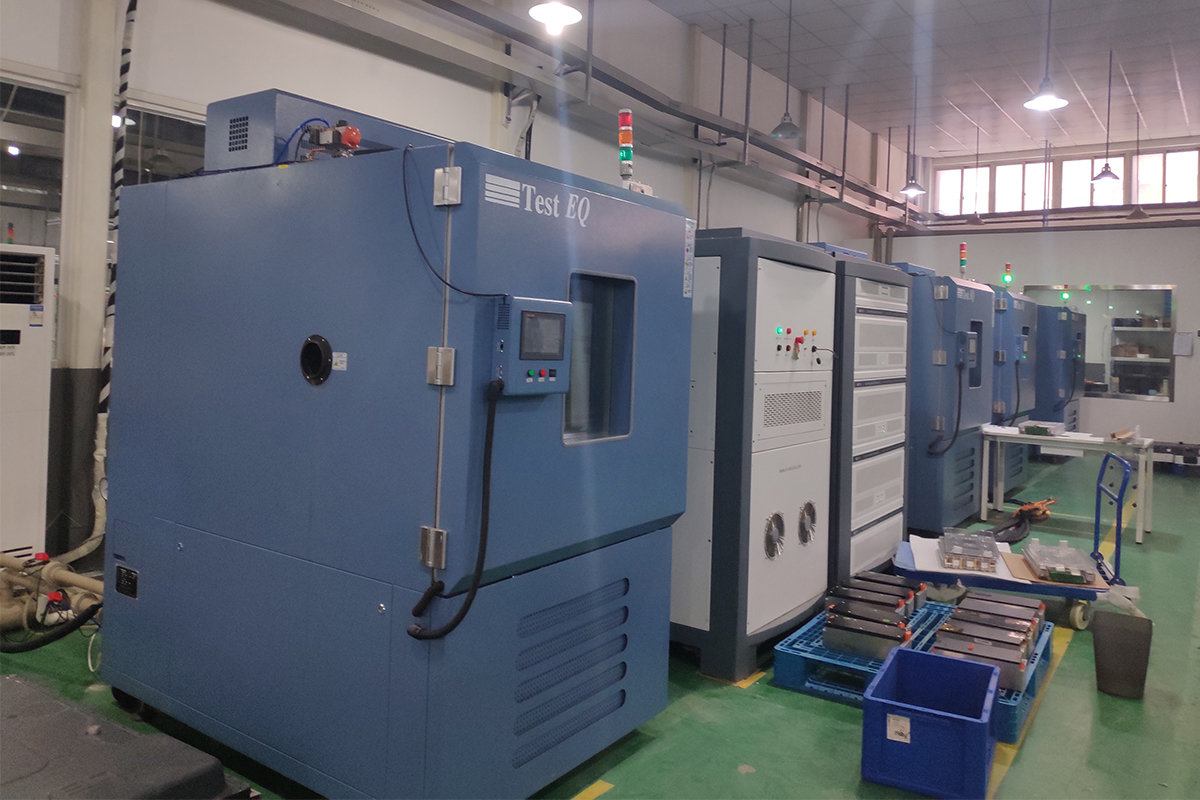
TestEQ Thermal Cycling Chamber for Semiconductor Reliability Testing
TestEQ provides thermal cycling and rapid temperature change chambers designed for electronics, semiconductor, automotive and reliability laboratory applications.
The current TestEQ thermal cycling chamber platform supports temperature ranges up to -70°C to +180°C, with optional configurations up to +200°C, and temperature change rates from 5°C/min to 30°C/min. The system is designed for continuous thermal cycling and can be customized according to chamber size, temperature range, ramp rate and test requirements.
Explore TestEQ Thermal Cycling Chamber
For semiconductor applications, engineers can specify the chamber according to:
IEC 60749-25 test requirements
IEC 60068-2-14 requirements
JEDEC reliability testing
Automotive semiconductor qualification
Solder interconnection testingCustom thermal cycling profiles
High-cycle reliability testing
IEC 60749-25 Applications
IEC 60749-25 temperature cycling is particularly relevant to:
Semiconductor Manufacturing
Evaluate package and interconnection reliability.
Automotive Electronics
Validate ICs, sensors, control modules and electronic components exposed to repeated thermal conditions.
PCB and Solder Reliability
Investigate solder fatigue and interconnection degradation.
Aerospace Electronics
Evaluate components requiring high reliability under environmental temperature variation.
R&D Laboratories
Support package development, failure analysis and accelerated reliability studies.
FAQ: IEC 60749-25 Temperature Cycling
1.What is IEC 60749-25?
IEC 60749-25 is a semiconductor mechanical and climatic test standard for evaluating the ability of semiconductor devices, components, board assemblies and solder interconnections to withstand alternating high and low temperature extremes.
2.What does IEC 60749-25 test?
It evaluates mechanical and physical/electrical reliability under repeated temperature cycling, including semiconductor packages and solder interconnections.
3.Is IEC 60749-25 the same as IEC 60068-2-14?
No. IEC 60749-25 is generally based on the principles of IEC 60068-2-14 but contains requirements specifically applicable to semiconductor devices.
4.What chamber is suitable for IEC 60749-25?
The appropriate chamber depends on the required temperature range, ramp rate, soak time, cycle rate, DUT thermal mass, sample quantity and test configuration. TestEQ can customize thermal cycling systems around these parameters.
5.Can TestEQ provide a customized IEC 60749-25 chamber?
Yes. TestEQ can configure chamber size, temperature range, ramp rate, airflow, fixtures, monitoring and control functions according to semiconductor and reliability laboratory requirements.
6.How should test samples be prepared for IEC 60749-25?
Test samples should be representative of the semiconductor device or assembly being qualified. Before temperature cycling, the samples should be properly identified, inspected and electrically characterized according to the applicable qualification plan. Test fixtures should also minimize unwanted mechanical constraints while maintaining reliable electrical connections and appropriate airflow around the DUT.
7.How is the number of temperature cycles determined?
The required number of temperature cycles is normally established by the applicable semiconductor qualification specification, customer requirement or product reliability plan. Engineers should consider the device type, application environment, acceleration objective and required reliability level when defining the cycle count. The chamber controller should support automatic cycle programming and continuous recording so the complete test history can be verified.
8.What should be checked after an IEC 60749-25 temperature cycling test?
After cycling, the samples should be visually inspected and electrically tested against the defined acceptance criteria. Depending on the device and qualification plan, additional analysis may include optical inspection, X-ray inspection, cross-section analysis or other failure-analysis techniques. Comparing pre-test and post-test measurements helps identify degradation such as solder fatigue, package damage, delamination or electrical discontinuity.
Related Test Standards and Resources
Recommended Products
Designed for repeated high- and low-temperature cycling of semiconductor devices, electronic components and assemblies, with configurable temperature ranges and ramp rates for reliability testing.
A solution for laboratories and manufacturers requiring controlled thermal cycling, high cycle counts and repeatable temperature profiles for reliability qualification.
Suitable for applications requiring rapid transitions between extreme hot and cold conditions to evaluate thermal shock resistance and potential package or material failures.
Recommended Standards
Explains temperature-change testing methods used across electronics, automotive, aerospace and industrial applications, providing useful background for engineers comparing IEC 60749-25 and general environmental testing requirements.
considerations for automotive integrated circuits and semiconductor qualification, making it particularly relevant to automotive electronics engineers and reliability laboratories.
Provides a semiconductor-focused reference for temperature cycling qualification and helps engineers compare JEDEC reliability requirements with IEC 60749-25 testing approaches.
Recommended Resources
A practical guide covering thermal cycling principles, test procedures, failure mechanisms and chamber selection for engineers planning reliability testing.
Helps engineers and laboratory teams understand how to define temperature profiles, ramp rates, dwell times, cycle counts and chamber requirements before starting a thermal cycling program.
Focuses on rapid temperature-change applications, chamber performance factors and system selection for semiconductor, automotive electronics and other high-reliability testing environments.
CTA
Need an IEC 60749-25 Temperature Cycling Test Solution?
Whether you are qualifying semiconductor packages, ICs, solder interconnections, PCB assemblies or automotive electronic components, the test chamber should be selected according to the complete thermal profile—not simply the advertised temperature range.
TestEQ provides thermal cycling chambers and customized environmental reliability testing systems for semiconductor manufacturers, automotive suppliers, R&D laboratories and global testing organizations.
Contact TestEQ to discuss your IEC 60749-25 temperature cycling requirements, including temperature range, ramp rate, cycle count, DUT size and chamber capacity.
"Request a Custom Thermal Cycling Chamber Solution from TestEQ"